
Window tinting
Tinting film is a thin sheet stuck to the inside face of the glass, and in a Sharjah summer it is doing real work: it cuts the sun coming through the side and rear windows, keeps some of the heat out of a car that has been standing in a car park at 45 degrees, and slows the fading that turns a dashboard top grey and a rear parcel shelf pale. The part most workshops leave out is that tint here is regulated. Since a 2017 ministerial resolution the widely reported limit for a privately owned car has been 50 per cent on the side and rear glass — half the light still has to come through — with the front windscreen outside the allowance altogether. Limits move, and they differ by vehicle class, so we confirm the rule that applies to your car before any film is cut rather than asking you to take a number off a web page. We fit inside it, and we will not go darker for anybody.
Start here
- 1Describe what the car is doing, in your words
- 2We investigate it and send you the findings and the price
- 3You approve each line before anything is done
1
Sounds like your car?
Find the line closest to what your car is doing. You do not need the name of the job — the symptom is carried into the booking form with it, and every line below starts at the same place: what we check, and how the work is done.
- 1 The tint is full of bubbles
- 2 The old tint has gone purple
- 3 The film is peeling away at the edge of the glass
- 4 The car is unbearable inside after it has been parked in the sun
- 5 The sun comes straight in on the child seat in the back
- 6 I get glare in my eyes driving in the afternoon
- 7 People can see straight into the car at the traffic lights
- 8 I was told the tint on my car is darker than the limit
- 9 The film is scratched where the window winds up and down
- 10 The car was imported with tint already on it and I do not know if it is within the limit
2
What is included
- 2.1The limit that applies to your vehicle class confirmed with you before any film is cut, and the film fitted inside it
- 2.2The front windscreen left clear — we do not film a windscreen, whatever the car came from the factory or from another country with
- 2.3Old film stripped off where there is any, and the adhesive underneath taken off the glass as well, because new film laid over old glue lifts
- 2.4The inside face of the glass washed and scraped clean, since anything left under the film shows as a speck for as long as the film is on
- 2.5Film cut to the vehicle pattern where a pattern exists for it, or cut by hand and trimmed on the glass where it does not
- 2.6The rear screen heat-shrunk to the curve of the glass before it goes on, which is what stops the fingers of creases you see in a bad job
- 2.7Film floated on wet, worked out with a squeegee, and the edges set against the seal rather than short of it or over it
- 2.8Defroster lines and the rear screen aerial worked around rather than scraped through
- 2.9The categories of film that exist explained plainly — dyed, metallised, carbon and ceramic are different things and one of them can interfere with signal
- 2.10Cure time explained before you leave: haze and small water pockets are normal for the first days, and the windows stay up until they clear
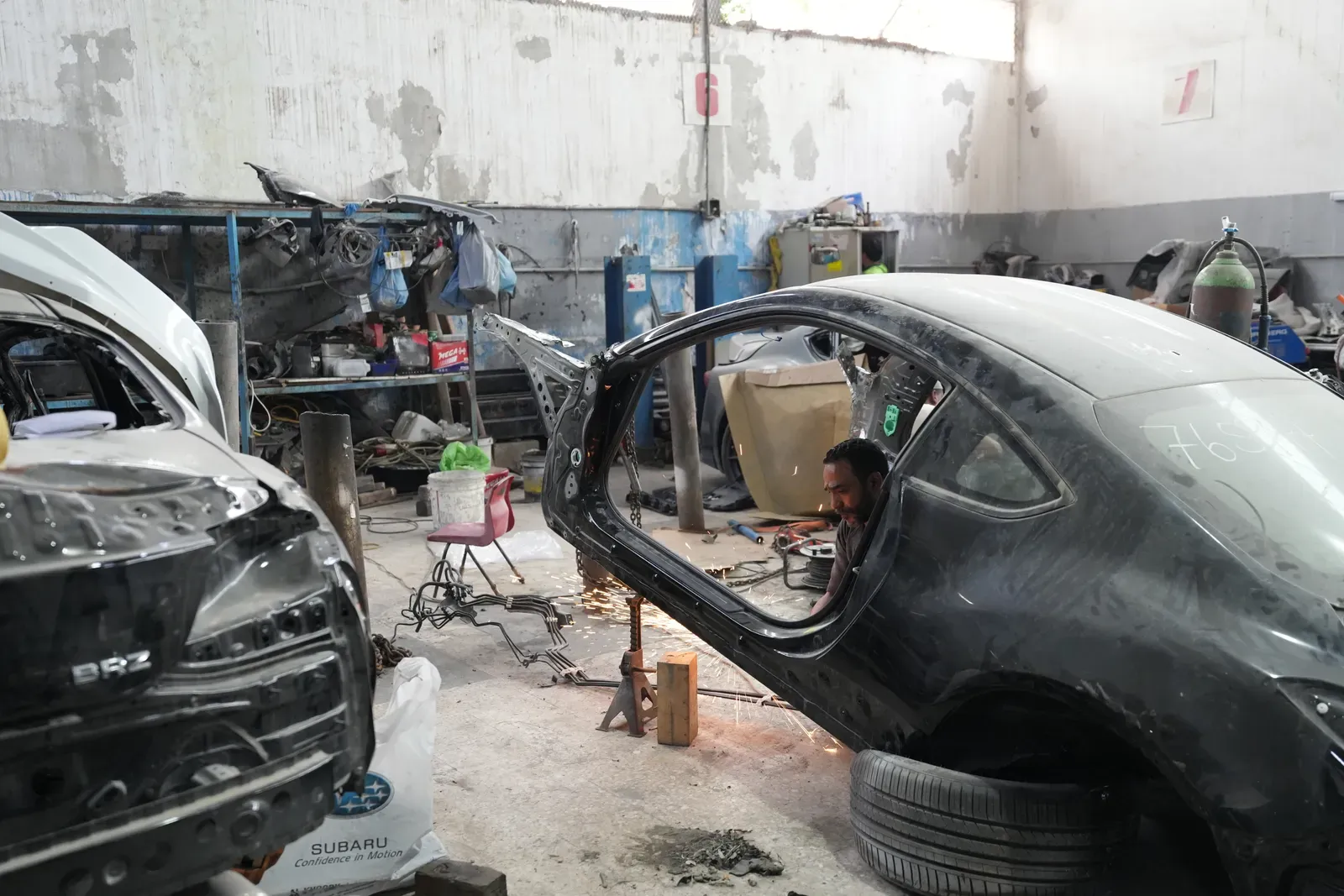
This work is done in this workshop, and nothing on your car is touched until you know what we found and what it costs.
3
What happens
-
3.1
The limit is agreed before anything is cut
The first conversation is about what the law allows, not about how dark you want it. The limit for a private car is federal, so it is the same in Sharjah as anywhere else in the country, and the front windscreen is outside the allowance altogether. We tell you exactly what we are going to fit and on which pieces of glass before a roll is opened. If you have been quoted something darker somewhere else, that is the difference between the two quotes.
-
3.2
Old film and its glue come off first
Film that has bubbled, gone purple or started lifting at a corner has to be removed completely, and the harder half of that job is the adhesive left behind on the glass after the sheet peels away. Film laid over old glue will lift in the same places for the same reason, so the glass goes back to bare before anything new touches it. On a rear screen this is slow work, because the defroster lines are printed onto the glass and a scraper taken across them breaks them.
-
3.3
The glass is cleaned, the film is cut to it
The inside face of the glass is washed, scraped and wiped down until nothing is left on it, because a hair or a grain of sand under the film is permanent and visible from the seat behind it. Where a cut pattern exists for the vehicle the film is plotter-cut to it; where it does not, it is cut oversize and trimmed on the glass itself. Both are normal. What is not normal is trimming with a blade against glass that is still in the door.
-
3.4
The rear screen is shrunk before it is fitted
A rear screen curves in two directions and a flat sheet of film will not lie on it, so the film is laid on the outside of the glass first and heat-shrunk until it takes the shape, then moved inside and fitted. Skipping that step is what produces the fingers of creases along the bottom of a badly tinted rear window. The film is floated on wet so it can be positioned, the fluid is worked out with a squeegee, and the edges are set against the seal.
-
3.5
Cure time, and what is normal while it settles
For the first days the film looks slightly hazy and may show small water pockets. That is fluid still leaving from underneath and it clears on its own, faster in this climate than in a cool one. The windows stay up until it does, because winding a door glass down while the film is still green drags the edge off. We tell you how long to leave them and what to come back for if something has not gone by then.
4
Common questions
How dark am I allowed to go?
For a privately owned car the figure reported consistently since a 2017 ministerial resolution is 50 per cent on the side and rear glass — put the other way round, at least half the light has to keep coming through. It was 30 per cent before that, which is why you will still find older advice quoting the lower number. Two cautions worth more than the number itself: the allowance is not the same for every vehicle class, and traffic law here is revised from time to time. So we confirm what currently applies to your car and tell you before we start, rather than having you act on a figure from a website. If you want it darker than the limit, the answer is no.
Can you tint the front windscreen?
No. The allowance covers the side and rear glass; the front windscreen is not part of it, and we do not put film on one. A narrow strip along the very top edge of the windscreen is a separate matter with its own size rule, and rather than quote you a figure we are not certain of, we will check the current rule with you before anything goes anywhere near that glass. If a car reaches us from abroad with a filmed windscreen, we will tell you it has to come off rather than work around it.
Will tint be a problem when I renew the registration?
Not from film we fitted, because we fit inside the limit and there is nothing on the car to argue about. The cars that have trouble are the ones carrying film darker than the allowance — a fine at the roadside is the visible risk, and a car over the limit can be impounded as well, but the quieter problem is that you are eventually left stripping it off. If tint already on your car worries you, bring it in and we will tell you what we think it is before you spend anything.
My car is leased or on a company registration. Can it be tinted?
The legal limit is one question and permission is another. Taxis and trucks are outside the tinting allowance entirely. For a leased or company-registered car the limit itself is not the obstacle so much as the fact that the car is not yours to change: the registered owner or the leasing company decides, and film is a change to the vehicle they get back. Get that permission in writing before you book, because removing film later to satisfy a return inspection is a job somebody has to pay for.
Is there an exemption that lets me go darker?
Permission to exceed the limit is something only the traffic authority can give, and it has to be obtained before the film is fitted, not explained afterwards at the roadside. Some emirates have also asked for prior approval to tint at all, so where your car is registered matters. A workshop cannot grant any of this and we will not fit above the limit on the strength of a verbal claim. If you hold an approval, bring it, and we will fit to exactly what it says on it.
Dyed, carbon, ceramic — does the type of film matter?
It matters, and it is a separate question from how dark the film is, which is the part people confuse. Two films at the same permitted darkness can behave very differently in the sun, because what keeps heat out is not the same as what blocks light. Dyed film is the basic category and the one that fades toward purple. Metallised film rejects heat well but can interfere with signal. Carbon and ceramic films are the categories sold on heat rejection without that interference. We will talk through which category suits the car and tell you plainly what is in front of us rather than reciting a brochure figure.
Can you take off old tint that has bubbled or gone purple?
Yes, and it is worth understanding that removal is its own job rather than something included in the minute before a new film goes on. The sheet itself comes away in pieces; the adhesive under it is the slow part, and on a rear screen it has to be softened and lifted without taking the printed defroster lines with it. We would rather quote removal and fitting as two things you can see separately than bury one inside the other. If you only want the old film gone and nothing put back, that is a job on its own too.
Related services
Work that is often quoted alongside this, each with its own page.
- Paint protection film (PPF) A clear film stuck onto the panels — real thickness, so a stone hits the film and not your paint.
- Ceramic coating A hard chemical layer on top of the paint — easier washing, not armour against stones.
- Car detailing Deep cleaning inside and out — it removes what is on the car, not what is in the paint.
- Car AC repair Leak testing, regas, compressor and evaporator work.