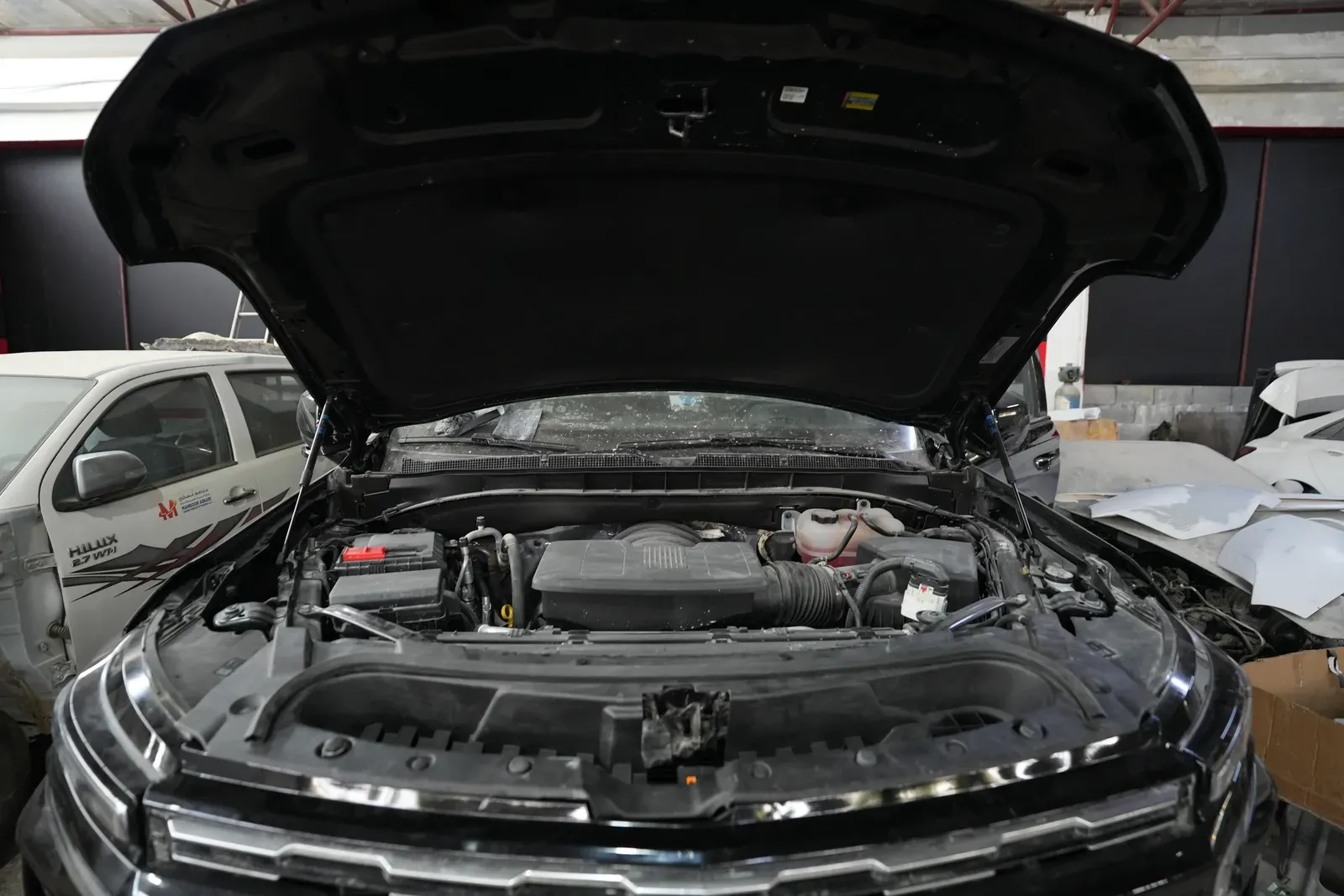
An engine bay open on the workshop floor, photographed close.

Lamborghini repair in Sharjah

Three unrelated cars wear this badge and the gearbox tells them apart faster than the body does. A Gallardo has e-gear, a single clutch worked by hydraulics. A Huracán has a seven-speed dual clutch. An Aventador has ISR, a single-clutch box with independently actuated shifting rods that nobody else builds, and it is abrupt at walking pace by design rather than by fault. The Urus is a different animal again. Which of the four is on the ramp decides almost everything that follows.

Why we see these

The thing that wears these cars out in the northern Emirates is not the highway. It is the last two hundred metres of every journey. Ramps into building basements, the lip at a mall entrance, kerbs at a villa gate and the tall speed bumps on residential streets all sit at exactly the height that a front splitter and an undertray do not clear, so the hydraulic front lift is not a novelty on a car kept here — it is used several times a day, every day, and it is asked to hold the nose up while the car crawls over a bump in traffic. A system cycled that often shows its leaks early. The same traffic does a second thing: a single-clutch gearbox held against the brakes at a junction in forty-five degree heat is working hard while the car is standing still, which is why the Gallardo and the Aventador wear their clutches on a schedule set by the commute rather than by the kilometre. Meanwhile the Urus in the same household is doing the school run, and its needs have almost nothing in common with the V10 sitting next to it.

What this make asks of a workshop

  • The gearbox identified by name before a clutch is discussed. e-gear, the Huracán dual clutch and Aventador ISR are three unrelated mechanisms with three different wear patterns and three different reasons for the same complaint, and treating them as one family is how an owner ends up paying for the wrong half of the car.
  • A lift approach that does not touch the front of the car. These arrive with a splitter and an undertray inches off the ground and they are driven on with the nose raised, on ramps laid to suit them — a car dragged onto a two-post lift leaves with damage that costs more than the job it came for.
  • Brake identification before a brake price. A carbon-ceramic disc does not wear by losing thickness the way an iron one does; its life is judged by how much mass the disc has lost, against a minimum figure etched into the bell by the manufacturer. That is a different check and a very different conversation about cost, and an owner deserves to know which one applies before anything is ordered.
  • The front axle lift treated as a hydraulic circuit with a pump, a valve block, lines and position sensing, not as a switch that has stopped working. On a car that lives with Sharjah ramps this is a service item in practice, and it is the system most likely to be the real reason a car has scraped.
  • Honesty about where the work stops. We do not take on structural repair of a carbon-fibre monocoque — the Aventador is built around one — and we do not do anything that needs a manufacturer security release, such as key and immobiliser coding or pairing a replacement control unit. Those go to the franchise, and we say so before you book. We make no claim to own or licence any manufacturer’s dealer diagnostic software.
  • A Urus assessed as what it is. It sits on the Volkswagen group MLB Evo platform with a 4.0 twin-turbo V8, an eight-speed torque-converter automatic and air suspension, and it shares that hardware with other group SUVs. Pretending it needs what a V10 car needs is as wrong as pretending it needs nothing special at all.

What actually comes in

Named at component level, with what the driver notices first and what we do to establish it is that and not something else that feels identical from the driving seat.

e-gear on the Gallardo — the clutch, the electro-hydraulic pump, its accumulator and the pump relay

A judder pulling away, a long wait before the car engages drive, the pump heard running repeatedly after the engine is switched off, or a clutch warning with the car refusing to move.

How we establish it

e-gear is a manual gearbox with a robot on the outside of it, so the fault is in the clutch, in the hydraulics that move it, or in the electrics that drive the hydraulics — and all three arrive as the same complaint. The control unit holds a clutch wear value and a clutch engagement position, and both get read. Then we watch the pump: how long it runs to bring the system up, how often it wakes, and how fast pressure bleeds away with the ignition off, which is what shows an accumulator that has lost its charge or a valve that is leaking internally. The relay that feeds the pump is checked as a matter of course because it is a known failure that mimics a dying pump exactly. Whatever gets replaced, the engagement point is set afterwards and the system taught the new values, because a Gallardo handed back on the old ones drives like a car with a fresh fault.

Aventador ISR seven-speed — the independent shifting rods, the single clutch and the actuation hydraulics

A hard bang into gear at walking pace, a lurch in a car park, hesitation on the first pull-away of the day, or a transmission warning after being held on the brakes in traffic.

How we establish it

The first thing an Aventador owner deserves is the line between character and fault. ISR uses rods that engage the next gear as the last one is released, and the single clutch that serves it is not trying to be smooth at crawling speed — a firm shift from rest is how this box behaves when it is healthy, and replacing a perfectly good clutch does not change it. What is not normal is a bang that gets worse as the car warms, a gear the box refuses to take, or a warning that appears after a long stretch of stop-start. We road test to the point the owner described, read clutch position and wear along with the gearbox temperatures it logs, then watch the actuation pressures while commanding shifts on the ramp. Where the answer is that the car is behaving as designed, that is what we say, and we explain how holding it in gear against the brakes at a junction is what shortens the clutch here.

Huracán seven-speed dual clutch — the clutch packs, the fluid and the mechatronic control of the LDF gearbox

A shudder at very low speed in traffic, a jolt between two particular gears, a delay before the car takes up drive from rest, or a gearbox message with the car dropping into a limited programme.

How we establish it

This is a different machine from the single-clutch boxes and it fails differently: two clutch packs, each serving its own set of gears, with a hydraulic control unit deciding how they overlap. That is why a complaint here usually belongs to one clutch rather than to the gearbox. We road test with live data showing clutch temperatures, commanded and actual pressures, and the adaptation values the unit has learned for each pack, so the shudder can be tied to the even gears or to the odd ones. Fluid condition is part of it and not an afterthought: a dual clutch that lives in this heat runs its fluid hotter than any European interval was set for. Where the car has never had a gearbox service, we say so plainly instead of quoting clutch packs, and any work ends with the adaptation reset rather than left on old values.

Ignition coils and spark plugs on the V10 — misfire across the Gallardo and Huracán ten-cylinder

A shake at idle that was not there last month, a flat spot under acceleration, a warning light that comes on after a long drive, and in the worst version a cylinder cut out with the car running on nine.

How we establish it

Ten cylinders means ten coils, and the ones that give trouble first are rarely the ones that are easy to reach. We read the misfire counters per cylinder rather than accepting a single stored code, then watch them live on the road under load, because a coil that is breaking down under heat and boost often behaves perfectly at idle in the workshop. Plugs come out for inspection on the same visit and the counters get watched again after coils are moved between cylinders, which is what proves a coil rather than assuming it. The practical point for the owner is access: reaching part of the bank means disturbing the intake, so doing the set in one visit rather than chasing them one at a time is usually the cheaper decision, and we say which coil failed rather than hiding it inside a round number.

Front axle lift system — the hydraulic pump, the valve block, the lines to the front struts and the position sensing

The nose will not rise, or it rises far more slowly than it used to, a lifting fault message appears on the screen, the pump runs without the car moving, or the front drops back down before the ramp is cleared.

How we establish it

On a car kept in Sharjah this system is used more than any other single function, so it is worth diagnosing properly rather than replacing the most expensive part in it. It is a closed hydraulic circuit: a pump, a valve block that holds the nose up once it is there, lines down to each front strut, and a way of knowing whether the car actually rose. We command the lift with live data on screen and watch whether the pump is being asked to run and whether the height feedback moves, then hold the car raised and time how long it stays there — a nose that sinks with the pump idle is a valve or a seal, not a pump. Lines and fittings at the strut are inspected for weeping. Where the pump itself is the answer we say so, and where it is a leak keeping an otherwise healthy pump working constantly, we say that instead.

Carbon-ceramic brake discs and their matched pads, judged by disc mass against the minimum etched on the bell

A squeal or a grinding, a brake warning, a pedal that has gone long, or an owner who has simply been quoted a figure that sounds impossible for a set of brakes.

How we establish it

Identification comes first and it is not a formality. A carbon-ceramic disc does not thin out the way cast iron does; the material oxidises and the disc loses mass, so its life is judged by weight against a minimum figure the manufacturer etched into the bell, after the disc has been cleaned to a defined procedure. Measuring its thickness tells you almost nothing. Pads have to be the ones formulated for that friction surface, because iron-disc pads on a ceramic disc destroy a disc worth many times the pads. So we confirm from the car and from the disc itself which system is fitted, tell you which wear criterion applies to it, and where the car turns out to be running iron discs that someone has priced as ceramic, we say that too. What that produces is a real decision about cost rather than a surprise at collection.

Urus running gear — the 4.0 twin-turbo V8, the eight-speed torque-converter automatic and the air suspension of the MLB Evo platform

The car sits low on one corner in the morning, a suspension warning appears, the gearbox shifts harshly when cold, or coolant and oil losses that an owner assumes must be exotic because of the badge.

How we establish it

The honest thing to tell a Urus owner is that their car is not a V10 in a taller body. It sits on the Volkswagen group MLB Evo platform with a 4.0 twin-turbo V8, a conventional eight-speed automatic with a torque converter, and air springs at all four corners, and that hardware appears under other group SUVs. That is good news for the owner, not bad: the diagnostic path is the group one, the parts exist through more than one channel, and nothing about it needs to be treated as unknowable. We read the four corner heights live and hold the system with the engine off when the complaint is suspension, road test with commanded and actual line pressure on screen when it is the gearbox, and pressure test the cooling system when it is a loss. What we will not do is quote it as though it were a V10 car, or as though it were an ordinary SUV.

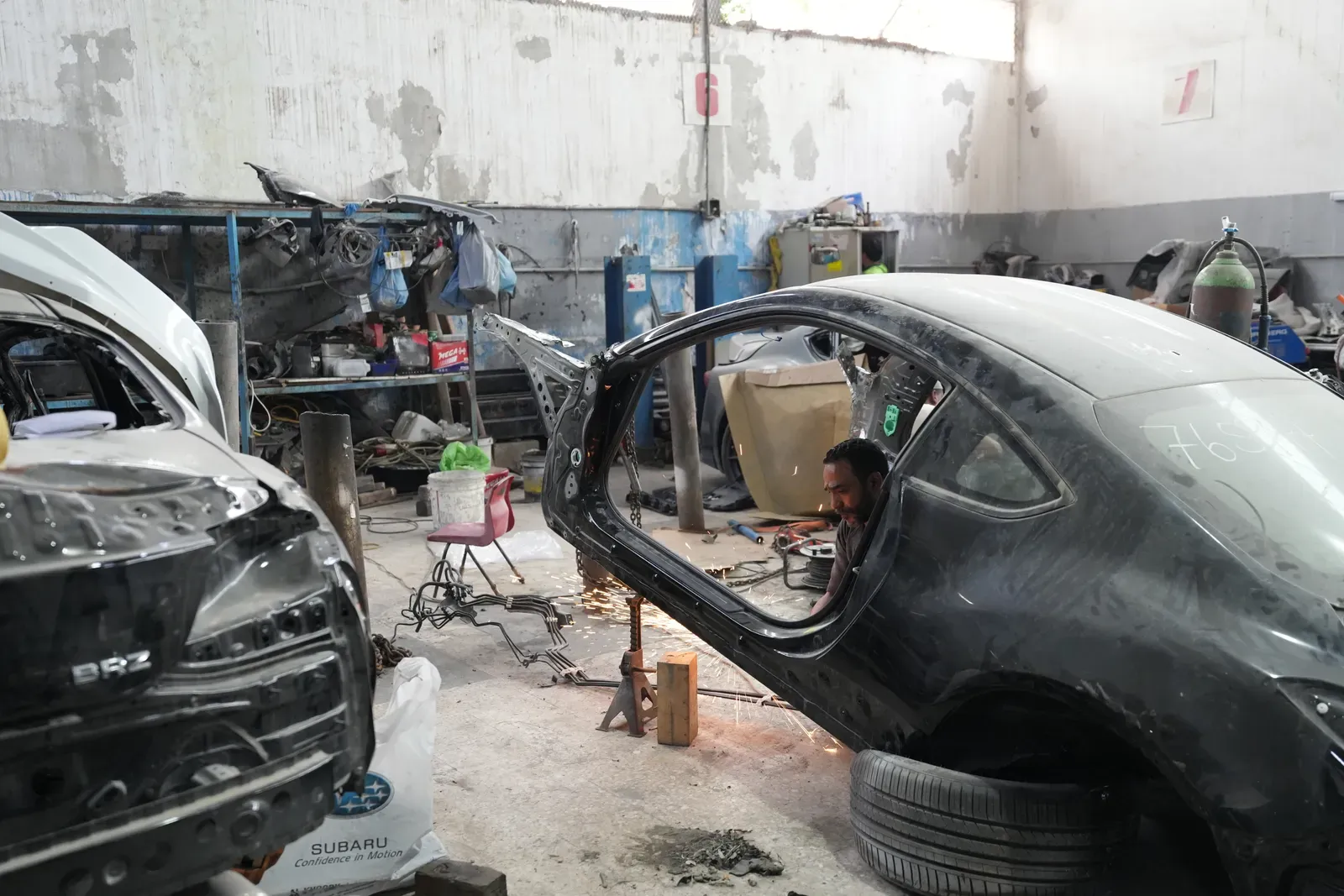
A body shell on axle stands with a technician working inside it.

Every one of these is found on a lift in this building, and priced before it is touched.

The work this usually turns into

And everything else, on the same car

The list above is what this make usually arrives needing. This is the rest of what the workshop does, and it applies to your car as much as to any other — worth knowing while it is already here.

Questions we get asked about these

Is a Urus the same kind of car to look after as a Huracán?

No, and anyone who tells you otherwise is selling the badge rather than servicing the car. The Urus sits on the Volkswagen group MLB Evo platform with a 4.0 twin-turbo V8, an eight-speed automatic with a torque converter and air suspension at all four corners, and that hardware is shared with other group SUVs. A Huracán has a naturally aspirated V10 and a dual-clutch gearbox and shares almost none of it. In practice that means the Urus is the more straightforward of the two to diagnose and to source parts for, and its common jobs — air springs, coolant, gearbox fluid, brakes on a heavy car — are group jobs done properly, not exotica. We would rather tell you that than charge you for mystery.

How do I know when carbon-ceramic discs are actually finished?

Not by thickness. A carbon-ceramic disc wears by losing mass as the material oxidises, and the manufacturer etches a minimum weight into the bell of the disc for exactly that reason. Checking it means cleaning the disc to the specified procedure and weighing it against that figure. A disc can look almost new and be at its limit, and it can look scruffy and have life left. This matters because a set of these is a serious amount of money and the decision should not rest on somebody glancing at an edge. It also matters in the other direction: if your car has ordinary iron discs and you have been quoted for ceramic, you should know before anybody orders parts.

My Aventador bangs into gear at low speed. Is the gearbox failing?

Usually not. ISR is a single-clutch gearbox with independently actuated shifting rods, and it was built to change gear violently fast rather than smoothly slowly. A firm, obvious shift from rest and in a car park is how it behaves when it is healthy, and no amount of money spent makes it drive like a torque-converter automatic. What is worth investigating is a bang that gets worse as the car warms up, a gear it will not take, a lurch that appears where it never used to, or a transmission warning after a spell in traffic. We road test to the condition you described, read clutch position, clutch wear and the temperatures the box logs, and give you the line between character and fault in writing rather than as a shrug.

The front lift has stopped working. Does the whole system have to be replaced?

Rarely. It is a closed hydraulic circuit and the usual answers are much smaller than the pump: a valve that no longer holds the nose up once it is raised, a weeping line or fitting at a front strut, or a sensing fault that stops the car believing it has risen. The way to tell them apart is to command the lift with live data on screen, see whether the pump is being asked to work and whether the height feedback actually moves, then hold the car up and watch how long it stays there. A nose that sinks while the pump is idle is not a pump problem. On cars kept here this system does more work than on almost any other, because every basement ramp and every speed bump asks for it, so it is worth getting the diagnosis right rather than replacing the expensive part first.

Is there Lamborghini work you send elsewhere?

Yes, and there are two clear ones. The first is structural repair of a carbon-fibre monocoque — the Aventador is built around one, and a tub that has been damaged in an accident is not something we take on; that belongs to a facility set up and qualified for structural composite work, and the honest thing is to say so before your car is on our ramp rather than after. The second is anything that needs a manufacturer security release: key and immobiliser coding, or pairing a replacement control unit to the car. That is released through the franchised channel. We also make no claim to own or licence any manufacturer’s dealer software, and we are not approved, authorised or appointed by Lamborghini.

Bring it in and we will find out

Nothing happens to the car until the fault has a name and you have approved the work against it.

Book WhatsApp us Call