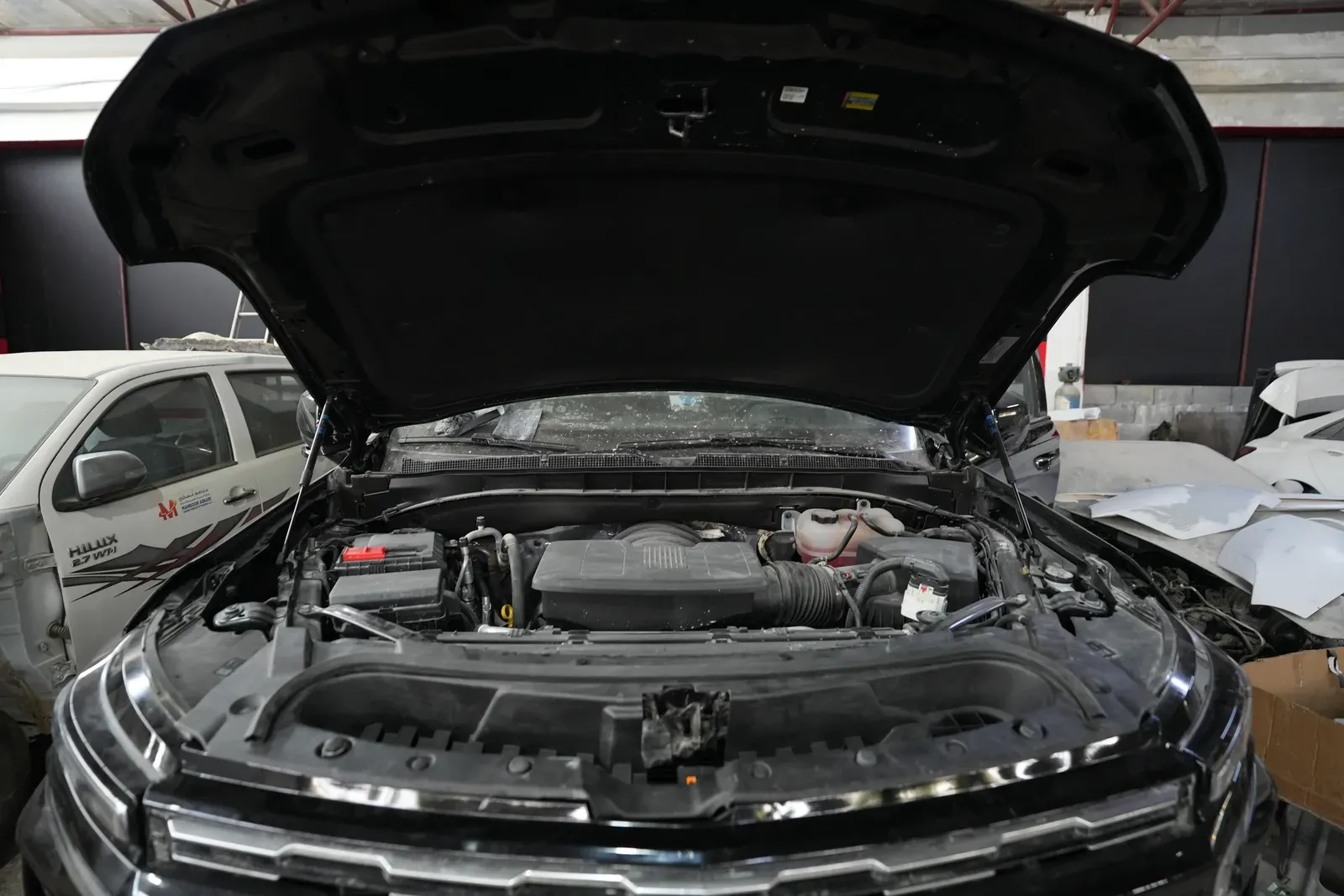
An engine bay open on the workshop floor, photographed close.

Ford repair and servicing in Sharjah

Most of what reaches us wearing a Ford badge is running a turbocharged V6, not the V8 the name still suggests. So the first thing we settle is which engine is in front of us, because a 3.5 EcoBoost, a 2.7 EcoBoost and a naturally aspirated 3.5 Cyclone fail in three different places and only one of them puts its water pump where you can see it. After that the job is testing rather than guessing.

Why we see these

Ford sells family and work vehicles here in quantity, and that shapes the workload. An Explorer doing school runs and an F-150 doing site work both spend their lives on short journeys in heat, which is the hardest possible duty cycle for a turbocharged engine and for a driveline unit that was filled once and never looked at again. The coast adds the other half. Humid mornings near the water put a lot of moisture through a charge air cooler that is then chilled by a fast run, and the driveability complaint that follows gets blamed on the gearbox far more often than on the intercooler it actually came from. Add dust into every radiator stack and a transfer unit under the bonnet that lives next to a hot engine, and the Sharjah version of these cars asks a different first question than the same model in a cooler place.

What this make asks of a workshop

  • The engine and its calibration established before anything is quoted. Several EcoBoost driveability complaints are addressed in the powertrain calibration rather than in a part, so we read what the modules identify themselves as and whether the calibration held by the car is the current one, before a single component is condemned.
  • A transmission fill done to a temperature, not to a dipstick. The 10R80 ten-speed is levelled with the fluid inside a specified temperature window read live on the scan tool, and it takes the low-viscosity fluid the gearbox was designed around rather than an older Mercon off a shelf. Too much and too little both come back as the same shudder.
  • A boost leak test and the ability to open the charge air system properly. On a turbocharged Ford the couplers, the clamps and the intercooler itself are part of the fuel system in practice, and a misfire chased on plugs and coils alone is a bill with no repair at the end of it.
  • Ramp time and a plan for the front of a 3.5 Cyclone. Ford put the water pump inside the engine, driven off the timing chain, so replacing it means the front cover comes off. That is a booking decision made before the car arrives, not a discovery on day two.
  • A parts channel that names the build. EcoBoost timing components, cam phasers and their solenoids were revised, and a box that says only the displacement is a box we will not fit without checking which version is inside it.
  • Patience with body electrics. Door latch actuators, a door-ajar signal that will not clear and the interior lighting and locking that follow it are ordinary Ford work, and they are found by testing the circuit at the connector rather than by fitting modules.

What actually comes in

Named at component level, with what the driver notices first and what we do to establish it is that and not something else that feels identical from the driving seat.

Water pump inside the timing cover, driven by the chain — 3.5 Cyclone V6

Coolant disappearing with nothing at all on the floor, a temperature needle that creeps up in traffic, and sometimes a milky film on the oil cap.

How we establish it

This is the fault that makes Ford owners think they have a head gasket. On the 3.5 Cyclone the pump sits inside the front cover and is turned by the timing chain, so when its seal goes the coolant leaves through a weep passage inside the engine rather than onto the driveway. We pressure-test the cooling system cold and watch whether it holds overnight, check the weep drain behind the cover for a coolant trace, and look at the oil for emulsion. We also say the access out loud before you agree to anything: the front of the engine comes apart to reach it, and that is a very different quotation from a pump you can see.

Timing chain, cam phasers and the phaser control solenoids — 3.5 and 2.7 EcoBoost

A rattle for a second or two immediately after a cold start that goes away once the oil is up, later a rough idle and a warning light.

How we establish it

A phaser is locked in place by oil pressure, so a rattle at the moment the pressure is lowest is a phaser question before it is a chain question. We read the camshaft-to-crankshaft correlation values in live data with the engine hot, look at whether the correlation codes stored are one bank or both, and check the oil level, its condition and the actual service history, because these phasers and their control solenoids do not survive long service intervals on a short-journey car. Only then do we say chain, phaser or solenoid — they are three different jobs and three different prices.

Charge air cooler and the water that collects in it — EcoBoost in coastal humidity

A shudder or a stumble at a steady highway cruise, most often on a humid morning near the coast, sometimes a flashing engine light for a moment and then nothing.

How we establish it

Humid air is cooled hard inside the intercooler and gives up its water there. The water pools, a change of throttle throws a slug of it into the engine, and the car misfires for a second at exactly the speed it does every time. That complaint gets sold as a gearbox almost as often as it gets diagnosed. We record misfire counters cylinder by cylinder during a road test on the road you described rather than on the forecourt, watch the fuel trims and the boost pressure at that instant, and boost-leak test the charge pipes and their couplers at the same time so a split coupler is not left behind a cleaned intercooler.

Shift quality and fluid level in the 10R80 ten-speed automatic

A hard bump between two of the lower gears, a hunting feeling at town speed as it changes its mind, or a shudder at light throttle like driving over a rumble strip.

How we establish it

We road test with the transmission fluid temperature and the commanded gear on the screen, because half of these complaints are the gearbox behaving correctly at a level or a temperature it should not be at. The level is checked with the fluid inside its specified temperature window, not cold and not after a long run, and the fluid specification is confirmed against what the gearbox asks for. Where the shift adaptations have been corrupted by a low level or a previous repair we say so rather than selling a valve body, and where it really is internal we say that too, in advance.

Power transfer unit and rear drive unit fluid — Explorer and Edge

A whine that rises and falls with road speed rather than with engine speed, a hot oily smell after a long run, or a wet patch where the driveshaft enters the unit.

How we establish it

The power transfer unit sits bolted to the gearbox in the hottest part of the engine bay and holds a small quantity of oil that gets treated as a lifetime fill. In this climate it is not one. We road test to establish whether the noise follows road speed or engine speed, draw a sample and look at its colour and smell, check the vent and the output seal for a leak that has been feeding the noise, and check the rear unit separately rather than assuming both ends are the same story. Replacing a whining unit without saying why it whined is how the second one fails too.

Cam phasers and variable cam timing solenoids on the Coyote 5.0 V8 — Mustang

A clatter from the top of the engine for the first few seconds on a cold start, and a tick at idle once it is warm that changes with engine speed.

How we establish it

On the Coyote the same few seconds of noise can be the phasers not holding, the solenoid screens blocked, or an entirely healthy engine with oil that has drained back. We listen at the top of each bank with the engine cold and then hot, read the cam timing values against commanded on both banks, and inspect the solenoid screens for varnish before anything is priced. A Mustang that has been driven in short bursts and serviced late gets its oil and its filter judged as part of this, because that is what these phasers actually live on.

Vacuum-operated front wheel end locks (IWE) on four-wheel-drive F-150 and Ranger

A grinding or crunching from a front wheel when pulling away or turning at low speed, which comes and goes and is worse in the first minutes.

How we establish it

This is one people take to a gearbox specialist. The front hubs on these trucks are engaged and released by vacuum, and when a hose, the check valve or the solenoid leaks the hub sits half engaged and grinds. We test the vacuum at the hub with a pump rather than guessing, check the solenoid and the one-way valve, and follow the lines that run past a hot engine and go hard. It is a cheap fault diagnosed properly and an expensive one diagnosed by assumption.

Air conditioning condenser, compressor clutch and the airflow across the front stack

Cold on the move and warm the moment the car stops, or air that is cool for twenty minutes and then gives up on the way home in the afternoon.

How we establish it

We read the vent temperature at the centre outlet with the system stabilised and watch the high and low side pressures change as the cooling fan comes in, because an air conditioning complaint that only appears when the car is stationary is usually an airflow or fan problem rather than a gas problem. The condenser on these front ends fills with dust and sits directly behind whatever the road threw at it, and a system topped up without answering why it was low is a system that will be low again.

Door latch actuators and the door-ajar circuit behind them

A door that will not latch or will not open from inside, a door-ajar warning that stays on with every door shut, interior lights that never go out and a battery flat in the morning.

How we establish it

The latch on these doors carries the switch that tells the car the door is shut, so one failing actuator produces a list of complaints that look electrical and are mechanical. We operate each latch and watch the door status change in live data door by door, test the circuit at the connector for supply and ground, and then check what the open door is doing to the parasitic draw overnight. That last step is what separates a flat battery caused by a latch from a flat battery caused by a battery.

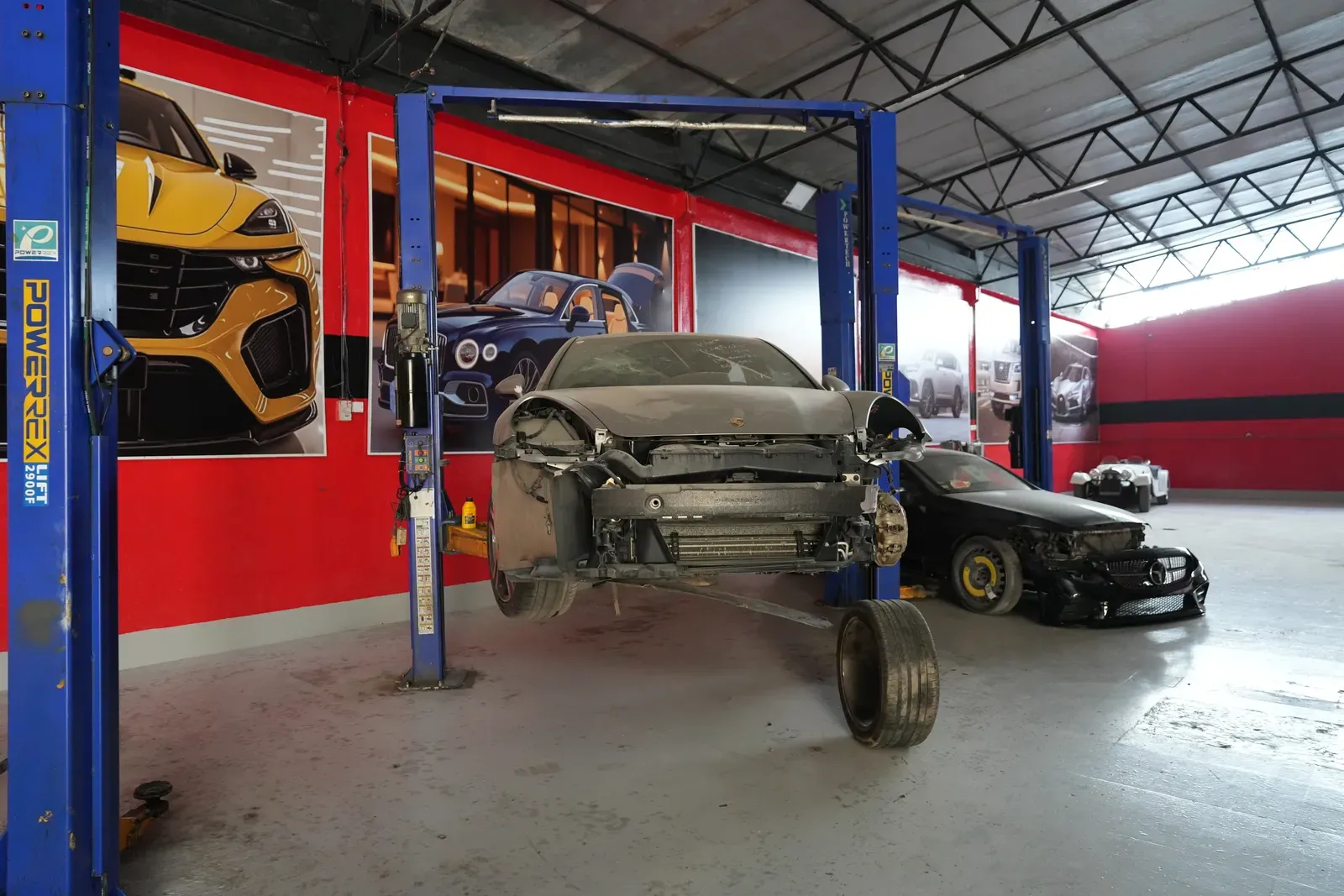
A car on a two-post lift with its front end stripped.

Every one of these is found on a lift in this building, and priced before it is touched.

The work this usually turns into

And everything else, on the same car

The list above is what this make usually arrives needing. This is the rest of what the workshop does, and it applies to your car as much as to any other — worth knowing while it is already here.

Questions we get asked about these

My Explorer keeps losing coolant and there is nothing on the driveway. Where is it going?

On the 3.5 Cyclone V6 the first thing to rule in or out is the water pump, because Ford put it inside the front cover and drove it off the timing chain. When its seal fails the coolant leaves through an internal weep passage, so the level falls and the floor stays dry. A pressure test held cold, the weep drain behind the cover and the state of the oil settle it. It is worth settling properly: this is routinely called a head gasket, and the two are different jobs. If it turns out to be a hose, a cap or the expansion tank, which it sometimes is, we would rather find that first.

My F-150 shudders at a steady 100 on the highway. Is the gearbox finished?

Not necessarily, and on an EcoBoost this is the complaint most often paid for twice. Two very different things feel the same from the seat: water collecting inside the charge air cooler and being thrown into the engine at a change of throttle, which shows as a brief misfire at a particular speed, and a torque converter clutch that is slipping, which shows as a steady vibration with no misfire at all. They are told apart on a road test with misfire counters, boost pressure and transmission temperature on the screen at the moment the shudder happens. That is a short test and it decides which of two very different bills you are looking at.

The 10R80 is described as sealed for life. Does it ever need fluid?

Fluid ages by heat, and a ten-speed automatic behind a turbocharged engine in this climate sees a great deal of it. What matters more than the argument about intervals is how it is done. The level is set with the fluid inside a specified temperature window read live, and it takes the low-viscosity fluid the gearbox was built around — an older Mercon is not a substitute. A gearbox filled cold or filled after a long run is filled wrong, and the shudder that follows gets blamed on the gearbox rather than on the fill.

There is a rattle for a second when I start the EcoBoost cold. Is that the timing chain?

It might be, and on these engines the more common answer is the cam phasers. A phaser is held by oil pressure, and at the instant of a cold start the pressure has not arrived yet, which is exactly when you hear it. We read the cam-to-crank correlation values hot, see whether the stored codes point at one bank or both, and judge the oil and the service history at the same time, because phasers and their control solenoids are the parts that suffer from late oil changes on a short-journey car. Chain, phaser and solenoid are three different repairs, and we would rather name which one it is than sell the biggest of the three.

Are you a Ford centre, and do you have their dealer software?

No, and we will not describe ourselves that way. Nobody at Ford appointed us, and the line at the bottom of this page says exactly that. What matters to your car is a narrower question: whether the job includes the tests the fault actually needs — correlation values read live, a boost leak test, a transmission fill done to temperature, a circuit tested at the connector — and whether we will tell you when something has to go to the franchise instead. Some module programming is locked to the manufacturer, and that is a real limit. We would rather name it before your car is apart than after.

Bring it in and we will find out

Nothing happens to the car until the fault has a name and you have approved the work against it.

Book WhatsApp us Call