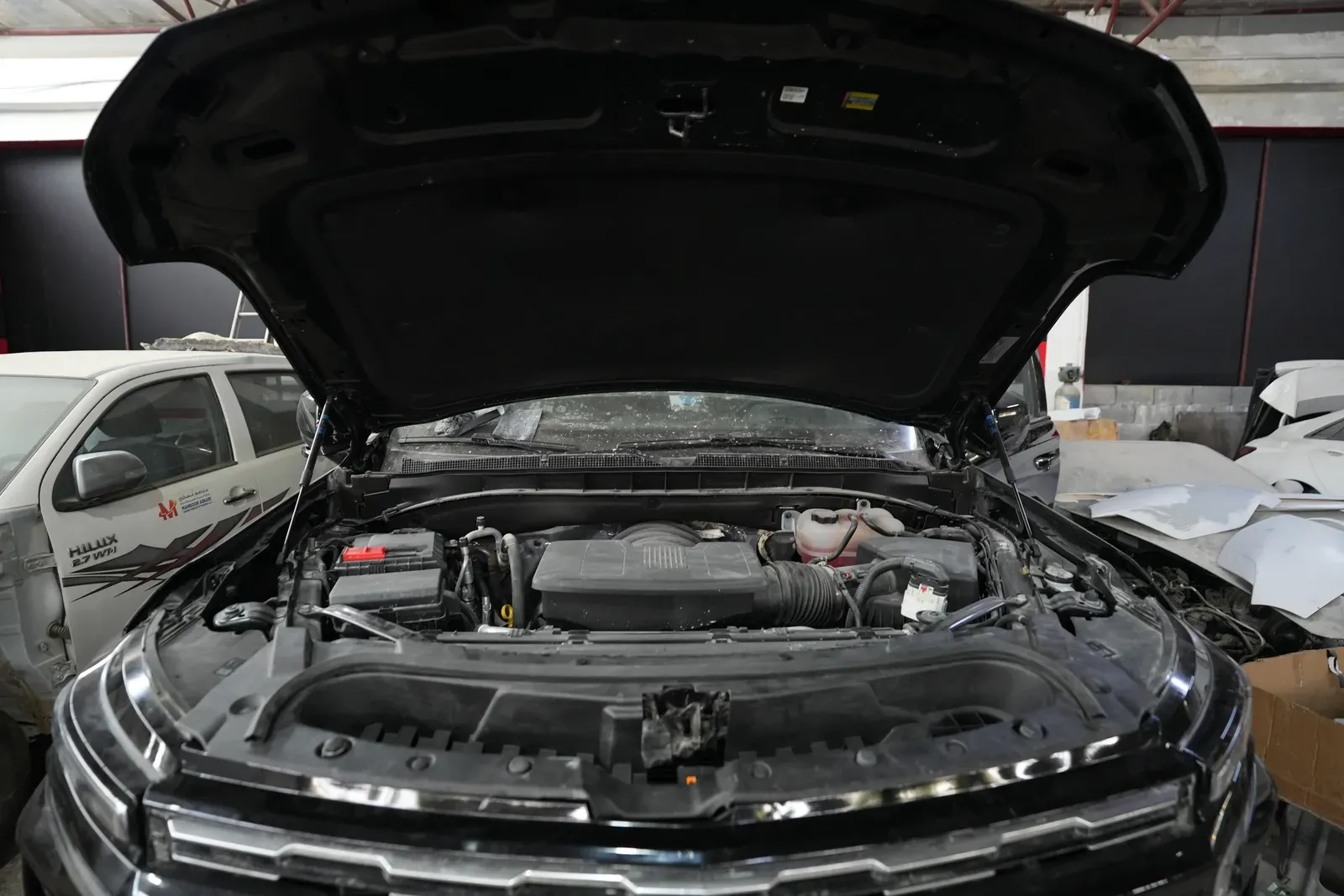
An engine bay open on the workshop floor, photographed close.

Ferrari repair in Sharjah

With a Ferrari the answer changes at the generation line, not at the odometer. The 355 and the 360 drive their camshafts off rubber belts, so a date on a sticker decides the largest bill the car will ever present. The F136 V8 in the F430 and the 458 runs chains and asks an entirely different set of questions, and the turbocharged F154 asks a third set again. So nothing gets quoted until we have established which engine, which gearbox and which model year is actually on the ramp.

Why we see these

A Ferrari in the northern Emirates lives indoors and comes out in short bursts, and two consequences of that shape most of the work. The first is cabin heat. A car parked in a closed garage through July still bakes, and the soft-touch coating Ferrari applied to switchgear, vent surrounds, console trim and the steering column shrouds turns tacky here years earlier than it does in a milder climate — owners meet it on a window switch long before they meet it anywhere else. The second is paperwork. A large share of these cars change hands privately or arrive as used imports, and the invoice that would say when the cambelts last came off, or what the clutch was reading at its last service, rarely travels with the car. On a belt-driven 355 or 360 that missing date is the most expensive unknown an owner can carry. On an F1 car the clutch figure is the second. Neither has to stay unknown: one of them is a date, and the other is a number the gearbox module will give up in ten minutes.

What this make asks of a workshop

  • The engine family and the model year fixed from the chassis number before any service is priced. Belt-driven and chain-driven Ferrari V8s carry completely different major services, and a shop that quotes one interval for both is guessing at the most expensive job on the car.
  • The F1 transmission treated as a hydraulic system rather than as a clutch. Pump run time, accumulator pressure and the clutch position point matter as much as the wear percentage, and every clutch or actuator job ends with the position point set and the system self-calibrated, not with the car handed back on yesterday’s values.
  • Exhaust heat shields removed for a manifold inspection rather than a torch shone past them. On the 360 and F430 the cracks form at welded seams that the shielding covers, which is exactly why owners are told for years that the noise is normal.
  • Interior trim handled as refinishing work, not cleaning. A degraded soft-touch coating has to come off the part completely and a new finish go on; anything that only wipes the surface leaves the same panel sticky again by the next summer.
  • Honesty about where our work stops. We do not code keys or immobiliser modules, and we do not take on anything that needs a manufacturer security release to complete — that work belongs to the franchise, and we say so before you book rather than after the car is apart. We also make no claim to own or licence any manufacturer’s dealer diagnostic software.
  • Room to work on a car with a very low nose and an engine that may have to come out. Access is planned before the car arrives, because a Ferrari lifted or dragged in the wrong place costs more to put right than the repair it came in for.

What actually comes in

Named at component level, with what the driver notices first and what we do to establish it is that and not something else that feels identical from the driving seat.

Exhaust manifolds and their welded seams on the 360 and the F430, under the heat shielding

A hard rasp or a ticking from behind the cabin that is loudest on a cold start and quietens as the metal expands, a smell of exhaust at the back of the car, and sometimes a SLOW DOWN warning on the dash.

How we establish it

These manifolds crack at the welds, and the shielding that keeps the heat off everything else is also what hides the crack, so the fault gets dismissed as a noisy exhaust for years. We take the shields off and inspect the seams directly with the engine cold, then run it and look for the leak while it is moving under load. Live lambda and fuel trim data go on screen at the same time, because a leak upstream of the sensor makes the engine read lean and start adding fuel it does not need, and that is often what put the warning on the dash in the first place. Where the car still has its original pre-catalysts we say plainly why this matters more than a noise: material breaking down ahead of the turbine of the exhaust is the reason a cracked manifold on these cars is not something to live with for another season.

Timing drive — rubber cambelts on the 355 and 360, and the chain drive of the F136 V8 in the F430 and 458

Usually no symptom at all. The complaint that arrives instead is a quotation the owner does not understand, or a car bought with no record of when the belts were last changed.

How we establish it

The first job is to settle which car this is, because the two answers are not variations of each other. A belt-driven 355 or 360 has a service governed by the age of the rubber rather than by distance covered, and on a car with no history the honest position is that the date is unknown and has to be treated as due. A chain-driven F136 has no belt to replace at all, and anybody selling one a belt service is selling it a job its engine has no place for. We confirm the drive type from the chassis and engine data, inspect what can be seen of the drive, and where the car is chain-driven we listen instead for the start-up rattle that points at the variators rather than at the chain. The owner then gets a straight answer about what their specific car is due, including the answer that nothing is due.

Camshaft phase variators and their oil supply on the F136 V8 — the 458, and the same design in the California and the 599

A loud rattle from the back of the car for a second or two on the first start of the day, gone by the time the owner has reversed off the drive, and sometimes never heard again until the next cold morning.

How we establish it

A variator is held in position by oil pressure, and one that has drained overnight clatters until the gallery fills. That is the noise, and separating it from a chain or a tensioner matters because the two repairs are not the same size. We record the noise at a genuine cold start rather than after the car has been moved around the yard, watch oil pressure come up on live data as it happens, and read the cam position data the engine itself is logging for each bank against the crank. Oil grade and condition get checked in the same visit, because a variator fed with the wrong viscosity in this climate behaves like a failing one. Where the rattle is present on one bank only and the cam position data agrees, we say which bank, rather than quoting the top end of the engine as a whole.

F1 single-clutch automated manual — the clutch, the hydraulic actuator, the pump and the pressure accumulator on the 355, 360 and F430

A shudder pulling away from a junction, a long pause before the car takes up drive, the pump audibly running far more often than it used to, or a gearbox warning with the car refusing to select a gear.

How we establish it

This is one clutch, worked by hydraulics, and the two halves fail separately. The transmission module holds a clutch wear percentage and a clutch position point, and both are read out, but a percentage on its own has misled more owners than it has helped — a figure that looks alarming on a car that is driven properly can be perfectly serviceable, and a comfortable-looking figure on a car with a tired accumulator still drives badly. So we read the wear and the position point, then watch how long the pump runs and how quickly pressure falls with the engine off, which is what exposes an accumulator that has lost its gas charge. The actuator is checked for external leakage at the same time. The result names one of three things — clutch, hydraulics, or a system that simply needs its position point set — and the position point is set and the system self-calibrated before the car leaves, because a clutch fitted without that step drives worse than the one that came out.

Soft-touch coating on switchgear, vent surrounds, console trim and column shrouds

Every button in the cabin has gone tacky and marks with a fingerprint, the trim has started to look wet, and anything that touches it — a cloth, a sleeve, a phone — comes away with the finish on it.

How we establish it

This is a coating failing, not dirt, and it is worth saying so because the wrong response makes it permanent. The rubberised finish Ferrari used on interior parts of this period breaks down with heat, ultraviolet and humidity, and a Sharjah car reaches that point sooner than a European one. Solvents and household cleaners take off the top layer and leave a patchy part that is harder to refinish afterwards. We identify which pieces are actually affected and which are simply dirty, and the answer for the affected ones is removal of the failed coating from the part and a new finish applied to it. What the owner needs from us before anything comes out of the dashboard is a straight list of which parts are worth refinishing, which are better replaced, and which are fine.

Magnetorheological dampers and the bumpy road setting on the steering wheel

The ride has gone hard and stays hard, the bumpy road button no longer changes anything, a suspension message appears on the dash, or there is oil misting down the body of one damper.

How we establish it

These dampers are filled with a fluid whose stiffness changes with a magnetic field, so a fault can be electrical or it can be a leak, and they feel identical from the seat. We read the suspension module for which corner is reporting, then measure the coil circuit at each damper and command a damping change while watching the current the module is actually delivering — a unit that reads open or short has an electrical failure, and a unit that reads correctly but never changes the ride has lost its fluid. The bumpy road setting is confirmed working as a separate check, because on these cars it is a driver-selected softening of the same dampers and an owner who reports it as dead has usually found the fault before the dash did. A damper that is misting is named as the one that is misting, not as a set.

Turbochargers, boost control and the charge-air circuit of the F154 V8 — the California T, the 488 and the Portofino

A loss of pull that comes and goes, a whistle or a flutter under acceleration, a warning light after a few minutes of hard driving, or a car that will not rev past a certain point.

How we establish it

The F154 is a different diagnostic problem from the naturally aspirated F136 and it is worth being explicit about that, because the two get treated as one engine family by search results and by parts counters. A turbocharged Ferrari has a pressure target, a wastegate that has to reach it, a charge-air path that has to hold it, and an oil and coolant supply to each turbo that has to survive shutdown heat in this climate. So the test is a road test with commanded boost against actual boost on screen, followed by a pressure test of the charge-air side to find where it is escaping, and an inspection of the oil feed and drain lines at each turbo for misting. The complaint then belongs to a leak, a wastegate actuator, or a turbo, rather than to turbo lag or to the fuel in the tank.

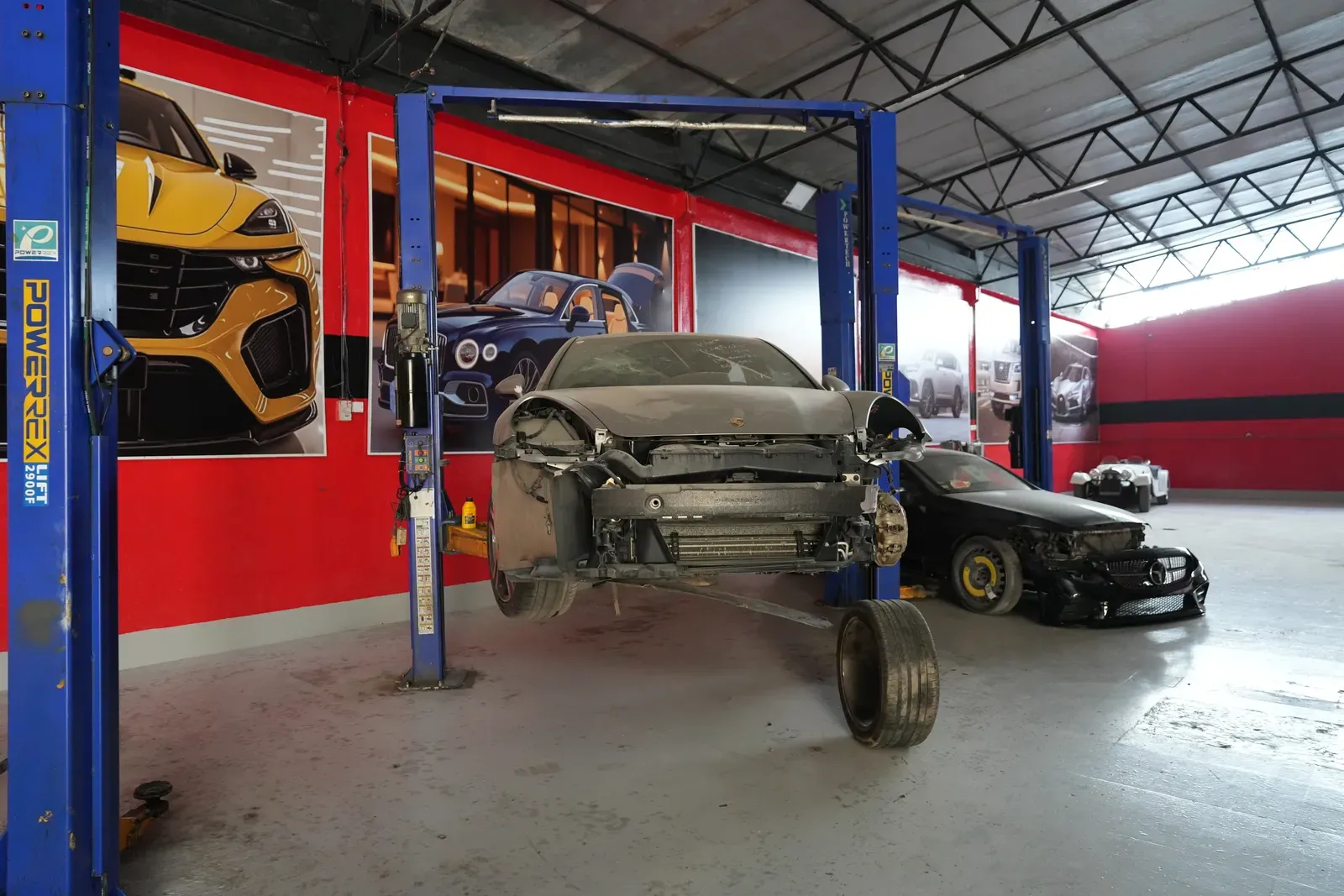
A car on a two-post lift with its front end stripped.

Every one of these is found on a lift in this building, and priced before it is touched.

The work this usually turns into

And everything else, on the same car

The list above is what this make usually arrives needing. This is the rest of what the workshop does, and it applies to your car as much as to any other — worth knowing while it is already here.

Questions we get asked about these

Does my car need a belt service, or does it have chains?

It depends on the generation, and it is the first thing we establish. The 355 and the 360 drive their camshafts off rubber belts, and that service is governed by the age of the rubber rather than by the distance the car has covered — a car that has done very little in six years is not exempt. From the F430 onwards the F136 V8 runs a chain, and there is no belt service to buy; if someone has quoted you one for a chain-driven car, they have quoted you a job your engine has no place for. We confirm which you have from the chassis and engine data before any figure is discussed, and if the answer is that nothing is due, that is the answer you get.

How much life is left in my F1 clutch?

The transmission module holds a wear percentage and a clutch position point, and we read both out for you. What we will not do is hand you the percentage on its own and call it a diagnosis. That number has frightened owners into changing healthy clutches and it has reassured owners whose real problem was hydraulic. A car whose accumulator has lost its charge or whose pump is running constantly will slip, shudder and hesitate with plenty of clutch material left, and fitting a clutch to it changes nothing. So the reading is taken alongside pump run time, pressure hold with the engine off and how the car behaves from rest. You get the number, and you get what it means for your car.

The exhaust sounds louder than it used to. Is that something or nothing?

On a 360 or an F430 it is worth a proper look rather than a shrug. The manifolds on these cars crack at their welded seams, the heat shielding hides it, and the noise is loudest cold and fades as the metal expands — which is exactly why it gets normalised. A leak ahead of the oxygen sensor also makes the engine read lean and add fuel, so it can put a warning on the dash that looks like a fuelling fault. The reason we do not leave it is what sits downstream: material breaking up inside the exhaust path is the version of this story that ends in an engine repair rather than a manifold. Shields off, seams inspected, and then you know.

Can the sticky buttons and trim be fixed, or does it all have to be replaced?

Most of it can be refinished. The coating is a soft-touch layer that has broken down with heat and humidity, and the fix is to take that layer off the part completely and apply a new finish, not to clean it. This matters because the common first attempt — a solvent or a household cleaner — removes some of the layer, leaves the rest, and gives you a patchy part that is harder to refinish afterwards. Some pieces are genuinely better replaced, usually where the part is also cracked or distorted. What you should get before anything is taken out of the car is a list of which is which, and in a Sharjah car it is worth doing the whole affected set at once rather than one switch at a time, because the parts around it are on the same clock.

Is there Ferrari work you will not take on?

Yes, and we would rather say it now than after your car is apart. We do not code keys or immobiliser modules, and we do not take on any job that needs a manufacturer security release to finish — a replacement engine or transmission control unit that has to be paired to the car falls in that group. That work is released through the franchised channel and no amount of effort on our side changes it. We also make no claim to own or licence any manufacturer’s dealer software. Before you book, we will tell you whether your particular job can be completed here with the calibrations and resets it needs, or whether part of it has to go to the franchise — and we are not approved, authorised or appointed by Ferrari in any case.

Bring it in and we will find out

Nothing happens to the car until the fault has a name and you have approved the work against it.

Book WhatsApp us Call