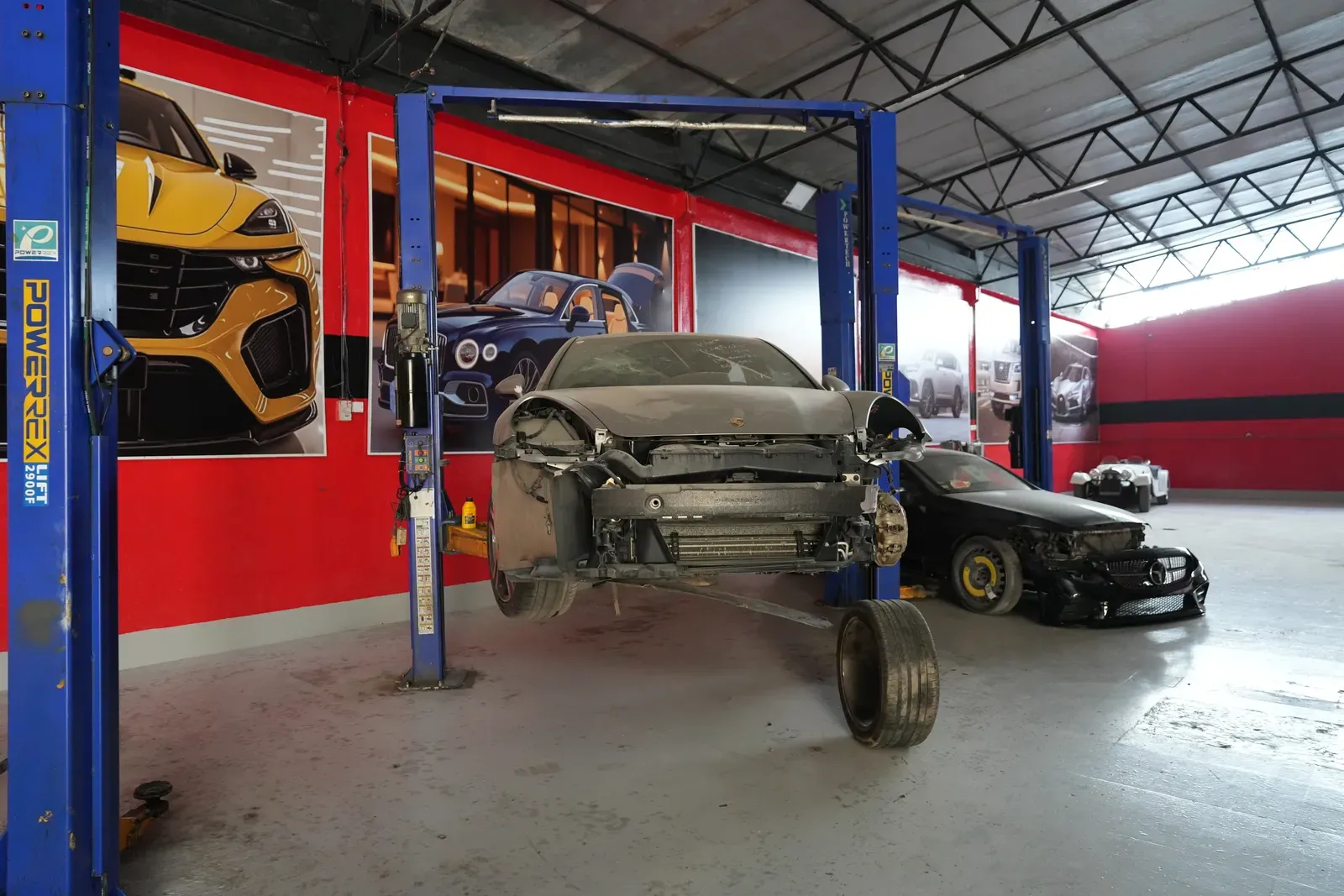
A car raised on a lift with its front end stripped down.

Mercedes-Benz repair in Sharjah

Most of what brings a Mercedes here is one of four things: the air suspension, the gearbox electronics, a V6 or V8 timing gear, or a cooling part that has been baked for eight summers. Those are separate jobs with separate tests, and the first thing we do is work out which of them you have.

Why we see these

Sharjah runs a large second-hand Mercedes fleet — E-Class and S-Class saloons kept a long time, and GL, GLS and G-Class used as ordinary family cars. Two things follow from that. The first is that air suspension, an expensive option that stayed uncommon in Europe, is fitted to a very high share of the cars we see. The second is heat: an air spring is a rubber bellows folding on itself several times a minute in an engine-bay and wheel-arch environment that spends months above 45°C, and rubber that would last a decade in Germany perishes here in a fraction of that. A Mercedes air strut in this country is a wear item on a local clock, not a European one.

What this make asks of a workshop

  • Ride height is a number the suspension module holds, not something you judge by eye at the kerb — the four corner values are read live, and the car is set back to its own specification after any strut, link or sensor is touched
  • AIRMATIC work needs the car on a lift with the system able to be commanded up and down, and it needs the leak found before any compressor is fitted, because a new compressor on an unfixed leak burns out the same way the old one did
  • ASSYST decides the service, not the odometer, and the oil is an approval — MB-Approval 229.5, 229.51 or 229.52 depending on engine and after-treatment. The sheet number is what we fit against and what goes on the invoice
  • The 722.9 seven-speed has no dipstick. Its fluid and filter change is done to the MB sheet specification with the level set electronically at a stated fluid temperature, or the level is wrong however carefully the fluid was measured in
  • Adaptations and calibrations are part of the repair on these cars — steering angle after suspension work, a battery registered to the energy management, rear calipers into and out of service mode. We will tell you before you book if a specific coding job on your car has to go to a franchised dealer instead
  • AMG variants are a different parts list, not a trim level: the M156 and M177 have their own brake, fluid and cooling specifications, and the M156 in particular has a documented camshaft and head-bolt history that a standard V8 does not

What actually comes in

Named at component level, with what the driver notices first and what we do to establish it is that and not something else that feels identical from the driving seat.

AIRMATIC and AIR BODY CONTROL air springs — the rubber bellows on the strut (W211, W212, W221, W222, and the X164 and X166 GL and GLS)

The car is sitting down on one corner in the morning and lifts itself again a minute after starting, or it stays down and the dash says the vehicle is too low.

How we establish it

The corner is raised, the system shut down, and the bellows and the top of the strut are wetted with soapy water while the folds are worked open — a perished fold bubbles where it cracks. We read the four ride-height sensor values live and note which corners fall and how fast, because one corner dropping overnight is a strut and all four dropping together is usually not.

The AIRMATIC compressor, its relay and the valve block

The car takes a long time to come up, there is a pump running under the car for far longer than it used to, and eventually the car does not rise at all and an AIRMATIC malfunction message appears.

How we establish it

Compressor run time and the system pressure are read from the module, and the relay is checked for the burnt contacts that leave the compressor running on after the car is locked. Then we separate the three: a strut leaking makes the compressor work until it overheats, a valve block leaking internally bleeds all four corners down evenly, and a dead compressor does neither. Fitting a compressor without settling that question is how the second one fails too.

Balance-shaft gear on the M272 V6 and idler gear on the M273 V8 — the early production run, roughly 2004 to 2008

Check engine light, sometimes a rough idle, on a C350, E350, ML350, R350, CLK350 or SLK of that era. Often no noise at all until it is well advanced.

How we establish it

The stored codes are the starting point — camshaft-to-crankshaft correlation faults in the P0016 to P0019 group are the signature — and we then read live camshaft position against crankshaft position to see how far the adjusters are having to compensate. The engine number decides whether the car falls in the affected range, and that is checked before anyone talks about opening the front of the engine, because this is an engine-out-class job and nobody should be quoted it on a code alone.

Timing chain, tensioner and chain rails on the M271 four-cylinder (C180 and C200 Kompressor, W203 and W204, CLK and SLK)

A rattle for two or three seconds on a cold start that goes away once oil pressure builds, later a check engine light.

How we establish it

We listen at the front cover on a genuinely cold engine, because a chain that has stretched is quiet by the time the car has been idling in a queue outside. The camshaft adjuster codes are read, and the chain and rail are inspected through the cam cover with the engine set to a known position, so that the answer is chain, tensioner, rail or adjuster magnet rather than all four quoted at once.

Conductor plate and the 13-pin connector on the 722.6 five-speed

The gearbox locks into one gear with no warning, or will not select, and there is a wet patch on the gearbox where the wiring leaves it.

How we establish it

Speed-sensor codes in the P0715 and P0720 group point at the conductor plate. Before anything is ordered we pull the 13-pin connector and look at whether fluid has tracked into it and up the loom, because on this gearbox that connector is the usual leak and the fluid it wicks along the wires reaches the transmission control unit. A gearbox condemned on codes alone here is frequently a connector and a conductor plate.

Valve body and conductor plate on the 7G-Tronic 722.9, and the fluid that was never sealed for life

A delay of a second or two from P into D, a knock into gear, a flare or a jerk between two particular gears, or a shudder at light throttle around 60 to 80 km/h.

How we establish it

We road test with gearbox live data on screen — commanded gear against actual gear, slip across the torque converter lock-up clutch, and fluid temperature — so the complaint is tied to a specific shift rather than to the gearbox in general. A shudder that appears only at lock-up and only when the fluid is hot is a different repair from a solenoid in the valve body. Where the fault turns out to be fluid condition on a car that has never had a service, we will say so rather than sell the valve body.

Thermostat housing, water pump and the auxiliary electric fan on the M271, M272 and M276

The temperature needle climbs when the car is crawling and settles again once it is moving, the air conditioning goes warm in traffic, and there is a sweet smell after a long drive.

How we establish it

A cooling-system pressure test cold, held, so a housing seam that only weeps under pressure is found rather than guessed at. Coolant temperature and fan duty are read live at idle with the air conditioning loaded, because in this climate the auxiliary fan is doing real work every day and a fan that has stopped commanding full speed looks exactly like a thermostat from the driving seat.

Oil cooler seals in the V of the M278 and M157 V8, and valve-cover gaskets on the M272 and M273

A burning oil smell after driving, smoke from the back of the engine bay at a standstill, and the oil level dropping between services with nothing on the floor.

How we establish it

The engine is degreased and run, then looked at from underneath with the car in the air, because oil that has blown back over a hot exhaust tells you nothing about where it started. On these V8s the cooler seals sit under the intake in the valley, which is why the leak appears at the back of the block and why it is worth proving before the intake comes off. A leak at the rear main is a different job again, and the two are separated by where the oil first appears, not by where it ends up.

SBC hydraulic unit on the cars that carried it — W211 E-Class, W219 CLS and R230 SL of that period

A red brake warning with a message to visit a workshop, a pedal that suddenly feels different from the one you know, and a pump audible more often than it used to be.

How we establish it

SBC is not a conventional braking system and it is not diagnosed like one. The unit keeps its own internal actuation counter and the module has to be interrogated for it and for the pressure and pump-run faults it stores. We establish whether the complaint is the hydraulic unit, the pressure sensor or a low system pressure from elsewhere, and we tell you plainly if the answer is a job that has to go to a franchised dealer.

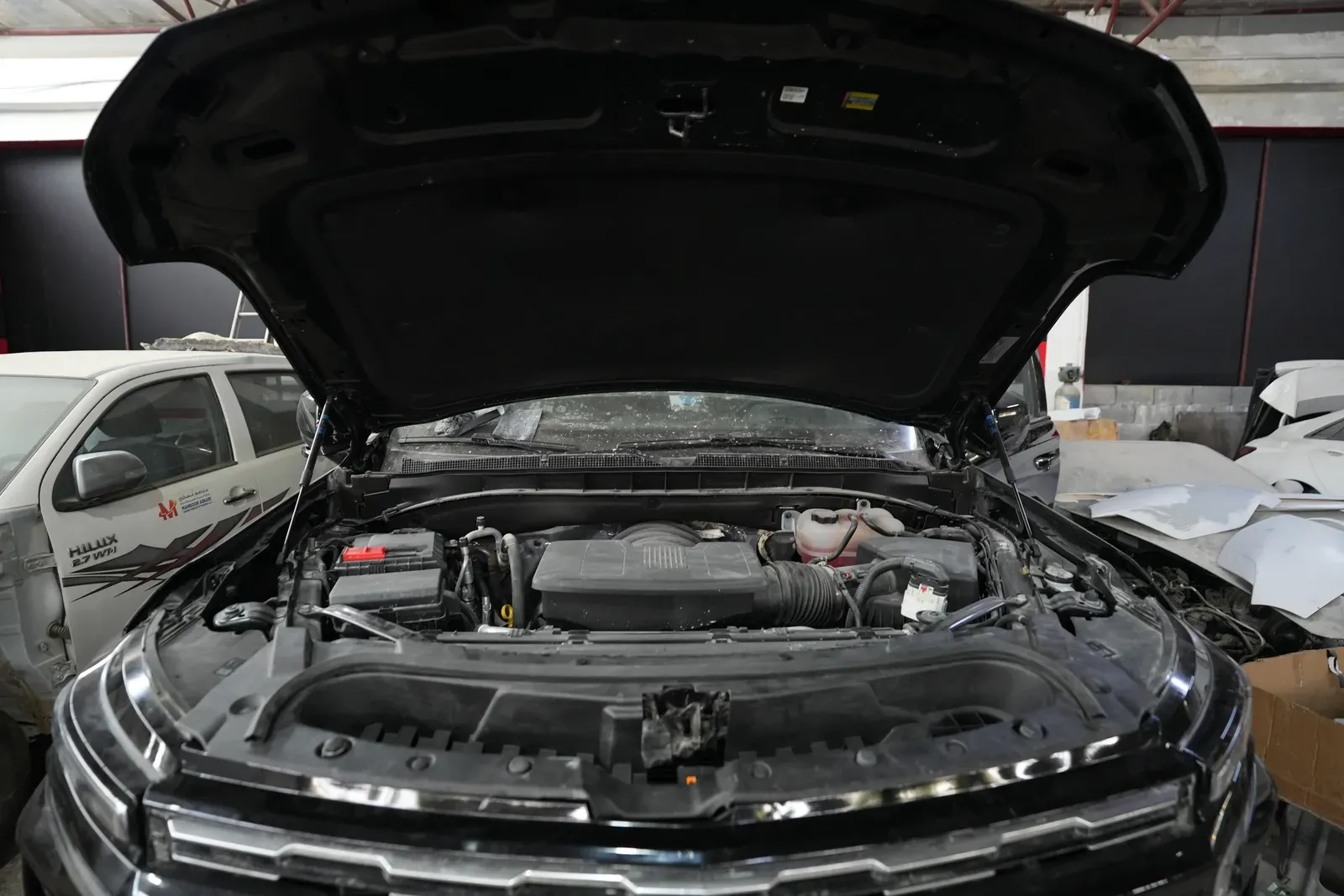
An engine bay open under the bonnet, photographed close.

Every one of these is found on a lift in this building, and priced before it is touched.

The work this usually turns into

And everything else, on the same car

The list above is what this make usually arrives needing. This is the rest of what the workshop does, and it applies to your car as much as to any other — worth knowing while it is already here.

Questions we get asked about these

One air strut has failed. Do I have to do all four?

No. Same axle together is the sensible rule, the way it is with any damper, because two different rates across an axle change how the car behaves under braking. All four at once is a decision about age, not a technical requirement: if the other struts are the same age and have lived through the same summers they are on the same clock, and we will say so — but we will not present that as the only option.

Can I convert the air suspension to normal springs?

Conversion kits exist and people fit them. What you should know before you decide: the suspension module still expects ride-height signals and will normally log faults and light the dash unless that is dealt with, the ride is not the one the car was engineered around, and on models where the rear self-levels the loaded behaviour changes. We will tell you what it will actually do on your specific model before you spend anything, including where it is the wrong idea.

My compressor was replaced last year and it has failed again. Why?

Almost always because the leak that killed the first one was never found. The compressor is a small pump with a duty cycle; a strut or a valve block bleeding air makes it run until it overheats, and it dies of overwork rather than of age. That is why the leak test comes before the compressor quote here, and why we would rather tell you the job is bigger than you hoped than sell you the same part twice.

Is the 7G-Tronic gearbox really filled for life?

Mercedes-Benz publishes fluid and filter intervals for these gearboxes. "Sealed for life" is a phrase that travelled through the trade, not a manufacturer instruction, and a gearbox in this country lives at a fluid temperature Europe rarely sees. The important part is how it is refilled: the 722.9 has no dipstick, so the level is set with the fluid at a stated temperature and read electronically. Done any other way the level is wrong even if the right amount went in.

Why do several unrelated warnings appear on my Mercedes at once?

Because a dozen modules share one supply, and on these cars a weak battery shows itself as a list of faults rather than as a slow crank. Heat is what ends a battery here, not cold. There are two more items worth naming: the auxiliary battery — on some models a small capacitor-based voltage converter rather than a battery — which throws its own message, and a parasitic drain from a module that never goes to sleep. On the W211 the rear SAM sits where water from a blocked plenum drain reaches it, and a wet SAM produces faults that look like anything except water. We measure the drain and load-test the battery before replacing modules.

Do you work on the diesel models?

Yes, but honestly: diesel passenger Mercedes are far less common on the road here than in Europe, and most of what arrives is an OM642 V6 in an older ML, GL or a van. We would rather tell you that than copy out a European diesel fault list as if it were the local picture. If you have one, bring it and we will look at it on its own terms — and if a part or a job on it has to come through a channel we cannot reach quickly, you will hear that before the car is stripped, not after.

Bring it in and we will find out

Nothing happens to the car until the fault has a name and you have approved the work against it.

Book WhatsApp us Call