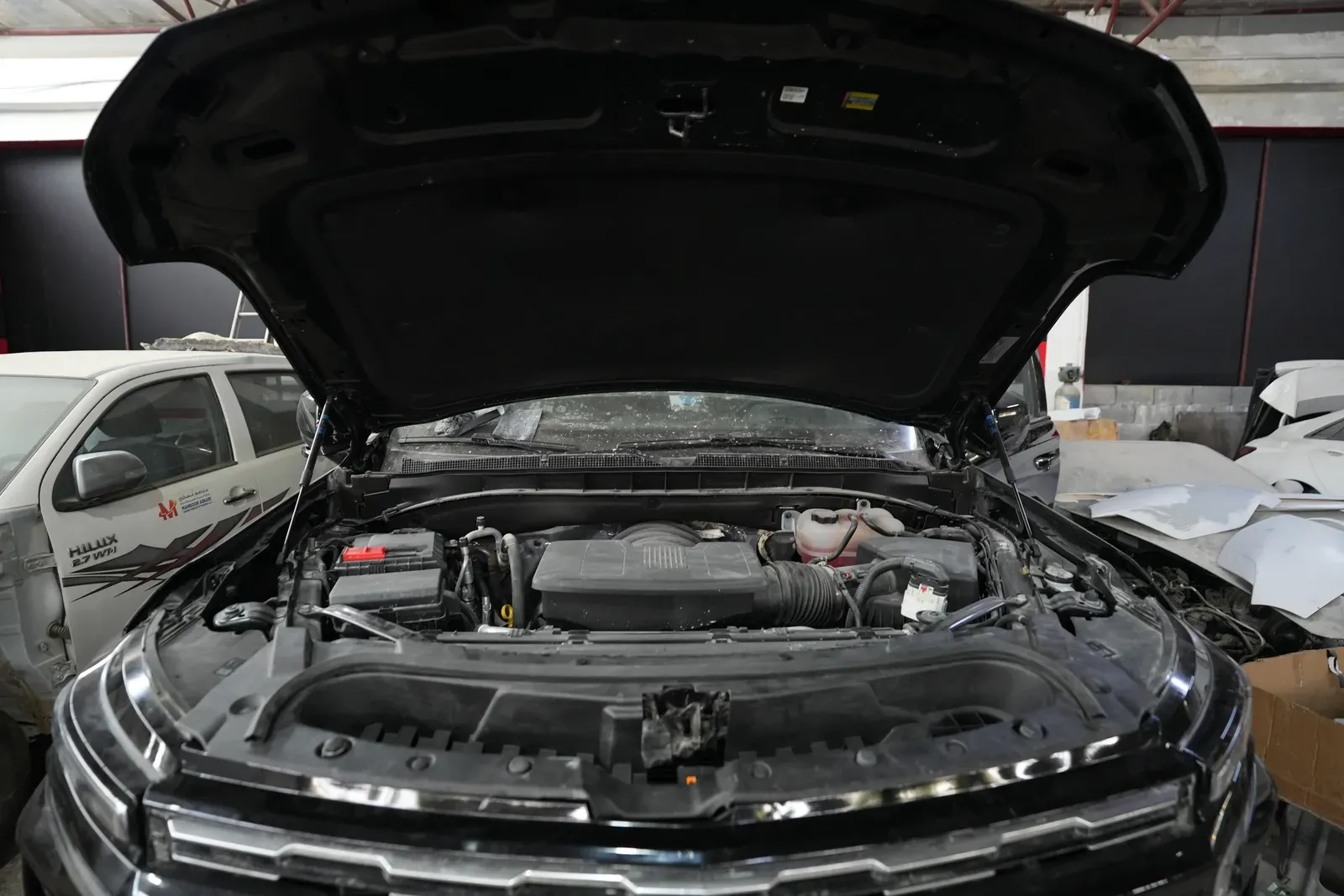
An engine bay open on the workshop floor, photographed close.

Hyundai repair and servicing in Sharjah

Most Hyundais that reach us are out of warranty, with a second owner, and carrying something the last workshop described as a noise. The first thing we establish is which engine is under the bonnet. A Theta II 2.4 GDI and a Lambda 3.3 V6 do not fail in the same place, and the cheap answer on one of them is the expensive answer on the other.

Why we see these

Hyundai sells here in volume, and the cars that end up in a workshop are the ones a family has kept: an Accent or an Elantra driven to work every day, a Creta or a Tucson doing the school run, a Santa Fe or a Palisade loaded up for the weekend. Almost all of them are petrol GCC cars, so the diesel troubles that fill European Hyundai forums are not what we see. What we see instead is heat and short journeys — a car that rarely gets a long run, an air conditioning system at full load for five months of the year, and direct injection engines designed around a gentler duty cycle than Sharjah traffic in August.

What this make asks of a workshop

  • Establishing the engine and the injection system before anything else. Theta II, Lambda, and whether the car injects only into the cylinder or has port injectors as well, changes both the fault list and the service.
  • Servicing to the severe-condition column in the handbook rather than the easy one. Short trips, standing traffic and 45-degree ambient are exactly the conditions that column describes, and a Hyundai run on the long interval in Sharjah is running on tired oil for the last part of every cycle.
  • Per-cylinder misfire counters and fuel trims read as live data, not a printed code list. On a direct injection engine the counters name the cylinder, and that is what decides whether anything is worth taking apart.
  • A cold start we do ourselves. Several of these faults only speak on the first start of the day, so the car stays overnight and is started by us in the morning, rather than being started warm in the afternoon and declared healthy.
  • Air conditioning judged at the ambient you actually drive in, with the refrigerant the car takes read off the label under the bonnet. Most of these cars take R134a and later ones take R1234yf, and they are not interchangeable.
  • Rear suspension bolts tightened with the car at ride height, not hanging on a lift. A rubber bush clamped at full droop is pre-twisted and tears out early, which is why a rear bush job sometimes comes back within the year.

What actually comes in

Named at component level, with what the driver notices first and what we do to establish it is that and not something else that feels identical from the driving seat.

Connecting-rod bearings and the crankshaft journals — Theta II 2.4 GDI (Sonata, Santa Fe, Tucson)

Oil disappearing between services first, with no leak on the floor. Then a deep knock from low in the engine on the first start of the day that fades as the oil warms. Later the knock stays, and rises with the revs.

How we establish it

This is established in a fixed order, because guessing at it is expensive in both directions. We listen on a genuinely cold start — the car sits overnight and we start it, it is not started warm in the afternoon — and we listen low, at the sump line, not at the cam cover. Oil pressure is taken with a mechanical gauge at the galley rather than trusted to the warning lamp, which only knows about a pressure low enough to be an emergency. The oil itself is read for level, for a fuel smell and for the glitter that bearing material leaves behind. An oil analysis on its own does not settle this and we will not sell it as though it does. If everything points the same way the sump comes off and the shells are read directly, and you are told before that happens what it costs to look and what the two possible answers are.

Cam-cover gaskets and the oil-control valve screens — Lambda 3.3 and 3.8 V6 (Santa Fe, Palisade)

A hot oil smell after parking, oil creeping down the back of the engine, and sometimes a rough idle or a camshaft timing code once the small screens behind the oil-control valves have silted up.

How we establish it

The rear bank of a transverse V6 sits against the bulkhead, which is where these leaks start and where they are hardest to see, so the car goes up, the area is cleaned and the engine is run before anything is quoted. A stain under the front of the engine is very often oil that has travelled from somewhere else. Where there is a cam timing code alongside the leak we take the oil-control valve out and look at its filter screen instead of replacing the valve on the strength of the code, because a silted screen and a dead solenoid read identically to a scan tool and only one of them is a part you need to buy.

Carbon on the intake valves and ports — direct-injection petrol engines with no port injectors

A shudder for a few seconds after a cold start that then clears, a misfire count that climbs at idle, a longer crank than the car used to need, or a car that has quietly lost its response pulling out of a junction over two or three years.

How we establish it

Direct injection sprays the fuel past the valve instead of over it, so nothing washes the back of the valve and the oil vapour coming from the crankcase bakes onto it. We read misfire counters cylinder by cylinder and fuel trims at idle and just off idle, check the crankcase ventilation circuit that is feeding the deposit in the first place, and look into the port with a borescope before anybody proposes cleaning it. The reason for that order is simple: a tired coil, a worn plug and a carboned valve all arrive as a rough idle, and only one of them justifies taking an inlet manifold off.

Electric power steering column coupler and the motor mounting — Elantra, Tucson and Creta

A knock or a rubbery clonk felt through the steering wheel when you turn it a little either way at parking speed, or when a front wheel drops into a joint in the road, with nothing obviously loose in the suspension.

How we establish it

This is a steering noise and not a suspension noise, and it gets sold as ball joints more often than anything else on these cars. With the car in the air and the wheels hanging, the knock is still there when the wheel is rocked, which already rules out most of the front end. We put a hand on the coupler between the assist motor and the column while somebody rocks the wheel and feel the lost motion directly, and we read the steering module and its torque-sensor live data before deciding whether the noise and any complaint about heavy or uneven assistance are even the same fault.

Torque-converter lock-up shudder and the fluid in the six-speed automatic

A fine vibration at light throttle at a steady cruise, at the speed where the gearbox is holding top gear and trying to lock up, that disappears the moment you press harder or lift off.

How we establish it

A lock-up shudder is felt in the seat and blamed on the engine, so the first job is to prove where it lives: we watch engine speed against turbine and output speed in live data while the shudder is happening, and confirm it vanishes the instant lock-up is released. Then the fluid. It is checked to the car’s own procedure and at the temperature the car specifies, not on a cold dipstick in a car park, because the handbook wording that leads owners to believe this fluid never needs attention is the single most common reason these gearboxes shudder. We will say which of the two we think it is, and we will say plainly that a fluid service on a badly worn gearbox is not a repair.

Air-conditioning compressor, condenser and the cooling fan under a 45-degree heat load

Cold at speed and warm in traffic, a compressor that cuts in and out on a long drive, or air that is merely cool rather than cold from the day the temperature goes above forty.

How we establish it

We take vent temperature and both service-port pressures with the car standing, at an ambient we write down, because a system that is adequate at thirty degrees can be short of capacity at forty-five and the shortfall is only visible at the condition you actually drive in. The condenser is inspected for the pack of fine dust that builds up on its face, fan operation is commanded and watched rather than assumed, and the refrigerant the car takes is read from the label under the bonnet before anything is connected. Where the compressor is the answer we also establish why it died, since a compressor that failed on a blocked condenser will do it again.

Rear trailing-arm and assist-arm bushes on the multi-link rear axle

A dull knock from the back over a speed bump that you feel in the seat more than you hear it, the back of the car feeling loose on a lane change, and a rear tyre wearing on its inner edge.

How we establish it

Rear bushes are levered individually with the car in the air, arm by arm, because a rear axle that knocks has five or six candidates at each corner and replacing all of them is how a rear suspension ends up costing what a gearbox costs. When a bush is replaced the bolt is tightened with the suspension loaded at ride height rather than hanging, and the rear geometry is reset afterwards, because on this axle the rear toe and camber are what eat the inner edge of a tyre. Where the alignment is done somewhere we send you, we say so before you book rather than after.

Collapsed hydraulic engine mount at the front of a transverse four-cylinder

A vibration through the floor and the seat that is there with the car in drive at a standstill and gone the moment you select neutral, plus a thump into the cabin as you take up drive or lift off sharply.

How we establish it

A vibration that changes with gear selection and not with engine speed is a mount and not a misfire, and separating those two is the first thing that happens. The mounts are loaded with a bar while the engine is rocked, and the hydraulic mount is checked for the fluid weep that says its chamber has split. We also check that the mount bracket bolts were pulled up properly after any previous engine work, because a mount that was never torqued gives the same symptom as one that has failed and costs nothing to correct.

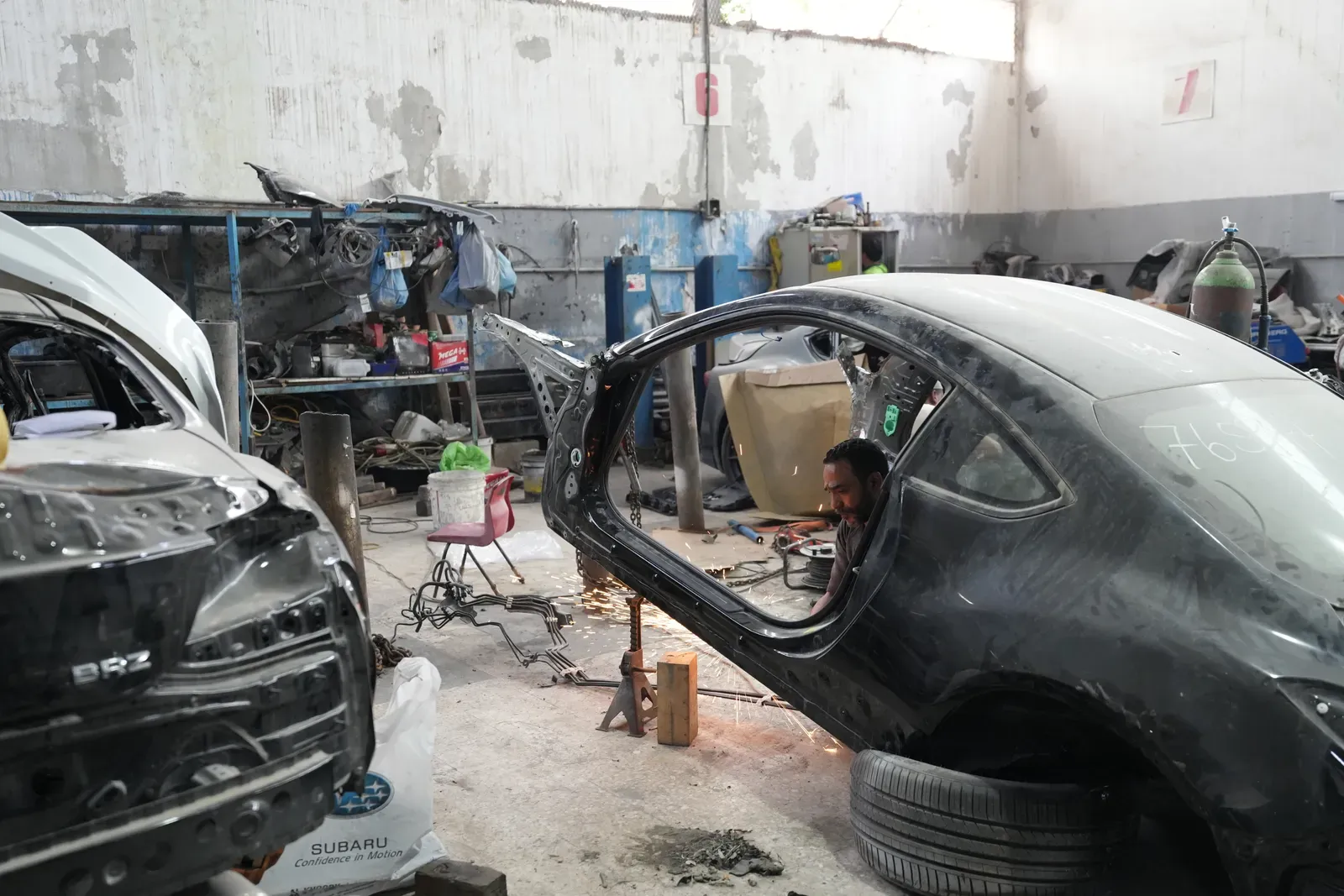
A body shell on axle stands with a technician working inside it.

Every one of these is found on a lift in this building, and priced before it is touched.

The work this usually turns into

And everything else, on the same car

The list above is what this make usually arrives needing. This is the rest of what the workshop does, and it applies to your car as much as to any other — worth knowing while it is already here.

Questions we get asked about these

My Hyundai is using oil and there is a knock in the morning. Is the engine finished?

Not necessarily, and that order of symptoms is worth taking seriously rather than panicking about. Oil consumption first and a cold knock afterwards is the pattern the Theta II 2.4 GDI is known for, and it is established with a cold-start listening pass low on the block, a mechanical oil pressure reading, the condition of the oil, and finally the bearing shells themselves. Two honest cautions. A knock that is loudest at the top of the engine on a cold start is often something much cheaper, so the listening is not a formality. And there are documented service actions on some of these engines in some markets — whether one applies to your car is decided by the VIN and by where the car was sold, only a franchised dealer can answer that, and we will not tell you that you are covered. Be careful with anyone who does.

Is an oil analysis enough to tell me whether the bearings are going?

No, and it is sold as though it were. A sample can show bearing metal, which is useful, but a clean sample proves very little: the wear may not have started shedding yet, the oil may have been changed recently, and the numbers have no meaning without a baseline for that engine. We use it as one input alongside a cold-start listen, a mechanical oil pressure reading and the state of the oil on the dipstick. When those three agree, dropping the sump answers the question outright, and we would rather quote you for looking than sell you a test that leaves you exactly where you started.

My car is GDI. Do the intake valves have to be cleaned at a set interval?

No. Carbon on the intake valves is a real consequence of injecting straight into the cylinder, but how fast it builds depends on the engine, on the crankcase ventilation, on the oil and on how the car is driven, and a workshop that sells the job on a mileage number is selling a calendar rather than a diagnosis. We do it on evidence: misfire counts per cylinder, fuel trims at and just off idle, and a look into the port. If the deposit is not the reason your car runs the way it does, we will tell you that, and we will also look at the crankcase ventilation, because cleaning the valves without dealing with what fed them is a repeat visit.

The steering knocks over bumps. The last workshop wanted to change the ball joints.

It may be the ball joints, but on these cars there is a specific alternative worth ruling out first because it costs nothing to check. The electric power steering system has a coupler between the assist motor and the column, and when that develops play it produces a knock you feel through the wheel itself rather than through the floor. The test is quick: with the car in the air and the wheels hanging, a suspension knock largely goes quiet and a coupler knock does not. We check that before quoting anything at the front of the car.

Do you have Hyundai’s own dealer diagnostic system?

We will not claim to hold the manufacturer’s own tooling, and we are not a Hyundai centre — nobody appointed us, and the line at the foot of this page says so. What matters to your car is narrower than the name on a laptop: whether the scan tool used on it can read live data and per-cylinder counters rather than a code list, and whether it can carry out the resets and relearns the car expects after a part changes. Ask us about the specific job on your car and you will get a straight answer, including where the honest answer is that a particular module has to be programmed by the franchise. We would rather name that limit before we start than run into it with your car apart.

Bring it in and we will find out

Nothing happens to the car until the fault has a name and you have approved the work against it.

Book WhatsApp us Call