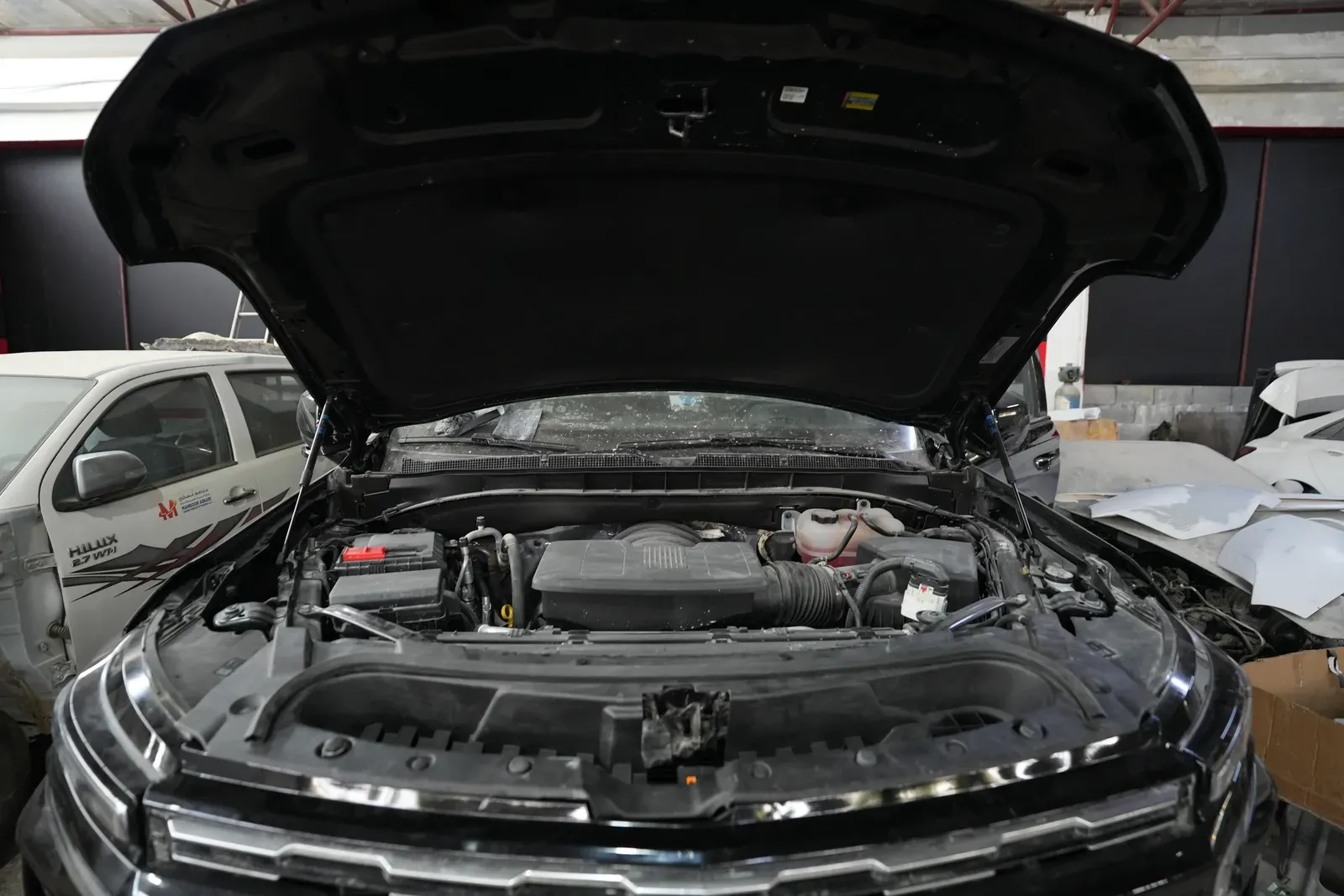
An engine bay open on the workshop floor, photographed close.

Mercedes-AMG servicing and repair in Sharjah

The badge names an engine, not a trim level. A C63 built in 2011 has the naturally aspirated 6.2 M156; a C63 built in 2018 has the 4.0 twin-turbo M177, which shares no major part with it. An E55 of the mid-2000s has the supercharged 5.4 M113K, and an A45 has the M139 four. Behind most of them is not a torque-converter automatic at all but SPEEDSHIFT MCT, which starts the car moving on a wet clutch pack. Establishing which of those is in front of us is not paperwork — it decides the oil, its volume, the gearbox fluid and the entire parts list.

Why we see these

These cars live a specific life in this emirate and it is the one they were least designed for. Almost none of them is the household’s only car. They do short journeys, they are driven hard in bursts on a road that is either empty or stationary, and then they sit in heat — which means the cooling system, the oil and the gearbox rarely reach a steady state and very often reach their limit. Everything AMG added over the standard car adds heat: more compression, more boost, more power through the same body. The second thing that is true here is that the cars arrive cheap and stay expensive. A ten-year-old 6.2 costs a fraction of what it cost new, and its owner has usually bought it on that number — but the brakes, the tyres, the oil volume and the gearbox service were all specified when the car was new and have not become cheaper. The useful thing a workshop can do is tell an owner which of those is due now, which can wait a season, and which one will take the engine with it if it waits.

What this make asks of a workshop

  • The engine identified by its M number before anything is quoted. C63, E63 and S63 have each named more than one engine across the years, and an M156 and an M177 do not share an oil volume, a filter, a plug interval or a cooling system. The badge on the boot is not the specification.
  • Oil to the approval the engine asks for, in the quantity it asks for. These engines carry substantially more oil than the non-AMG engine in the same body — enough that filling one to a standard figure leaves it low — and an approval such as MB 229.5 is what the engine and its after-treatment were built around, not a marketing number.
  • The cooling system tested under load rather than at idle. An AMG cooling system that looks perfectly healthy standing in a workshop is the normal presentation of a car that overheats on the Emirates Road in August, and a stationary pressure test does not reproduce the case that matters.
  • SPEEDSHIFT MCT understood as a wet-clutch gearbox, not as an automatic. It starts the car moving on a clutch pack immersed in oil in place of a torque converter, so its fluid is doing a job no torque-converter fluid does, its service is real, and its clutch has an adaptation that can be read.
  • Brake hardware identified before a brake job is priced. AMG has sold two-piece floating composite steel discs and carbon ceramics on the same model in the same year, they take different pads, and one of them cannot be quoted from a catalogue by registration alone.
  • Tyres matched to the approval marked on the sidewall where the car carries one. An MO or MO1 marking is a specific construction developed for the car, not a size — and on a car making this much power in this heat, that distinction is a safety item rather than a preference.

What actually comes in

Named at component level, with what the driver notices first and what we do to establish it is that and not something else that feels identical from the driving seat.

Cylinder head bolts and camshaft lobe and rocker wear on the naturally aspirated 6.2 — M156 and M159, roughly 2007 to 2011

A smell of coolant after a hard drive with no visible leak on the floor, a coolant level that falls slowly with nothing to show for it, or a tapping from the top of the engine that is loudest when cold.

How we establish it

These are two separate faults on one engine and they are the two that decide whether a 6.2 is worth buying. The head bolts of the early production run corrode where they pass through the coolant jacket, lose clamp, and let coolant seep at the head face — which is why the smell arrives before the puddle, and why it is often noticed after a hard drive rather than in a car park. Separately, the camshaft lobes and the rockers riding on them wear on engines that have not had oil changed often enough, and that wear is progressive rather than sudden. So the work is to look, not to guess: a pressure test on the cooling system held long enough to find a seep rather than a leak, the bolt heads and the head face inspected directly, and the valvetrain listened to cold and then looked at through the oil filler and the cam covers. We say which of the two we have found, because they are not the same repair and they are not the same decision for an owner.

Supercharger coupling and the intercooler circulation pump on the supercharged 5.4 — M113K in E55, CLS55, SL55 and G55

The car feels flat when pushed but perfectly normal driven gently, sometimes with a rattle from the front of the engine at idle, and sometimes with power that fades the longer the car is driven hard.

How we establish it

A supercharged engine has a failure the turbocharged ones do not: it is driven by a belt through a coupling, and that coupling wears. When it does, the blower turns a little less than the engine thinks it does, and the car simply feels ordinary — no warning light, no stored fault, nothing a scan tool has any opinion about. That is why an owner is so often told nothing is wrong. The second item is the small electric pump that circulates coolant through the air-to-water intercooler, and here the symptom is the giveaway: a car that pulls properly for the first minute and then loses its edge is a car whose charge air is no longer being cooled, and in this climate that is the condition it will spend its life in. We measure rather than infer — intake air temperature after the intercooler read as live data on the road, boost pressure against what is being requested under load, and the coupling inspected with the belt off.

Turbocharger oil feed and return lines inside the vee of the 4.0 twin-turbo — M177 and M178 — and what heat soak after shutdown does to them

A blue haze on start-up after the car has stood, a whistle or siren note that was not there before, or an oil consumption the owner cannot account for on a car with no leak underneath it.

How we establish it

This engine puts its two turbochargers in the vee between the cylinder banks rather than outboard of them. It is a good design and it makes the car respond the way it does, but it means the oil feed and return lines run through the single hottest volume on the engine — and the moment that matters is not while driving, it is the minute after the key comes out, when the coolant stops moving and the heat that was being carried away sits in the vee instead. That is what the car’s after-run pump exists to deal with, and it is why an after-run circuit that has quietly stopped working is a more serious fault on this engine than the same failure would be on a conventional one. So we check that the after-run actually runs before we look at anything else, then read the oil condition and the turbocharger shaft play directly. The advice that goes with it costs nothing and is worth more than most repairs: give the car the half minute at idle before switching it off after a hard drive.

The wet start-off clutch of SPEEDSHIFT MCT and its fluid — the clutch pack that sits where a torque converter would

A shunt or a hesitation moving off from rest, a change that has become harsh in slow traffic, or a gearbox that behaves properly cold and badly once everything is hot.

How we establish it

This is the single most misdiagnosed item on an AMG, because the gearbox is described as an automatic and is then treated as one. It is not: AMG removed the torque converter and put a multi-plate clutch running in oil in its place, which is what gives the car its response from rest and what makes the fluid in it a working part rather than a lubricant. A converter absorbs a shunt at take-up; a clutch pack transmits it, so the same wear that a conventional automatic hides, this gearbox reports to the driver’s seat. The right first move is therefore to read the clutch adaptation values and the gearbox oil temperature under load, not to quote a rebuild. A great many of these gearboxes are one fluid service and one relearn away from behaving properly, and the ones that are not will say so in the adaptation figures before anybody opens anything.

Hydraulic engine mounts on the AMG V8 — the fluid-filled mounts that control the idle the standard car does not have to control

A vibration through the seat and the steering wheel at idle that disappears the moment the car moves, and sometimes a knock from the front of the car over a speed bump taken slowly.

How we establish it

A large-capacity V8 at idle produces a pulse that a rubber mount alone will pass straight into the cabin, so these cars use mounts filled with fluid and, on some of them, mounts the car actively changes the stiffness of. When the fluid leaks out, the mount does not fail in any way that stops the car — it simply becomes a rubber mount, and the owner is left with a vibration that everybody can feel and nobody can find, usually after being told it is an engine problem. It is diagnosed by looking at the right thing: the mounts inspected from underneath for the fluid that has left them, the engine’s movement watched under load against the brakes, and, where the car has the active type, the mount’s own control checked for whether it is being commanded at all. It is a cheap answer to an alarming symptom, which is the best kind of finding to be able to give somebody.

Charge air cooling and the roller-bearing turbocharger on the 2.0 four — M133 and M139 in A45, CLA45 and GLA45

Power that is clearly there on a cool morning and clearly not there on a hot afternoon, or a car that pulls hard for one run and then will not repeat it.

How we establish it

This is the highest specific output of any four-cylinder engine sold in numbers, and it gets there by pushing a great deal of air through a small engine — which makes the temperature of that air the limiting factor rather than an incidental. On a European ambient the charge cooler has margin. At 45°C standing in traffic it does not, and the engine protects itself by pulling timing and reducing boost, exactly as it was designed to. So the first question is whether the car is faulty or is doing its job, and that is answered with data rather than opinion: intake temperature after the cooler, requested against actual boost, and any timing correction, all read on the road at the moment the owner says the power disappears. Where the answer is heat, the honest advice is about the cooling circuit and the driving, not a part. Where it is the turbocharger itself, the shaft is checked directly — a roller-bearing turbo gives a different and much earlier warning than a plain bearing one, and it is worth catching at that stage.

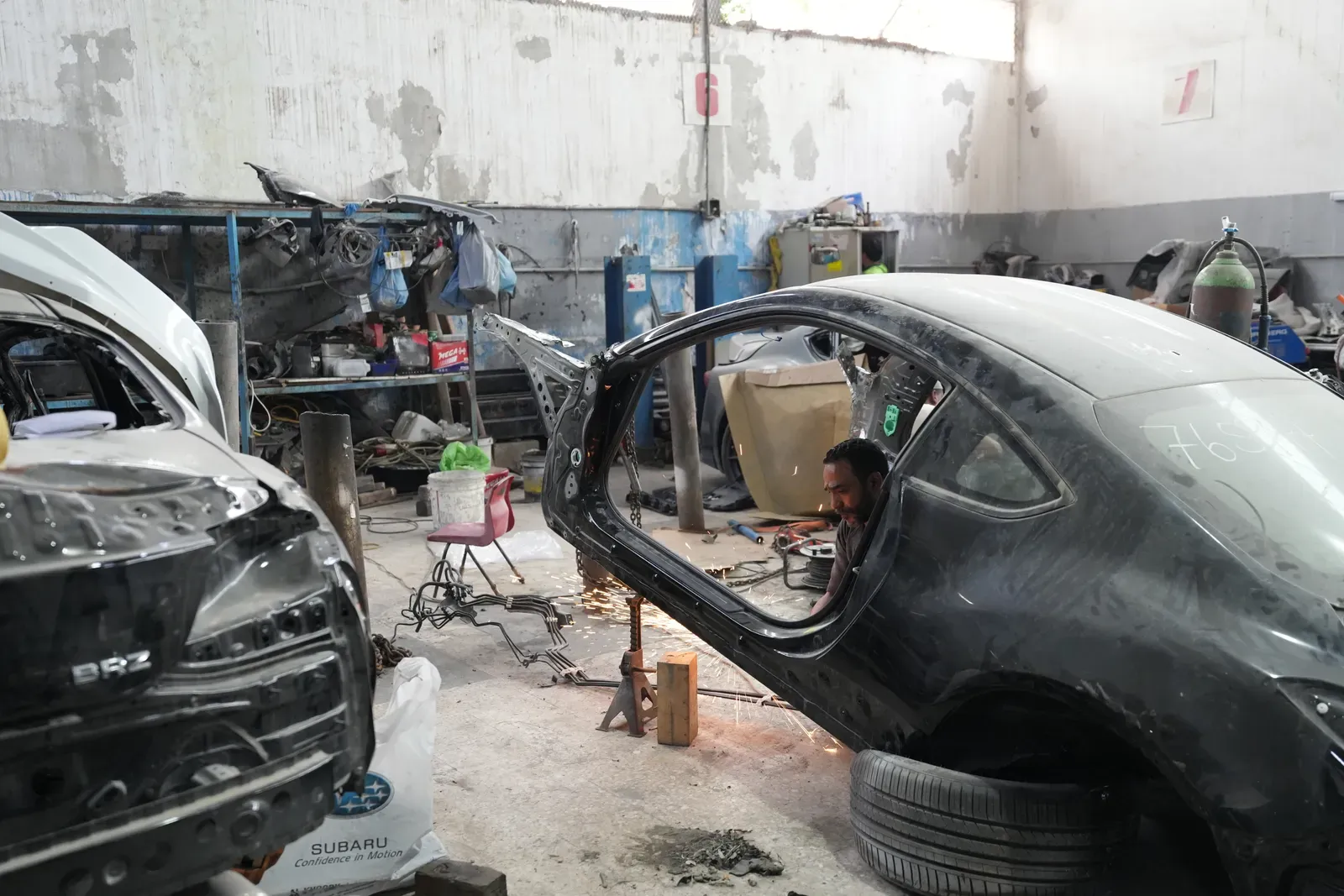
A body shell on axle stands with a technician working inside it.

Every one of these is found on a lift in this building, and priced before it is touched.

The work this usually turns into

And everything else, on the same car

The list above is what this make usually arrives needing. This is the rest of what the workshop does, and it applies to your car as much as to any other — worth knowing while it is already here.

Questions we get asked about these

Is a used C63 a sensible car to buy here?

It depends entirely on which C63, and that is the one question worth answering before any other. The naturally aspirated 6.2 of the earlier cars has two known items that decide the matter — the head bolts of the early production run and camshaft and rocker wear on engines run long on old oil — and both can be looked for directly rather than guessed at. The later 4.0 twin-turbo is a different engine with different concerns, chiefly heat and the oil that lives in the vee with the turbochargers. Either can be a good car. Neither should be bought on the badge, on the service book alone, or without somebody putting it on a ramp first. That is exactly what our pre-purchase inspection is for, and on a car in this price bracket it is the cheapest part of the transaction.

My AMG gearbox shunts when it moves off. Does it need a rebuild?

Usually not, and the reason is worth knowing because it is the thing most often got wrong about these cars. SPEEDSHIFT MCT has no torque converter. AMG replaced it with a clutch pack running in oil, which is what makes the car respond from rest the way it does — and it is also why a shunt reaches your seat instead of being absorbed the way a conventional automatic would absorb it. So the first things to establish are the condition of the fluid and what the clutch adaptation values say, both of which are read, not guessed. A large proportion of these are one proper fluid service and one relearn away from behaving correctly. If yours is genuinely past that, the adaptation figures will say so before anything is opened, and you will see them.

Does an AMG need a different oil from a normal Mercedes?

A different specification in some cases and a noticeably different quantity in most of them. These engines hold considerably more oil than the standard engine in the same body, enough that an AMG filled to a figure taken from the ordinary car is left low — and low oil in an engine working this hard in this heat is the expensive kind of mistake. The approval matters as much as the grade: a viscosity on the bottle is not an approval, and MB 229.5 and its relatives describe what the engine and its exhaust after-treatment were designed around. We fit oil carrying the approval the engine asks for, in the quantity it asks for, and both are written on the invoice so you can check them.

Why does my car lose power in the afternoon but not in the morning?

Because it is almost certainly protecting itself, and that is the design working rather than a defect. A forced-induction engine is limited by the temperature of the air it is compressing, and every one of these was developed in an ambient a long way below a Sharjah afternoon. When the charge air gets too hot, the engine reduces boost and retards its ignition timing to stay out of trouble, and the driver feels that as the car going soft. What separates that from a real fault is data, read on the road at the moment it happens: intake temperature after the cooler, boost requested against boost achieved, and whether the engine is pulling timing. If it is protecting itself, we will tell you that and talk about the cooling circuit rather than sell you a part. If it is not, we will show you what is actually failing.

Do I have steel or ceramic brakes, and does it change the price?

It changes it a great deal, and it is established by looking at the car rather than by typing a registration into a catalogue. AMG has offered two-piece floating composite steel discs and carbon ceramic discs on the same model in the same year, they use different pads, and the pad that suits one will ruin the other. There is no honest way to quote a brake job on one of these cars without identifying which is fitted first, so that is what we do before a number is given. If you are holding a quote from anywhere that did not ask, that is worth noticing.

Bring it in and we will find out

Nothing happens to the car until the fault has a name and you have approved the work against it.

Book WhatsApp us Call