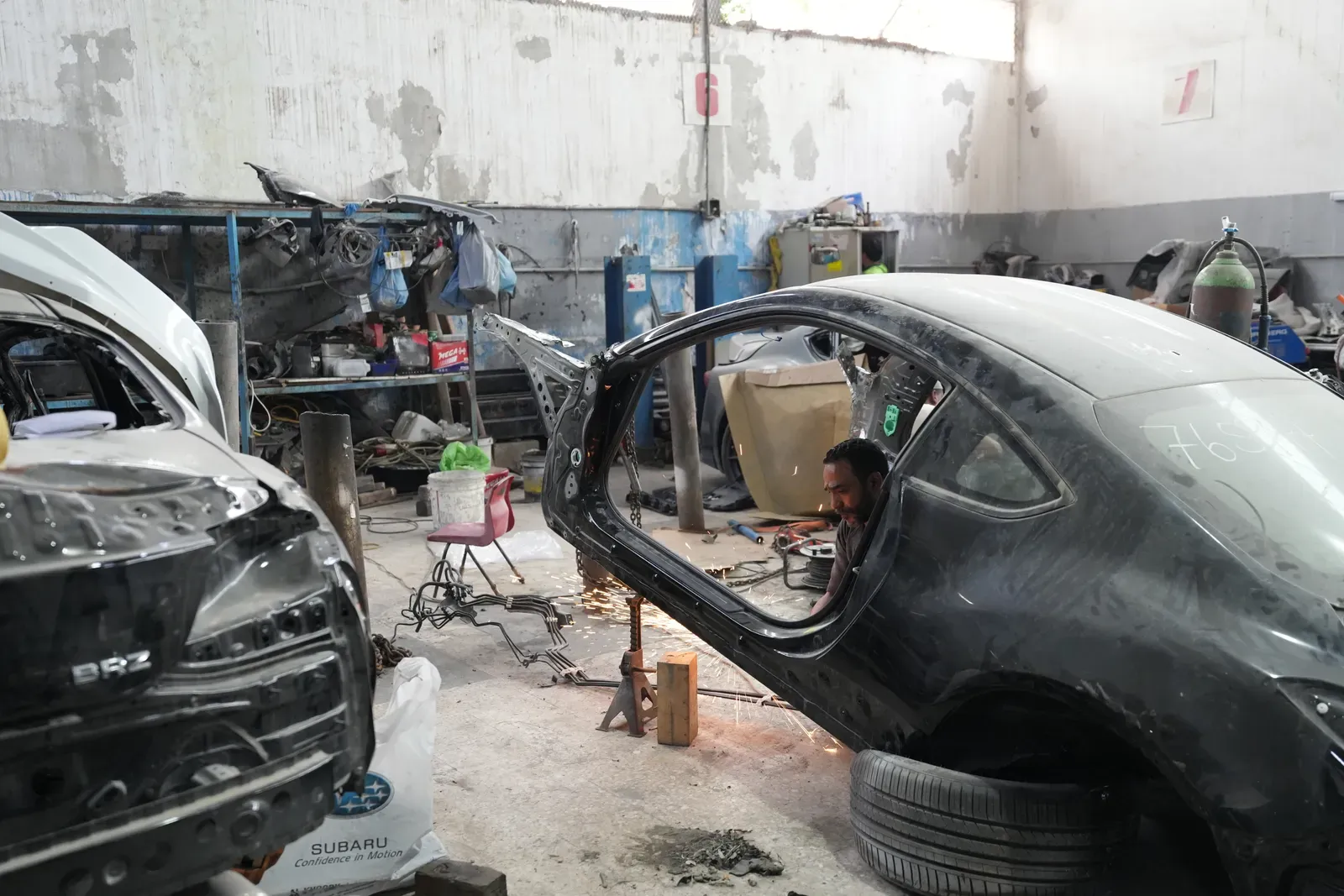
An engine bay open on the workshop floor, photographed close.

Mitsubishi repair and servicing in Sharjah

One question decides most Mitsubishi jobs before any other: belt or chain. The 6G72, 6G74 and 6G75 petrol V6s in the Pajero run a rubber timing belt on an interval, and they are interference engines, which means a snapped belt bends valves. The 4M41 3.2 diesel and the 4B11 and 4B12 fours in the Lancer run a chain instead. Getting that one fact wrong costs an engine, so we settle it from the engine code rather than from the year on the registration card.

Why we see these

The Pajero has been a working vehicle in the Emirates for a very long time, which means the ones reaching a workshop now are not new cars with a fault — they are long-serving cars with a history, often a fourth or fifth owner, and a service record that stops somewhere in the middle. The L200 Triton sits beside it in a different role entirely: a trade pickup that does site work, carries weight it was not always meant to carry, and is expected back on the road the same week. Then there is the Lancer, which is a first car for a great many people here and gets the maintenance a first car gets. Three completely different use patterns under one badge, and they fail in three different places. What they share is that almost nobody has written down when the belt was last done, and on an interference V6 that missing piece of paper is the most expensive unknown in the workshop.

What this make asks of a workshop

  • Belt or chain established from the engine code, never from the age of the car. A 6G72, 6G74 or 6G75 runs a timing belt with a replacement interval; a 4M41 diesel or a 4B11 or 4B12 four runs a chain. The V6 is an interference design, so guessing this is not a cheap mistake.
  • The water pump, the tensioner and the idler pulleys replaced with the belt on those V6s, because they sit behind it. The labour to reach them has already been paid for once, and a pump that fails afterwards takes the new belt with it.
  • Super Select 4WD treated as a vacuum and electrical system before it is treated as a mechanical one. The front differential is engaged by an actuator with vacuum lines, a solenoid and a position switch reporting to a 4WD control unit, and a perished vacuum hose looks exactly like a failed transfer case from the driving seat.
  • CVTF-J4 by name for the Lancer and Outlander CVT. A universal continuously variable transmission fluid off a shelf is not the specification, and this is a unit that punishes the substitution.
  • A ball joint press and the ramp time a Pajero front end takes. On the double-wishbone front the joints are pressed into the arms rather than bolted to them, and quoting that job as if it were a bolt-on item is how a car ends up stranded on a lift.
  • Torsion bar front ends on the Pajero Sport and the L200 reset to the ride height the geometry was designed around after any suspension work, rather than wound up to level a sagging nose.

What actually comes in

Named at component level, with what the driver notices first and what we do to establish it is that and not something else that feels identical from the driving seat.

Timing belt, its tensioner and the water pump behind it — 6G72, 6G74 and 6G75 petrol V6

Often nothing at all until it lets go. Before that there may be a squeal or a chirp from the front on a cold start, a slow weep of coolant down the front of the block, or simply a car whose last belt nobody can account for.

How we establish it

This is the one fault on the make that is cheaper to prevent than to find. We confirm the engine code first, then inspect the belt for glazing, cracking between the teeth and any sign of oil or coolant on it, and check the tensioner and idlers for bearing noise and the water pump for weep at its drain. Where there is no record at all, we say plainly that the safe assumption on an interference V6 is that it is due, and we let you decide with that on the table rather than after the event.

Timing chain guide and tensioner on the 4M41 3.2 DI-D diesel

A rattle from the front of the engine that is loudest on a cold start and does not fully go away, sometimes a whirring that follows engine speed, and a diesel that has started to feel less willing than it used to.

How we establish it

The chain on this engine is not a lifetime item just because it is a chain, and the guide is the part that fails rather than the chain itself. We listen with the engine cold and again warm, read the stored codes, and check oil condition and level, because a chain tensioner that has been fed on overdue oil is being asked to do a job it cannot. We also separate this noise from injector knock and from a worn front pulley, all three of which come from the same end of the engine and sound alike to a driver.

Super Select 4WD front differential actuator, the free-wheel engage solenoid and the transfer position switch

The 4WD indicator on the dash flashes and will not settle, the lever moves but the display never confirms the range, the car stays in two-wheel drive when 4H is selected, or it refuses to come back out of four-wheel drive on tarmac.

How we establish it

A flashing indicator means the control unit asked for a range and the switch never confirmed it, which is a reporting fault as often as a mechanical one. We read the 4WD codes, check the vacuum supply and the lines to the front differential actuator for splits and disconnected fittings, test the solenoid and the position switch electrically, and watch the actuator rod actually move before anything is opened. On a car of this age a perished hose and a corroded switch are far more likely than a transfer case, and they are a different bill entirely.

Pajero double-wishbone front end — upper and lower ball joints and upper arm bushes

A knock from the front over speed bumps, a clunk when the wheel is turned at walking pace, steering that wanders and needs correcting, or an inner edge of a front tyre wearing away while the rest of it looks fine.

How we establish it

On this front end the joints are load bearing and pressed into the arms, so play in one of them shows up as a knock, as wandering and as tyre wear all at once and gets blamed on alignment. The car goes in the air with the wheels hanging and every joint is levered under load in turn until the movement belongs to one component. We also say which items are noise and which are safety before anything is quoted, because on a Pajero those two lists are not the same list.

Lancer and Outlander CVT — CVTF-J4 fluid condition, valve body and step motor

A hesitation of a second or two before the car moves off, a shudder holding a steady speed, revs that climb without the car going with them, or a jolt when it drops back down to a standstill.

How we establish it

Mitsubishi names a fluid for this unit and the name matters, so the first thing established is what is actually in it and what condition that fluid is in. We read the transmission codes and watch ratio control and fluid temperature on live data while the car is driven at the speed the complaint appears at, rather than judging it stationary. Where the unit itself is worn we will say so, because a fluid and filter service sold against a worn belt and pulley set is money spent on a delay, not on a repair.

MIVEC oil control valve and chain tensioner on the 4B11 and 4B12 four-cylinders

A rough idle when the engine is hot, a flat spot in the middle of the rev range, a cam timing code that returns after the light has been cleared, or a short rattle on start-up.

How we establish it

Variable valve timing on these engines is worked by oil pressure through a control valve, so the fault is as often the oil and the screen in front of that valve as the valve itself. We compare commanded against actual cam position in live data with the engine hot, check the valve circuit for supply and signal, and inspect the filter screen and the oil condition. On an engine with a chain, a rattle that appears only in the first second is treated as a tensioner question and not dismissed because chains are supposed to last.

Glow plugs, injector seat leaks and EGR carbon on the 4D56 and 4N15 diesels — L200 Triton and Pajero Sport

Long cranking on a cool morning, a diesel knock that is louder than it should be, black soot around an injector on the head, white smoke for the first minute, or a loss of pull under load with a warning light.

How we establish it

We test each glow plug for resistance and check that the control circuit is energising them for the time it should, rather than replacing a set because one cylinder is slow. Black soot tracking up around an injector is a leaking seat washer and it is worth catching early, because left alone the seat itself suffers. On the exhaust gas recirculation side we read live data for commanded against actual valve position before anything is removed, so a carboned valve is distinguished from a sensor telling the truth about a healthy one.

Viscous fan coupling, radiator core and the condenser fan on the Pajero under desert load

The gauge climbs while crawling, towing or in soft sand and drops again on the open road, the air conditioning goes warm at a standstill, and the fan is quiet at temperatures where it ought to be roaring.

How we establish it

A viscous coupling does not fail with a code, it just stops locking up, and the only symptom is a car that cools perfectly well as long as it is moving. We check the coupling for drag hot and cold, look through the core rather than at it for fins packed with dust and for bent or blocked sections, pressure-test the cooling system for the slow leak that has been topped up all year, and check that the condenser fan is commanded on with the air conditioning. Then we name the one that is failing rather than recommending the whole front of the car.

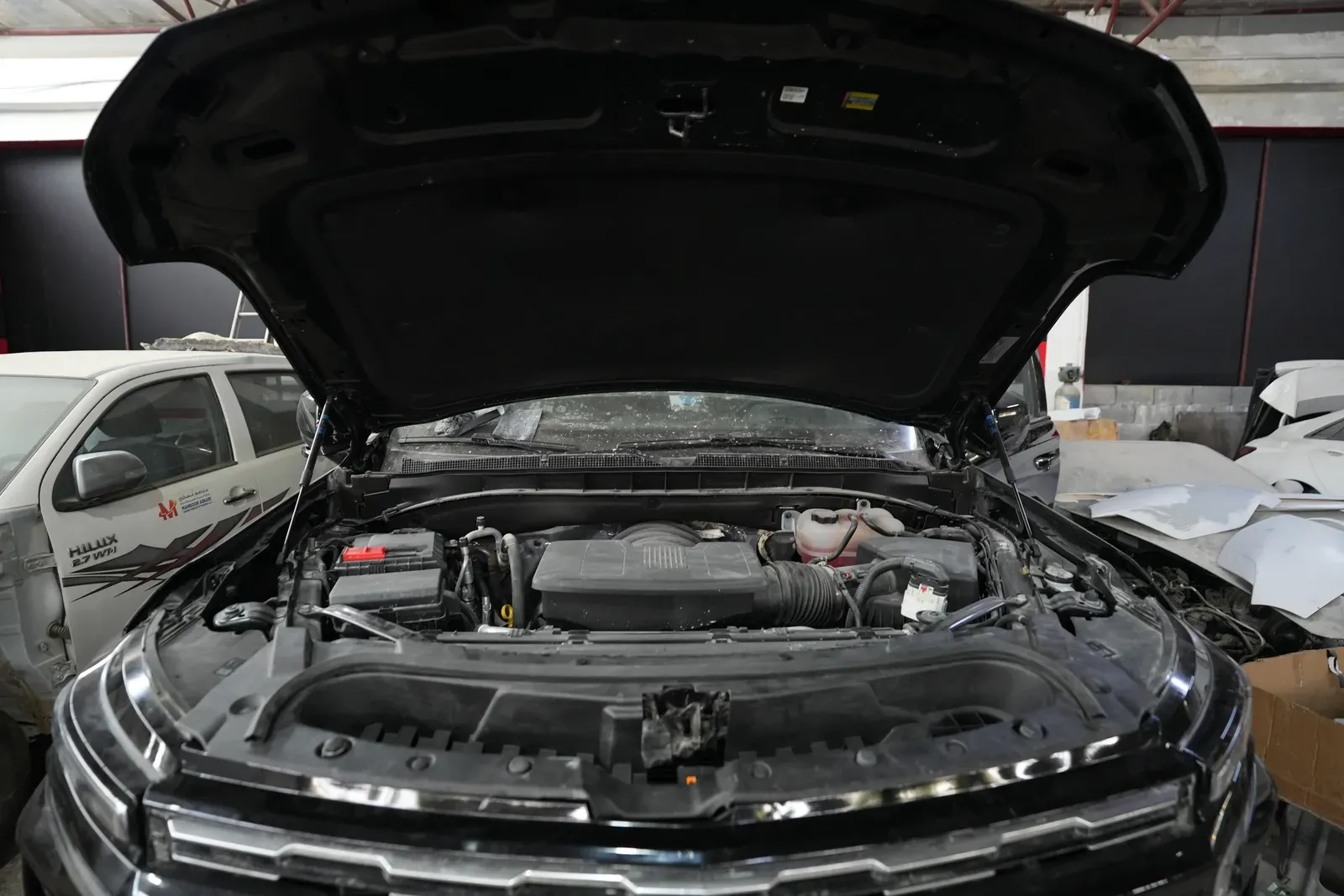
A body shell on axle stands with a technician working inside it.

Every one of these is found on a lift in this building, and priced before it is touched.

The work this usually turns into

And everything else, on the same car

The list above is what this make usually arrives needing. This is the rest of what the workshop does, and it applies to your car as much as to any other — worth knowing while it is already here.

Questions we get asked about these

Does my Pajero have a timing belt or a timing chain?

It depends on the engine, not on the model name or the year. The 6G72, 6G74 and 6G75 petrol V6s use a rubber timing belt that is a replacement item on an interval. The 4M41 3.2 diesel uses a chain. The petrol V6 is an interference engine, so if that belt breaks the valves and pistons meet and the repair is an engine rather than a belt. We identify the engine from the car before we tell you which of those two you own, because this is exactly the fact that is worth being certain about rather than approximately right about.

A previous owner says the belt was done, but there is no paperwork. What now?

We inspect what can be inspected — the belt for glazing and cracking between the teeth, any oil or coolant contamination on it, the tensioner and idlers for bearing noise, and the condition of the covers and fasteners, which often say whether the front of the engine has been opened before. That gives an informed opinion rather than a date. What we will not do is tell you it is fine because someone said so. On an interference V6 the safe assumption where there is no record is that the interval is unknown, and unknown is treated as due.

The 4WD light flashes and it will not engage. Is the transfer case gone?

Usually not, and that is worth establishing before anyone opens one. A flashing indicator on Super Select means the control unit asked for a range and never received confirmation from the position switch. The front differential is engaged by an actuator that runs on vacuum, with a solenoid and hoses in between, and any one of those can break the chain without a single gear being worn. We read the codes, test the vacuum supply and the switch, and watch the actuator move before we go near the gearbox. If it does turn out to be mechanical we will show you why we concluded that.

My Lancer shudders and hesitates before it moves. Is that the CVT?

It may be, and the first question is what fluid is in it and what condition it is in. Mitsubishi specifies CVTF-J4 for these units by name, and a generic continuously variable transmission fluid is not a substitute for it. But hesitation and shudder can also come from the engine side — a misfire under light load feels very similar from the driving seat. We drive the car with live data recording so we can watch ratio control, fluid temperature and misfire counters together, and whichever one is moving is the one you are paying to fix.

The Pajero knocks over bumps and pulls to one side. Is it just alignment?

Alignment cannot hold a setting on a front end that has play in it, so setting the angles first is money spent twice. On this suspension the ball joints carry the load and are pressed into the arms, and a worn one produces the knock, the pull and the inner-edge tyre wear together, which is why all three often arrive as one complaint. We put the car in the air and load each joint by hand and by bar until the movement belongs to one component, replace what is worn, and then set the geometry — in that order.

Bring it in and we will find out

Nothing happens to the car until the fault has a name and you have approved the work against it.

Book WhatsApp us Call