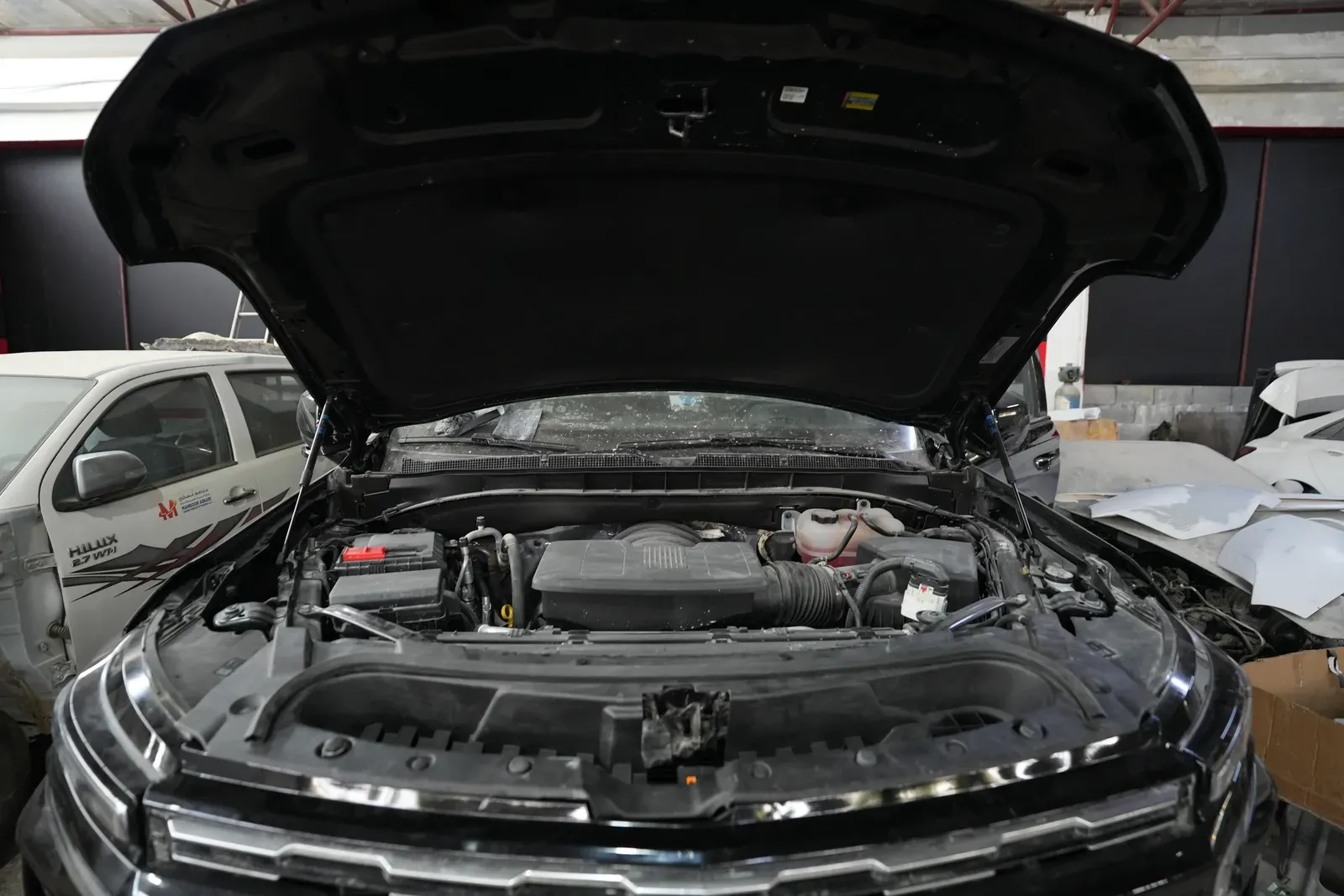
An engine bay open on the workshop floor, photographed close.

Porsche repair in Sharjah

With a Porsche the build year matters more than the odometer. A flat-six from the M96 and M97 era carries an intermediate shaft bearing and a cylinder coating that the 9A1 engine from 2009 does not, and a Cayenne V8 carries a coolant pipe design that changed twice. So the first thing we establish is which engine and which generation is actually in front of us, and the second is what that specific combination is known to do.

Why we see these

Two very different populations answer to the badge in the northern Emirates. The Cayenne, and lately the Macan, are ordinary daily transport here — heavy, used as family cars, and worked hard enough that their V8 cooling and their four-wheel-drive hardware wear on a real clock. The 911, the Cayman and the Boxster are the opposite: kept as second cars, driven at the weekend, and often parked for weeks between outings. That idleness is its own kind of wear. Seals that are never wetted with oil harden, a battery left connected to a car that never fully charges it is finished inside a year, tyres age out long before the tread does, and brake discs that live in humid coastal air corrode at the edge while the pads look new. And because a large share of these cars arrive as used imports, the service history that would tell us whether the intermediate shaft bearing was ever touched usually does not come with them, which is exactly the history that matters most on the older flat-six.

What this make asks of a workshop

  • The engine family established from the vehicle data before any advice is given. An M96, an M97 and a 9A1 look similar in the back of the car and have different known failure modes — the 9A1, from 2009, has no intermediate shaft at all, and repeating the bearing story on one of those wastes an owner’s money.
  • A lift and a low-approach ramp. These cars have front lips, low sills and specific jacking pads, and a flat-six that has to come out for internal work needs the car high enough and long enough to do it properly rather than quickly.
  • Brake system identified before a brake job is priced. A car on Porsche Ceramic Composite Brakes needs pads made for that disc and nothing else, and the wear criterion for a ceramic disc is not the one used on a cast-iron one. We tell you which system your car has, because it changes the size of the conversation entirely.
  • PDK treated as a serviceable gearbox. Porsche publishes a fluid and filter interval for it, the refill goes in to specification, and the clutch adaptation is reset afterwards — a dual-clutch box that has been drained and filled without that step drives worse than before it was touched.
  • Coolant work on a V8 Cayenne quoted with the access included. The pipework that fails sits in the valley under the intake, so the manifold is off before anybody can see it, and pretending otherwise turns into a phone call on day two.
  • Suspension set to the car’s own ride-height figures. On air-sprung Cayennes and Panameras the height is a value the module holds and the car is reset to it after any strut, link or level sensor is disturbed, not judged by eye at the kerb.

What actually comes in

Named at component level, with what the driver notices first and what we do to establish it is that and not something else that feels identical from the driving seat.

Intermediate shaft (IMS) bearing on the M96 and M97 flat-six — 996 and 997.1 Carrera, 986 and 987.1 Boxster and Cayman

Often nothing at all until it is late. Where there is a warning it is a faint rumble from behind the driver at idle, metallic glitter in the oil filter, or an oil weep from the centre of the engine at the gearbox face.

How we establish it

The useful work here is separating what is true from what the internet has made of it. The bearing is a real failure mode on these engines and it is a minority one; nobody can quote you odds for your specific car, and we will not pretend to. What we can do is look. The oil filter is cut open and the media examined for ferrous debris, the drained oil is checked with a magnet, and the engine is listened to at idle from underneath. The year and the engine number then decide what is even possible: on the earlier cars the bearing can be changed with the gearbox off, while on the later single-row unit it is not a bolt-on job and the answer is usually to monitor rather than to open the engine. If your car is a 2009-on 9A1 there is no intermediate shaft to worry about and we will tell you that instead of selling you a retrofit.

Cylinder bore scoring in the Lokasil liners of the M96 and M97 — commonly cylinder six on the 3.6 and 3.8

A tick or a light knock from one side of the engine for the first minute from cold that fades as it warms, oil consumption climbing, a smell of exhaust in the cabin and grey smoke on a cold morning.

How we establish it

This is found by looking, not by argument. A borescope goes down each spark plug hole with the piston driven clear, and the thrust side of the liner is inspected cylinder by cylinder — scoring shows as vertical marks and it is visible long before the engine is unsaleable. We back that up with a cylinder leak-down test to hear where the air is going, and with the oil consumption figure the owner has actually been recording. The reason this matters more than most engine diagnostics is that the answer is either a monitored car or a rebuild, with nothing sensible in between, and an owner deciding between keeping the car and selling it deserves that answer from inside the engine rather than from a forum thread.

Air-oil separator (AOS) and the crankcase breathing system on the flat-six

A cloud of white smoke behind the car on start-up or after a long idle, oil disappearing, a rough idle, and sometimes a whistle from the engine bay.

How we establish it

A collapsed diaphragm in the separator lets manifold vacuum pull oil out of the crankcase and burn it, and when it fails the other way the crankcase is left pressurised and pushes oil out of every seal it can find — including the one behind the flywheel, which then gets blamed. The test is a crankcase pressure measurement at the oil filler with the engine idling and a manometer, read against Porsche’s own figure for the engine. That single reading separates a separator from a set of seals, and it is the reason we will not quote a rear main seal on a car that has never had its breathing checked.

Rear main seal and the flywheel-face oil leak on the flat-six

Fresh oil drips appearing under the middle of the car after it has been parked, a burnt oil smell at the rear, and an oil level that falls with nothing else to explain it.

How we establish it

Three different leaks arrive at the same place on these engines and drip from the same seam: the seal behind the crankshaft, the intermediate shaft flange next to it, and the oil that runs down from higher up. Telling them apart matters, because one of them means the gearbox comes off and one of them does not. We degrease the area, add a trace dye to the oil, run the car and then look with an ultraviolet light at where the fresh oil actually starts. Crankcase pressure gets checked in the same visit, because a blocked breather is a common reason a seal that was fine last year is pushing oil this year, and replacing the seal without fixing that gets it back on the ramp.

Coolant crossover pipes in the valley of the Cayenne V8 — plastic on the 4.5 of the 955, adhesive-bonded on the 4.8 of the 957 and 958

Coolant loss with no visible leak, steam or a sweet smell from under the bonnet, and in the worst version the whole system emptying onto the road within a minute.

How we establish it

The pipework that carries coolant across these engines sits down in the valley of the V, underneath the intake manifold, where nothing leaks visibly and everything leaks eventually. On the earlier 4.5 the pipes themselves are plastic and go brittle with heat cycling; on the 4.8 the joint between pipe and housing is bonded, and an adhesive joint that has been heat-cycled for a decade lets go without warning rather than weeping first. We pressure-test the cooling system cold and hold it, and where pressure falls with nothing on the ground we say plainly that confirming it means the manifold comes off, so that the access cost is agreed before the car is opened and not discovered afterwards. If the pipes are already the later metal parts, we say that too and go looking elsewhere.

Transfer case servo motor and chain on the 9PA Cayenne — the 955 and 957

A four-wheel-drive or transfer case warning on the dash, the car refusing to leave low range or refusing to enter it, a grinding from the middle of the car, and sometimes limited drive.

How we establish it

Two different faults produce almost the same message and they cost very different amounts. The servo motor that shifts the range is an external unit and it fails on its own; the chain inside the transfer case stretches and wears its sprockets, which is an internal repair. We read the fault memory of the four-wheel-drive module for range-position and motor-circuit faults, command the range change and watch the position feedback while it is happening, and check the motor for the water ingress that kills it. Where the feedback moves correctly and the noise is still there, it is the chain, and we say so before anybody orders a motor and fits it into the same complaint.

Self-levelling air suspension — the compressor, its dryer and the axle level sensor linkages on the 955, 957 and 958 Cayenne and the 970 Panamera

The car sits low at the back overnight and pumps itself up after starting, the height selector will not raise it, or a suspension fault message appears and the ride locks at one setting.

How we establish it

The compressor on these is a small pump with a duty cycle and a desiccant dryer, and in dusty, humid coastal air the dryer saturates and the moisture that gets past it corrodes the valves downstream. So we do not start at the compressor. The four height values are read live and logged overnight to see which corner actually falls and how fast, the system is pressure-held with the engine off, and the level sensor arms are inspected for the snapped plastic ball joints that make a perfectly good strut report the wrong height. Then, and only then, do we say whether the answer is a strut, a valve block, the dryer or the compressor itself.

PDK dual-clutch gearbox — the mechatronic hydraulic unit, its fluid and the clutch adaptation

A jerk or a shunt on a downshift, a hesitation before the car takes up drive, a gearbox warning with the car dropping into a limited programme, or a shudder at very low speed in traffic.

How we establish it

PDK is not sealed for life and the fluid in one that lives in this heat is not the fluid a European interval assumes. We road test with gearbox live data on screen — clutch temperatures, the pressures the unit is commanding, and the adaptation values it has learned for each clutch — so the complaint is tied to one clutch and one shift rather than to the gearbox as a whole. A shudder that only appears when the fluid is hot behaves differently from a solenoid fault, and a box that has recently been drained and refilled without its adaptation reset behaves like both. Where fluid condition is the honest answer on a car that has never had a gearbox service, that is what we say, and the relearn is part of the job rather than an extra line.

Porsche Ceramic Composite Brake (PCCB) discs and their matched pads, identified before a brake job is quoted

A grinding or a squeal, a brake wear warning, or simply a car due for pads where the owner has been quoted a figure that does not sound like a brake job.

How we establish it

The first job is identification, and it is not a formality. Yellow calipers and a ceramic disc mean a system that behaves differently from the iron one: it uses pads formulated for that friction surface and no others, the disc wears at its coating rather than by losing thickness the way an iron one does, and Porsche specifies a different wear criterion for it. We confirm from the vehicle data and from the disc itself which system is fitted, then tell you what that means for cost and for parts availability before anything is ordered. Where a car has been running the wrong pads on a ceramic disc, that is worth knowing before the next set goes on, and where a car has ordinary iron discs and someone has quoted it as ceramic, that is worth knowing too.

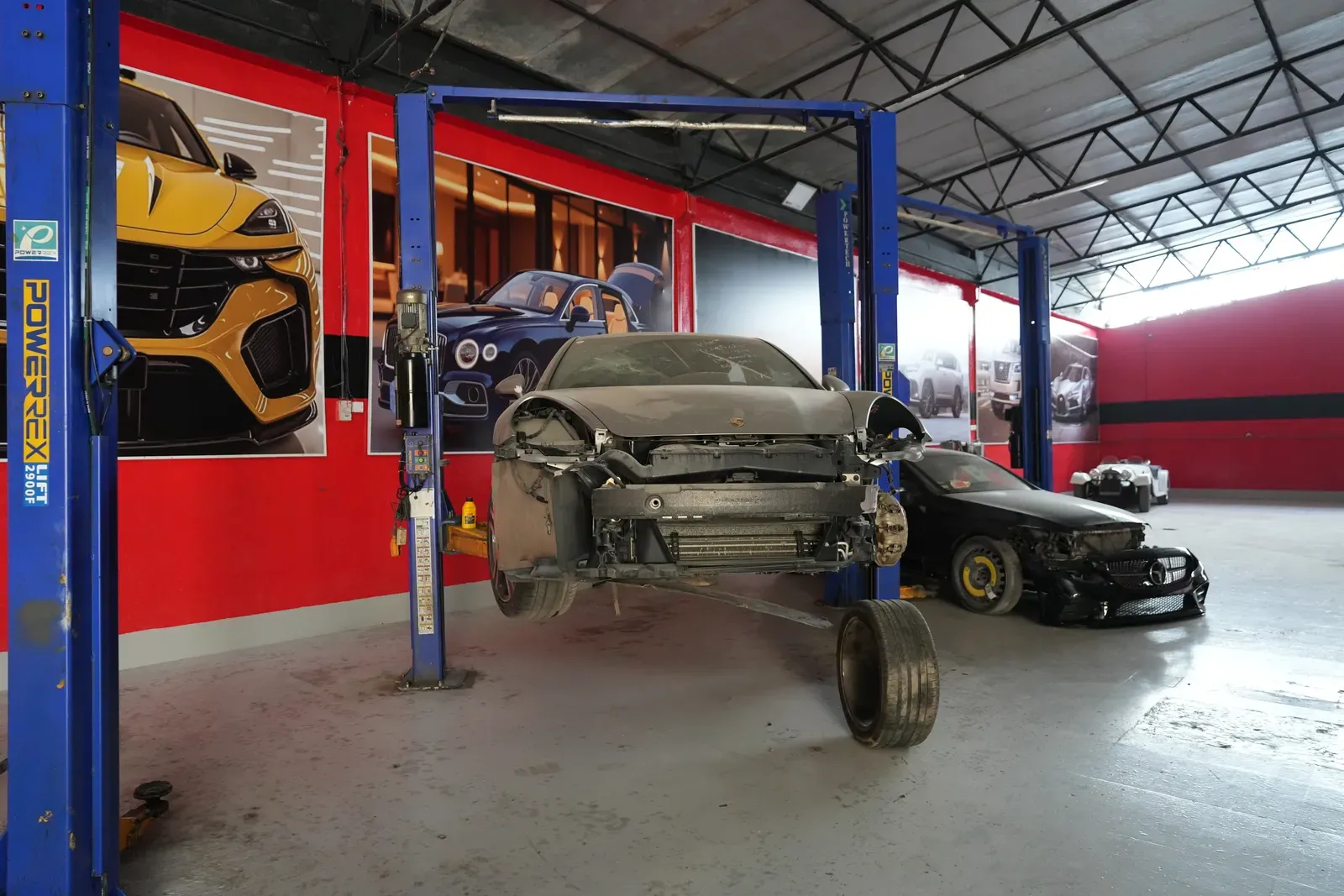
A car on a two-post lift with its front end stripped.

Every one of these is found on a lift in this building, and priced before it is touched.

The work this usually turns into

And everything else, on the same car

The list above is what this make usually arrives needing. This is the rest of what the workshop does, and it applies to your car as much as to any other — worth knowing while it is already here.

Questions we get asked about these

Should I have the IMS bearing replaced as a precaution?

Only after two questions are answered, and neither of them is about fear. First, does your car have an intermediate shaft at all — from 2009 the 9A1 engine does not, so on those cars there is nothing to retrofit and anybody offering it is selling you a part your engine has no place for. Second, if it does, which bearing is in it: on the earlier cars a replacement is a defined job done with the gearbox off, while the later single-row bearing is not accessible without opening the engine, and for most owners of those cars the sensible answer is regular oil inspection rather than speculative surgery. We will give you the answer for your chassis and engine number, including "leave it alone and watch the oil" where that is the honest one.

How do I know if my engine has bore scoring without taking it apart?

You look inside it through the spark plug holes. A borescope inspection is done with the engine in the car, cylinder by cylinder, and scoring on the thrust side shows as vertical marks on the liner well before the engine becomes undriveable. It is supported by a cylinder leak-down test and by the oil consumption the car has actually been showing. This is the single most useful thing to have done to an older flat-six before deciding whether to keep it, because the outcome is either a car you can plan around or a rebuild, and knowing which is worth more than any opinion about the model.

Does PDK fluid really need changing?

Yes. Porsche publishes an interval for the fluid and filter; "sealed for life" is a phrase that travelled through the trade, not an instruction from the factory. There are two things that matter more than the interval itself. One is that this gearbox lives at a fluid temperature here that a European figure was never set for, so the interval is a ceiling rather than a target. The other is the refill: the fluid goes in to the specified level and the clutch adaptation is reset afterwards, and a box that has been drained and filled without that step will shift worse than it did before, which is how a service gets blamed for breaking a gearbox it did not break.

My Cayenne lost all its coolant on the road. What happened?

On a V8 Cayenne the first place to look is the coolant pipework in the valley of the engine under the intake manifold. On the earlier 4.5 the pipes are plastic and go brittle; on the 4.8 the joint between the pipe and its housing is a bonded one, and a bond that has heat-cycled for years tends to release all at once rather than weep first, which is why owners describe it as sudden. The important practical point is that an engine that has been run hot after losing its coolant has a second problem now, so we check for that as well rather than fitting pipes and handing the car back. Access is through the manifold either way, and we quote it with that included.

Can you code a replacement key or a security module for a Porsche?

No, and we would rather be clear about the boundary than vague about it. Keys and immobiliser modules on these cars are paired against a manufacturer security system whose data is released through a franchised channel, so that work belongs to the dealer and no amount of effort on our side changes it. We also do not claim to own or hold a licence for any manufacturer’s dealer software. What we do is tell you honestly, before you book, whether your particular job can be finished here with the adaptations and resets it needs, or whether it has to go to the franchise — and we are not approved, authorised or appointed by Porsche in any case.

The car sits for weeks at a time. What does that do to it?

More than most owners expect, and it is different from the wear that comes from driving. A modern Porsche never fully goes to sleep, so a battery left connected to a car that is not driven is being slowly drained and rarely fully recharged, and it fails early. Seals that are never wetted with circulating oil harden and then weep on the first proper drive. Tyres age out of usefulness on a date rather than on a tread, and discs corrode at the edge in humid coastal air while the pads still look new. If your car lives like this, tell us, because it changes what we look at first: the list for a low-mileage car that stands is not the list for a high-mileage car that works.

Bring it in and we will find out

Nothing happens to the car until the fault has a name and you have approved the work against it.

Book WhatsApp us Call