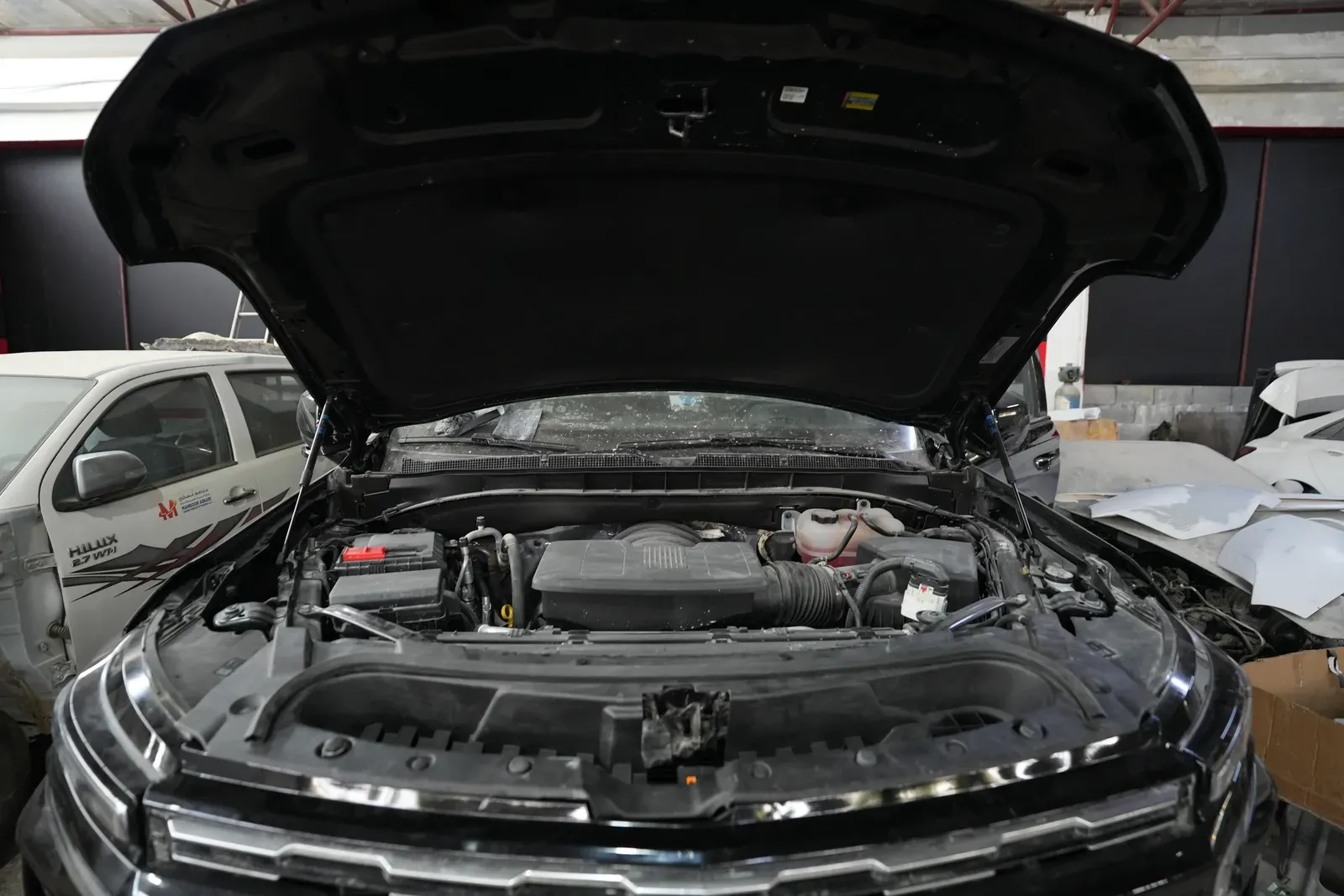
An engine bay open on the workshop floor, photographed close.

MG servicing and repair in Sharjah

One badge on the boot, several completely different cars underneath. A ZS can leave the factory with a 1.5 and a four-speed automatic, a 1.5 with a CVT, or a 1.3 turbo three-cylinder with a six-speed — and an HS carries a 1.5 turbo and a seven-speed wet dual clutch, which is a different machine again. Almost every wrong quote on one of these starts with somebody not asking which one is on the ramp.

Why we see these

Of the Chinese-owned marques on this hub, MG has been on the road here the longest, and that shows up in a way that matters to an owner rather than to a brochure: there is a real independent supply of parts for one, sitting in the industrial areas of this emirate alongside the agency channel, and for common items you can be given a price and a day rather than a shrug. Against that, the cars are young. Most of what reaches us is a first car, a second family car or a small fleet vehicle doing high mileage in city traffic, and the oldest examples have not yet lived long enough for anybody to know honestly how they wear at high distance in this heat. Any workshop telling you what an MG looks like at two hundred thousand kilometres in Sharjah is guessing, and we would rather say we do not know yet.

What this make asks of a workshop

  • Which car it actually is, established from the build data and not from the badge. ZS versions have been built with a four-speed torque-converter automatic, with a CVT and with a six-speed, and the three of them answer the complaint “it feels wrong when it pulls away” in three different ways.
  • The seven-speed dual clutch in the HS and RX5 treated as a wet clutch, which is what it is. It runs in its own oil, it has a filter, and almost everything written on the internet about dual-clutch gearboxes was written about dry ones and does not apply to it.
  • A parts answer with a channel and a day attached. For these cars a part comes from the agency, from the Chinese-parts trade established in the industrial areas here, or not at all — and which of the three it is should be said before the car is taken apart, not after.
  • Software recognised as software. A head unit that reboots itself, a cluster that drops out or a module that needs a calibration after a repair is not a mechanical fault and not something a workshop fixes by fitting parts, and being told that plainly saves an owner more money than any diagnosis.
  • The severe-use service column as the default on the turbocharged cars, because a small turbocharged engine doing short journeys in standing traffic at 45°C is working its oil far harder than the distance on the odometer suggests.
  • An honest position on what is not yet known. These are young cars here, and a fault list for them should be short and evidenced rather than long and assumed.

What actually comes in

Named at component level, with what the driver notices first and what we do to establish it is that and not something else that feels identical from the driving seat.

Oil and filter in the seven-speed wet dual clutch (HS, RX5)

A shunt or a hesitation pulling away from a junction, a gearbox that behaves differently cold than hot, and sometimes a message on the dash after a long crawl in traffic.

How we establish it

This gearbox runs its clutches in oil, which means the oil is doing the cooling as well as the lubricating, and a car that lives in stop-start traffic asks more of it than a distance reading suggests. So the first questions are what is in it, how old it is and what condition it comes out in — and whether the filter was changed with it or left, which is where a fluid service quietly becomes half a service. Alongside that we read the clutch adaptation values and where the actuator believes the clutch bites, run the learning procedure and drive the car again, because a great many of these complaints are a control question and not a worn clutch pack. Nobody should be pricing a clutch off a description of a hesitation.

The four-speed torque-converter automatic behind the 1.5 naturally aspirated engine (ZS)

It feels like it is searching on a gentle climb, the engine revs rise before the car does, and it holds a gear on the flyover longer than the driver expects.

How we establish it

A great deal of the advice an MG owner finds online is written about the dual clutch and is simply not about this car. The naturally aspirated ZS in this specification drives through an old-fashioned automatic with four ratios and a torque converter, and four ratios behind a modest engine genuinely does hunt on a gradient — that is the gearbox working as designed and not a fault to be repaired. What is worth checking is the fluid and its condition, the converter lock-up behaviour on live data at a steady throttle, and whether the complaint changes with air-conditioning load. We will say when the answer is that the car is behaving normally, because on this one it often is.

Charge-air cooler, its pipework and the clamps on the 1.5 turbo (15E4E)

It goes flat on an overtake and picks up again after it is switched off and restarted, sometimes with the engine light on and sometimes with nothing on the dash at all.

How we establish it

On a small turbocharged engine the air has to travel from the turbocharger, through the cooler and back to the inlet through joints that expand and contract every time the car is driven and parked in this climate. A joint that has let go gives exactly this complaint, and it costs a clamp. So the boost pipework is pressure tested as a circuit before anybody talks about a turbocharger, and requested boost is compared with actual boost on live data on the road rather than judged from the driver’s seat. We also look at the front of the cooler with a light, because a matrix packed with dust does the same thing on a hot afternoon and washes off.

Head unit and instrument display software — freezes, reboot loops and a screen that will not wake

The screen goes black and comes back on its own, the reversing camera does not appear in time, the radio restarts itself mid-journey, or the whole display is frozen on the logo.

How we establish it

This is common enough on these cars to be worth saying out loud, and it is the fault where an owner is most likely to be sold hardware for a software problem. We check the obvious physical causes that are genuinely ours — the supply and earth to the unit, the connector behind it, and whether the symptom followed an accessory being fitted — and we read the network for a module dropping off the bus, which makes a screen behave like this without the screen being at fault. Beyond that, the remedy for a head unit in a reboot loop is usually a software version, and that is an agency job. We will tell you so and we will not charge you to find that out twice.

Idle vibration on the 1.3 three-cylinder turbo, and whether the mounts are actually at fault

It shakes at a traffic light with the air conditioning on, settles as soon as it moves, and feels worse to a driver who came from a four-cylinder car.

How we establish it

A three-cylinder engine is not naturally balanced the way a four is, and a certain amount of shake at idle with the compressor loaded is the nature of the engine rather than a defect. That has to be separated from a mount that has actually collapsed, and it is separated by looking, not by opinion: the engine is watched as drive and reverse are selected against the brake, the mounts are inspected for split rubber and for fluid loss where they are hydraulic, and misfire counters are read per cylinder, since on three cylinders one weak one is felt far more than it would be on four. Where the answer is that the engine is behaving as built, that is what you will be told.

Continuously variable transmission fluid in the versions that carry a CVT (MG5, and ZS versions so equipped)

The engine note rises and stays there while the car catches up, a shudder on a light throttle at low speed, or a whine that comes and goes with road speed.

How we establish it

The rising engine note without a change of gear is what a CVT does and is not a fault, and telling an owner that is the first job. What is a fault is a shudder or a slip, and on this type of gearbox both point at fluid before they point at anything else, because the fluid is what holds the belt against the pulleys. It takes a specific CVT fluid and nothing else — a general automatic transmission fluid will destroy it — so the specification is read off the car before a drop goes in. We check condition, temperature under load on the road and any stored codes, and where a CVT is genuinely slipping we say what that costs rather than selling a flush that will not save it.

Front strut top mounts and coil springs on the ZS and HS over Sharjah speed bumps

A knock or a creak at the top of the strut when turning into a parking space, a clonk over a bump that the driver feels through the steering wheel rather than the floor.

How we establish it

A noise felt through the steering wheel comes from the top of the strut far more often than from the bottom, which is the opposite of where most people look first. The car goes up, the spring is inspected along its whole length for a broken lower coil — easy to miss and common on a car that meets a lot of bumps loaded — and the top mount bearing is turned by hand with the load off and listened to on lock with the load on. Both sides are inspected and only the side that is actually at fault is quoted. A strut job resets the front geometry, so alignment follows it, and we say that at the counter.

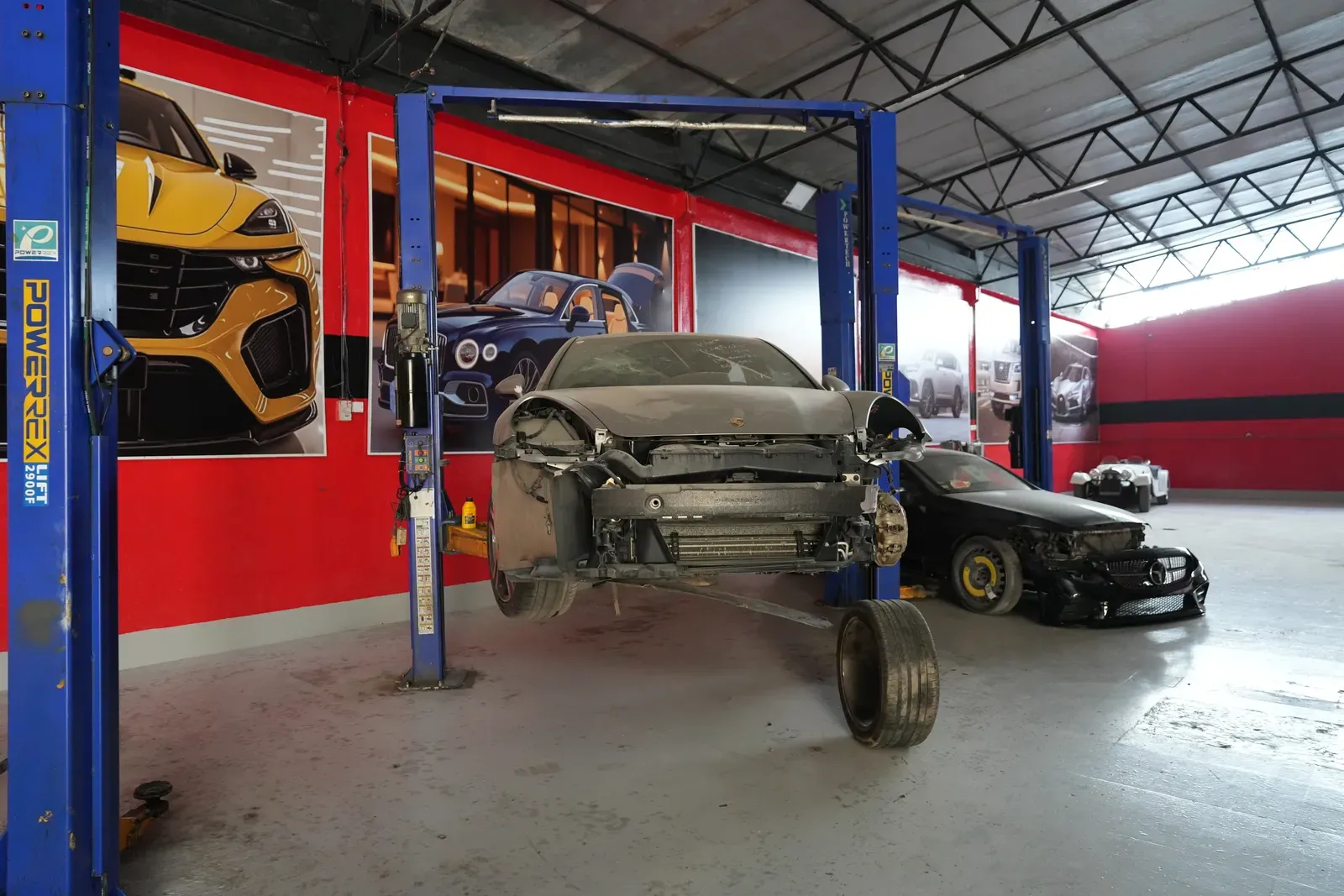
A car on a two-post lift with its front end stripped.

Every one of these is found on a lift in this building, and priced before it is touched.

The work this usually turns into

And everything else, on the same car

The list above is what this make usually arrives needing. This is the rest of what the workshop does, and it applies to your car as much as to any other — worth knowing while it is already here.

Questions we get asked about these

Can an independent workshop actually get parts for an MG here?

For a good many items, yes, and that is not true to the same degree of every marque on this part of the site. There is an established trade in parts for these cars in the industrial areas of this emirate alongside the agency channel, so filters, brakes, suspension parts, common sensors and service items are usually a price and a day rather than a question mark. Body panels, lamps, glass, screens and anything model-year-specific are a different conversation and can be a wait. What we will not do is start a job before that question has an answer — you should be told the channel and the lead time first, and then decide.

Is the dual clutch in the HS going to give trouble?

We are not going to answer that with a figure we do not have. What can be said usefully is that it is a wet dual clutch, so it has an oil and a filter that are service items rather than fill-for-life items, and that stop-start traffic in this climate is the hardest duty any dual clutch does. Keeping the oil and filter to schedule and having the adaptation values read when the car first starts to hesitate — rather than after a year of living with it — is the part an owner controls. Anything beyond that about long-term life would be an invention, because these cars are not old enough here for anybody to know.

My screen freezes and reboots. Should I buy a new head unit?

Not until somebody has ruled out the things that make a healthy screen behave like a broken one. A poor earth, a connector that has been disturbed, an accessory wired into the wrong supply, or another module dropping off the network will all produce this, and none of them is cured by a new unit. Those checks are quick and they are ours to do. If the unit itself is the problem, the remedy is usually a software version rather than a part, and that route runs through the agency — which is what we will tell you, rather than fitting hardware and hoping.

Why is my ZS so slow to change gear compared with my friend’s?

Because they are probably not the same car. The ZS has been built with a four-speed torque-converter automatic, with a CVT and with a six-speed behind the turbocharged three-cylinder, and those three feel nothing like each other. Four ratios behind a naturally aspirated 1.5 will hunt on a climb and hold a gear longer than a modern six will, and that is the design rather than a fault. We establish which gearbox is in your car from its build data before we agree there is anything wrong with it.

How often should the gearbox oil be changed on the HS?

Take the interval from the handbook for your own model year rather than from us or from a forum, because it has not been the same across all versions and we are not going to invent a number for yours. What we will say is that the severe-use conditions the handbook describes — short journeys, standing traffic, high ambient temperature — describe ordinary driving in Sharjah rather than an exception to it, so the shorter of the two columns is the one that applies to nearly every car here. Bring the book and we will work from it.

Bring it in and we will find out

Nothing happens to the car until the fault has a name and you have approved the work against it.

Book WhatsApp us Call