The dash says Service Air Suspension. Does the whole system have to be replaced?
Almost never. That message means the module could not reach a target height it was asked for, and there are several ordinary reasons for that: a leak at a fitting or an air spring, a height sensor whose linkage has come loose or whose reading has drifted, a dryer that is saturated after years in dust, or a compressor that has been asked to run so long it overheated and was switched off to protect itself. We read the target and measured height for each corner, hold pressure in the system to find the leak, and test each sensor against what the corner actually measures. Replacing a compressor without finding what overworked it is how the same fault comes back in a few months.
My truck will not come out of park. Is that the gearbox?
Usually not, and this is a good example of a cheap fault wearing an expensive face. There is no cable between the dial and the gearbox: the dial is a sensor, a module reads it, and a separate interlock physically holds the dial locked until the brake switch and the transmission both agree it is safe to move. So the first suspect is the brake light switch and its circuit, which is inexpensive and common. After that it is the interlock itself, then the shift module, and only then anything inside the gearbox. We test in that order and tell you which one it was.
Do you work on the EcoDiesel, and is it hard to get parts here?
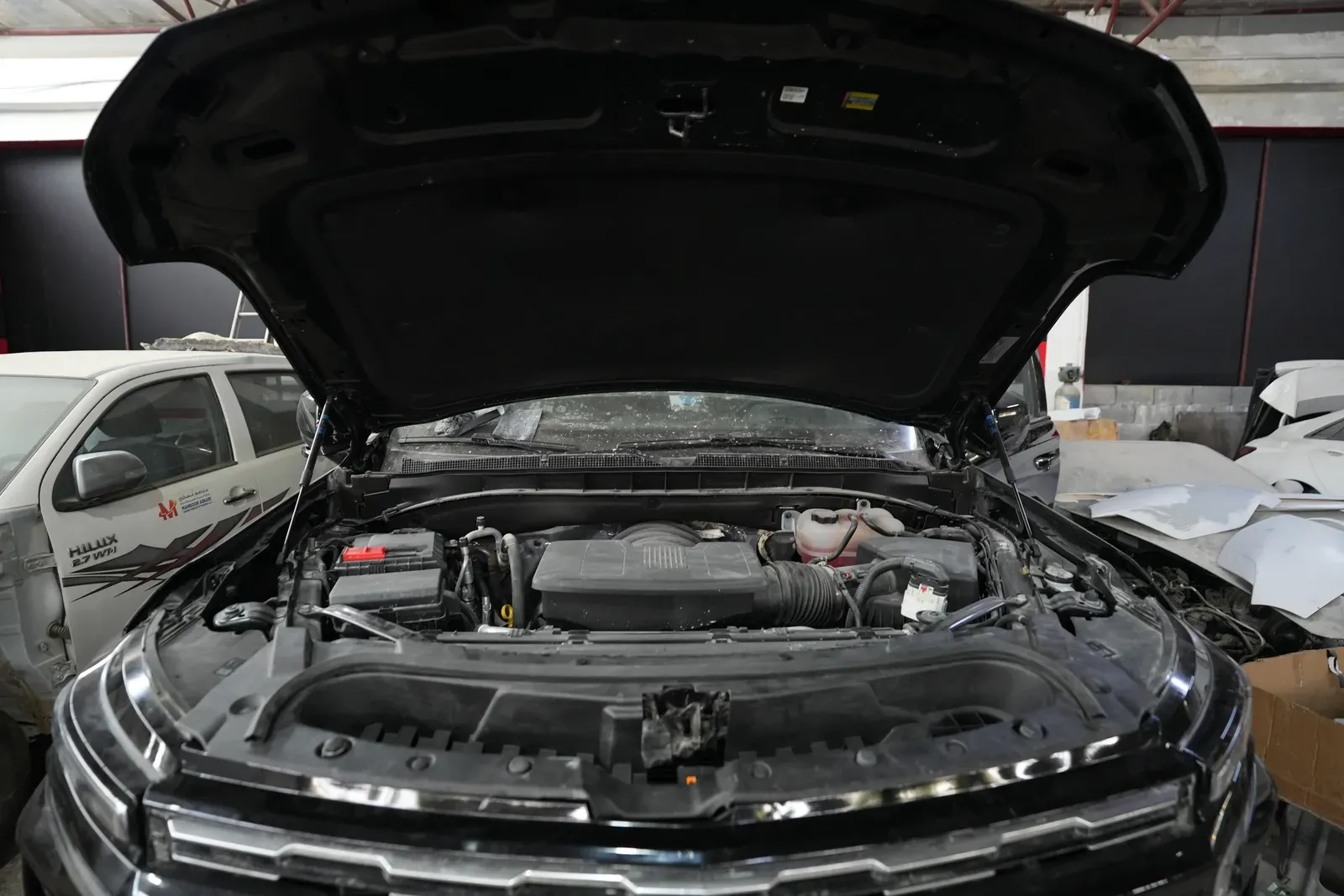
We do, and yes, the parts take longer. The diesel was not a regional engine, so practically every RAM delivered new here is petrol and any EcoDiesel in Sharjah has come in as a private import. That has no effect on how the work is done, but it does mean a component that would be on a shelf for a 5.7 has to be brought in for this. We would rather tell you that when you book, with a realistic wait attached, than have you find out on the fourth day with the truck on a ramp.
The back of the truck feels loose over bumps. Is that the air springs?
It might be, but there is a more likely answer that is particular to this truck. The 1500 holds its rear axle on five links and coil springs, so there is a track bar keeping the axle located sideways and bushed links keeping it located fore and aft — parts a leaf-sprung pickup does not have at all. When the track bar bush wears, the back of the truck moves across the lane over a ridge, and drivers usually describe that as a steering problem at the front. The truck goes on a lift with the axle loaded and each link is levered in turn, so you get a named part rather than a guess between the air system and the rear end.
Does it matter which RAM 1500 I have when you order parts?
It matters a great deal, and it is a common way for an order to go wrong. The older DS generation and the newer DT generation were sold new at the same time, under the same name, on the same forecourt, and they are different trucks underneath. On top of that the 2500 and 3500 do not share a rear suspension with each other. So we start with the chassis number rather than with the model year, and where a part could belong to either truck we check the number a second time before the box is opened. It costs a few minutes and it saves a day.