

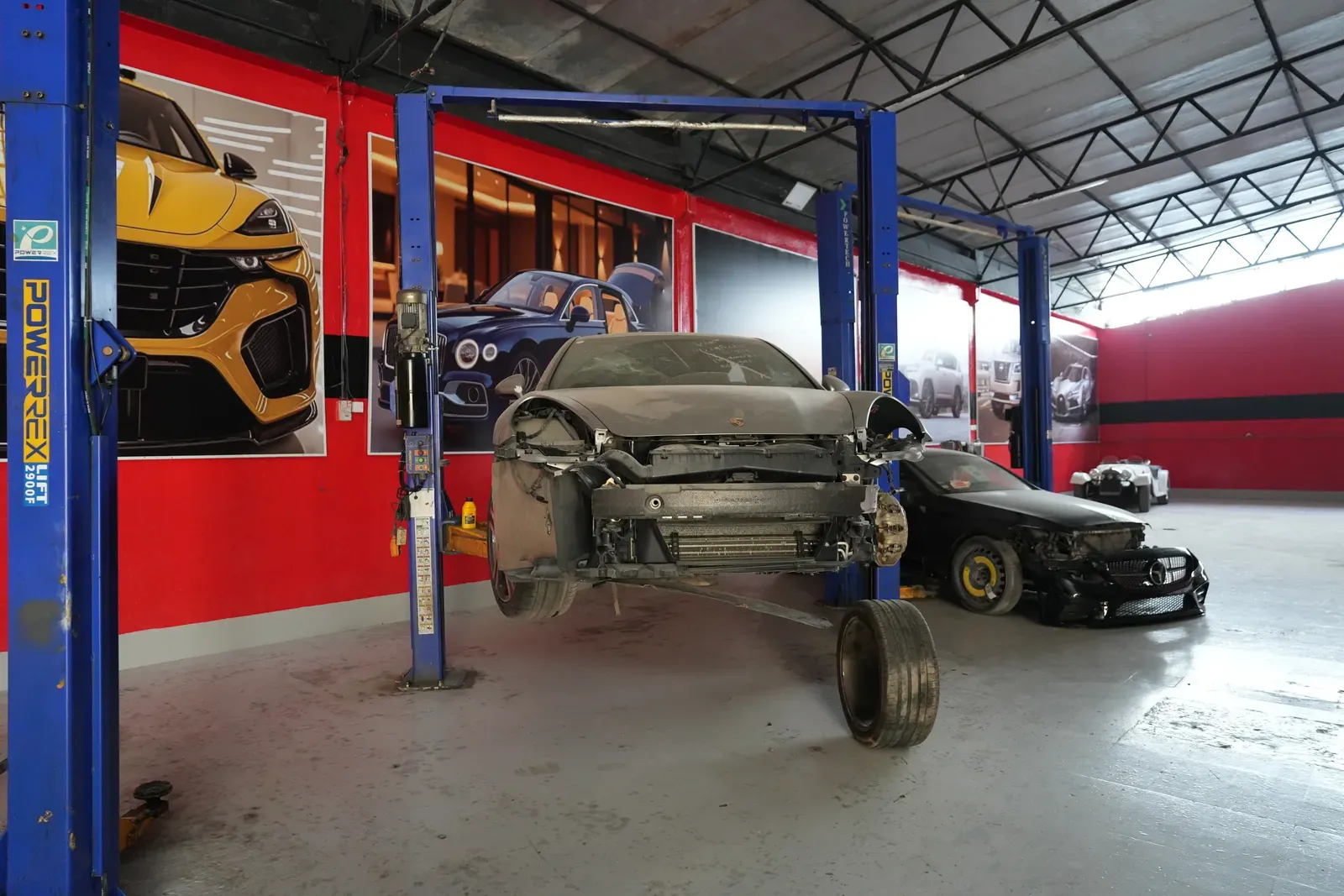
A gearbox is the repair where the number changes after the car is already on a ramp. The box comes apart, something is found inside it, and the conversation about money happens at the one moment the customer cannot walk away from it. Almost everything that decides between repairing the unit, fitting a used one and fitting a new one can be measured with the gearbox still bolted in the car.
Is it really the gearbox?
A shift that feels wrong is not automatically an internal fault, and the people who build the transmissions say so in their own service documents. GM’s diagnostic bulletin for its nine-speed automatics lists what can produce a harsh engagement before anything is stripped — “High engine idle speed”, a default condition caused by certain codes “that result in maximum line pressure to prevent clutch slippage”, and “Incomplete adapting or incorrect adapting” — and for a delayed engagement it lists “Low idle speed”, “Low fluid level”, “Cold transmission fluid temperature” and “Selector linkage”. Not one of those is a clutch pack. The same bulletin is blunt about the order of work: “If these components are not checked, a simple electrical condition could be misdiagnosed.” That is the argument we make about codes generally in a diagnostic scan is where the work starts, and it is why a gearbox job starts as a diagnosis.
What is tested before a gearbox is opened?
- The fault memory and the live data
- Stored and pending codes, freeze frame, and then the box watched while it works: commanded gear against actual gear, solenoid pressure commands, fluid temperature and torque converter slip. An electrical fault that is read in ten minutes does not need a gearbox on a bench to find it.
- The fluid level, at a stated temperature
- Not a glance at a dipstick. GM specifies the window — the level “must be checked when the transmission fluid temperature (TFT) is at 85–95°C (185–203°F)” — and warns that outside it the box ends up wrong either way: “An under-filled transmission will cause premature component wear or damage. An over-filled transmission will cause fluid to discharge out the vent tube, fluid foaming, or pump cavitation.”
- Line pressure, on a gauge
- The hydraulic pressure that makes a clutch hold is read at the test port rather than inferred. The step in that bulletin is exactly that: fit the pressure gauge, start the engine, and “Verify the Transmission Fluid Pressure = Greater than 345 kPa (50 psi).” That threshold belongs to that family of transmissions; the principle — a number, out of the box, before an opinion — belongs to all of them.
- A stall test
- Brakes held, throttle to the floor for a moment, highest engine speed recorded. Hyundai’s bulletin says what it is for — “This TSB provides a procedure to test each clutch in the transmission” — and what the two outcomes look like: “PASS: Stall speed is between 1700~2900 rpm … FAIL: Engine revs to redline limit.” It is also a test that punishes carelessness, which is why the same bulletin says “Do not hold the throttle fully open for more than 3 seconds.”
- A road test under load
- Because a gearbox misbehaves when it is working, not when it is idling in a yard. Converter lock-up is one of the things watched: GM’s figure is that when it applies, “slip speed should be controlled to below 100 RPM when the transmission is not shifting, and the throttle is held steady.” A shudder at a constant motorway speed is that measurement going wrong.
What does burnt gearbox fluid mean?
Gearbox fluid is the only part of the inside of a gearbox that comes out without dismantling it, and it carries a record. GM sets out what each finding means. Healthy fluid “should be red or brown” and “should be transparent so that objects or writing can be seen through it.” Then the finding that changes the whole job: “If the fluid is very dark, black, or has a burnt odor it would indicate clutch damage has occurred internally in the transmission and it would need to be removed from the vehicle and investigated.” The same applies to what is in the pan — a little friction material and fine silver streaks are described as normal, but “If large pieces and/or metal pieces are noted in the fluid, or the fluid when rubbed between fingers feels gritty/sandy, it would indicate hardware damage has occurred internally.” And one reading points somewhere else entirely: “Fluid that is cloudy or milky or appears to be contaminated with water indicates engine coolant or water contamination.” That is why what comes out of the pan is kept in front of you rather than washed down a drain before you arrive.
Burnt fluid is not a service that was missed. It is a reading of something that has already happened inside the box, and fresh fluid does not un-read it.
So should the fluid just be changed and see what happens?
It depends on what the readings already said, and the manufacturers are more careful here than the trade is. ZF, who build a great many of the eight-speed automatics on the road here, write in their own fluid data sheet that their transmissions “are generally filled with lifetime oil” and that “In principle, an oil change is only necessary when repairs are carried out” — then qualify it twice. Once with a figure of their own: “ZF recommends an oil change after 150,000 km for its transmissions.” And once with the sentence that matters in this country: “In operating conditions with high temperatures and loads, or with unknown vehicle use in the past, it can make sense to change the transmission oil at shorter intervals.” Their workshop instructions give the mechanism — “At very high operating temperatures, the oil ages faster than under normal conditions.” So: on a box that has been serviced and whose readings point at a solenoid or a dirty valve body, fresh fluid and a filter can genuinely fix it. On a high-mileage box that is already slipping, the worn friction material suspended in the old fluid is part of what is still giving it grip, and a flush can finish it. Those are two different cars, and the readings taken earlier are what tells them apart.
Rebuild, used gearbox or new: how do they compare?
| The road | What is known about the part | What it turns on |
|---|---|---|
| Repair the unit in the car | Everything, because it is your own box and the fault was measured in it. | Whether the fault is electronic or hydraulic — a solenoid, a valve body, a pressure sensor — rather than worn friction material. |
| Rebuild it | Everything, in the end: clutch packs, drums, bushes and valve body all come out onto the bench and are inspected. | What the strip actually reveals. A scored drum or debris that has been through the pump changes the job, which is why the work stops there until you have heard it. |
| Fit a used unit | Its source, whether it can be turned and inspected before fitting, and what its fluid looks like. Not its history, not its heat, not its fill. | How much of that unknown you are willing to carry, and how long the car can be off the road while a unit is found and checked. |
| Fit a new unit | The most of the three, because nothing has happened to it yet. | Availability for your model, and what the whole figure comes to once parts, labour, the diagnosis and VAT are added together. |
What a used unit costs you is not visible in its purchase price. It is every measurement at the top of this article, none of which can be taken on a gearbox sitting on a pallet. Read ZF’s sentence again and notice what they treat as a risk factor: “unknown vehicle use in the past”. A used gearbox is that sentence in physical form. It is still a reasonable choice — but a choice with a known gap in it, and the gap belongs in writing next to the figure rather than in the silence after the handshake. The same goes for the complaint that brought the car in: we keep a page for “The automatic gearbox (transmission) jerks when it shifts” and another for “The revs rise but the car does not speed up”, both filed under what is your car doing?.
- No line pressure reading, because there is no engine turning the pump.
- No stall test and no road test, because there is no car around it.
- No fluid history: what was in it, whether it was the specified fluid, whether it was ever changed, and at what temperature it spent its life.
- No knowledge of why it left the car it left. A gearbox removed from an accident-damaged car and one removed because it was failing look identical on a shelf.
- No record of whether the fault that finished the last box — an engine misfire, a blocked cooler, a wrong fill — is still in your car, waiting for the next one.