

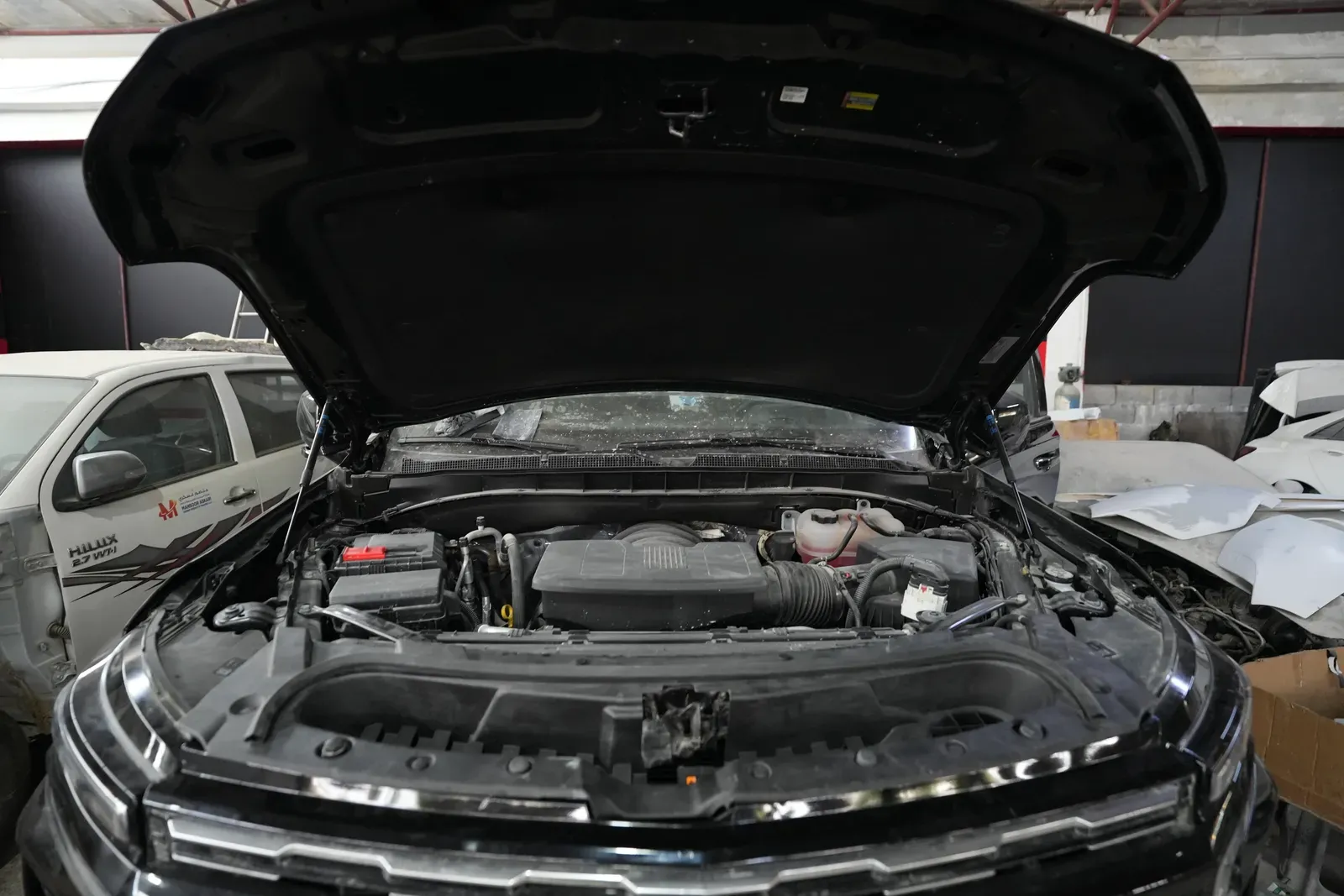
A battery is the easiest part in a car to blame, because it is the part that goes quiet. But a battery is also the part that gets blamed for what three other things did to it, and none of those three is repaired by lifting a new one into the tray. The useful question is not “is the battery dead” — it almost certainly is, by the time you are standing next to the car — but “what emptied it”.
What can be wrong when a car dies after standing?
Four things, and they are worth naming as a set rather than as a diagnosis. The battery may have genuinely failed — the article on heat and battery life covers why that happens here years earlier than it would elsewhere. The charging system may not be putting back what the car takes out. A circuit may still be drawing current hours after the car was locked, which the trade calls a parasitic drain. Or a connection may have enough resistance that the battery is never filled in the first place. From the driver’s seat all four are the same event: the two complaints on our own fault chart are “The battery goes flat if I leave the car for a few days” and “It clicks when I turn the key but will not start”, and neither sentence contains a part. A battery job exists because the first item on that list is a part and the other three are measurements.
A battery that is flat is evidence, not a conclusion. Something made it flat, and that something is still in the car after the new one is fitted.
How is the battery itself tested?
In two stages, because the easy stage is the one that lies. Resting voltage is the easy stage: Fluke’s figures for a twelve-volt battery are “~12.6 V → Fully charged” and “Below 12.0 V → Likely discharged or weak”. What it cannot tell you is whether the battery can still deliver current, which is the only thing a starter motor cares about. So the second stage puts it under load — a load test, or the conductance test a workshop tester prints a result from — and the voltage is watched while the engine is actually being cranked. Battery University is blunt about the limits of the instruments here, warning that “most resistance-based testers deliver state-of-health predictions that are not much better than 5 correct in 10, results that can be compared with tossing a coin”. We print that rather than hide it. A conductance result is strong evidence about a battery that fails and much weaker evidence about one that passes, which is exactly why a pass sends us to the charging system and the drain instead of ending the conversation.
How is the charging system tested?
At the battery, with the engine running, and then a second time in a way most people have never heard of. The first reading is simple — Fluke puts a healthy output at “13.7–14.7 V under normal conditions” — and a car sitting below that range is being quietly discharged every time it is driven. The second reading is alternating current where there should be none. Fluke describes it as “the small AC component that sits on top of the charging system’s 14-volt DC output”, explains the mechanism — “a single open diode lets AC leak into the system, increasing ripple” — and gives both ends of the scale: “Desirable ripple: ≤ 50 mV AC (0.05 V) at idle with load”, against a “Fault range: ≥ 0.30 – 0.50 V AC”. What matters here is their own list of what bad ripple produces: “flickering lights, battery-drain complaints, or erratic engine behavior”. An alternator can charge at a respectable voltage and still be feeding the car a fault.
What about the wiring in between?
This is the test that saves the most money and gets skipped the most often, because a corroded joint reads perfectly until current is asked to cross it. Fluke states the principle plainly: “Electrical voltage drop varies according to current flow. Unless you operate the circuit so current flows through it, you cannot measure voltage drop.” They also explain why the obvious alternative fails — because “a digital multimeter’s battery cannot supply the current that normally flows through most circuits, digital multimeter tests usually cannot detect restrictions as accurately as a voltage drop test”. The working limits are small numbers: “0.00V across a connection”, “0.20V across a wire or cable”, “0.10V at a ground”. And the consequence is the one that strands a car — “when the engine ground is restricted, starter current tries to return to the battery through the body ground circuit”.

Why does a drain test take so long?
Because a modern car is not off when it is off. MOTOR, the trade technical magazine, defines what is being measured — “the battery current that exists with the vehicle shut down, ignition key removed (or the key fob well away from the vehicle), all accessories off and, for more recent vehicles, all modules in their ‘sleep’ state” — and then names the trap. Disconnecting the battery, the intuitive way to get a meter into the circuit, is itself the problem: “when the battery is reconnected, ‘smart’ modules … that were ‘asleep’ will awaken when power is restored and skew the test results”, and waiting for them to settle again “can take 45 minutes to an hour on some vehicles”. Fluke give the same window as “10–45 minutes so modules can enter sleep mode”, and a scale to read the stable result against: “<50 mA = Normal”, “>100 mA = Suspect”. Once there is a figure, the circuit is named by removing fuses one at a time — “when the current drops significantly, you’ve found the problem circuit” — and only then does anybody have grounds to talk about a part.
| What it is | What separates it from the other three | What a new battery does about it |
|---|---|---|
| A battery that has genuinely failed | It fails a load or conductance test, or its voltage collapses while the engine is cranked even though it read well at rest. | Fixes it — as long as none of the other three is also true. |
| A charging system that is not charging | Voltage at the battery with the engine running sits outside the charging range, or AC ripple is high enough to name a diode. | Buys a few weeks. Then the new battery is emptied exactly the way the old one was. |
| A parasitic drain | A milliamp reading taken after the modules have gone to sleep, then traced fuse by fuse until it drops. | Resets the clock. The car goes flat again on the same schedule as before. |
| A connection with resistance in it | Voltage drop measured across terminals, earth straps and main feeds while current is actually flowing. | Nothing useful. The new battery is never filled, and the starter never gets what it needs. |
- Stop jump starting it and hoping. Repeatedly flattening and jump starting a lead-acid battery damages it further, so the third jump start makes a battery that was innocent on Monday guilty by Friday.
- Ask for the readings, not the verdict. A rest voltage, a load or conductance result and a charging voltage are three numbers that fit on one sheet of paper.
- Say how long the car stood. Two days, a week and a month are different tests, and the answer changes what is measured first.
- Say what else was fitted. A tracker, an alarm, a dashcam or an amplifier put in by somebody else is one of the commonest sources of a drain.
- Expect to leave the car. A drain measurement cannot be taken while you wait, because the modules have to shut down before the reading means anything.