
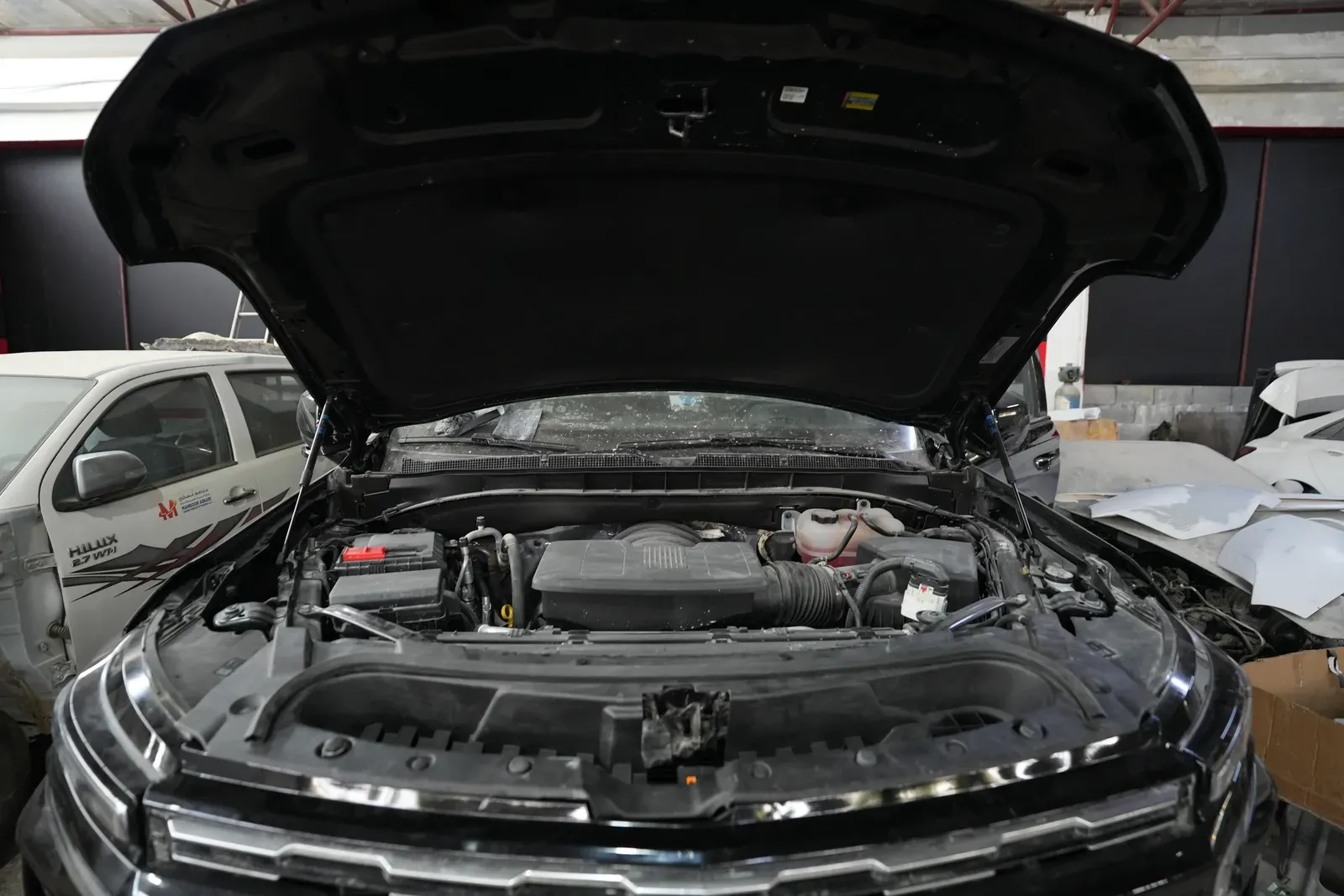
Almost every battery question we are asked in the bay is really a question about heat. How long should one last? Why did this one go without warning? Why did the car start this morning and not this afternoon? The three have one answer between them, and it is not the number printed on the sticker.
Heat is the clock, not the calendar
A lead-acid battery is a chemical machine. Its life is spent by reactions that carry on whether the car is driven or parked — the positive grid corroding, active material shedding off the plates, water leaving the electrolyte, sulfate hardening on what is left. Like almost all chemistry, those reactions run faster when it is hot. VARTA, who make the things, put it in one line: “As a rule of thumb, the chemical reactivity doubles for every 10 °C of temperature increase.”
Midtronics — who make the handheld testers hanging on the wall of most workshops, this one included — state the consequence for cars directly: “for every 15°F (8°C) increase in average operating temperature above 77°F (25°C), battery life is cut roughly in half.” Battery University gives the same rule and a worked example. Theirs is a stationary battery rather than an automotive one, so read the ratio and not the years: a unit specified to last ten years at 25°C “would only live 5 years if continuously exposed to 33°C (92°F) and 30 months if kept at a constant desert temperature of 41°C (106°F).”
The useful question about a battery here is not how old it is. It is how hot it has been.
Now put the climate next to it. The National Center of Meteorology’s July figures give a national mean air temperature of 34.6°C to 37.2°C, mean maxima of 39.7°C to 43.8°C, and a July record of 51.8°C at Mezaira’a in 2017. The number that matters most for a battery is the quietest one in that set: the mean July MINIMUM is 29.1°C to 31.4°C. VARTA say plainly that “an outside temperature of +20 °C is optimal for a car battery.” For five months of the year, a battery in this country does not reach its optimum even at four in the morning.
And under the bonnet is not the weather forecast
Those are shade air temperatures, measured properly at a weather station. The battery does not live in the shade. The background section of a US patent on battery heat shielding describes the engine bay this way: “During stop-and-go driving, or while the engine of the vehicle is idling, there is typically very little air or wind movement, causing the underhood air temperatures to often exceed 200° F.” That is 93°C. A second patent on the same subject puts the extreme case at 230°F, which is 110°C.
Two things follow from that sentence and both matter here. The first is that the worst case is not the motorway, it is the crawl — no airflow, engine working, nothing carrying the heat away. The second is where the heat comes from. The same patent is explicit: the battery’s temperature “increases primarily due to the convective heat surrounding such batteries and is usually not a result of any heat effects arising from the charge and discharge processes of the battery itself.” The battery is not cooking itself. The car and the country are cooking it.
What the heat is doing in there
- Grid corrosion
- The lead framework carrying the active material is eaten away from within. VARTA describe it as being “just like rust in body panels”, and Battery University notes it “cannot be avoided because the electrodes in a lead acid environment are always reactive”.
- Water loss
- Heat drives water out of the electrolyte through gassing and evaporation. Most batteries sold for modern cars are sealed, so nobody is putting it back.
- Shedding and sulfation
- Active material falls off the plates, and sulfate hardens onto what remains. Midtronics note that under-bonnet temperatures above 100°F “accelerated both electrolyte evaporation and sulfation”.
- Faster self-discharge
- A battery goes flat on its own with nothing connected, and “the rate typically doubles with every 10°C (18°F)”. A car left at the airport for three weeks in August is not in the state the same car would be in after three weeks in January.
None of it is reversible. “Once the battery is damaged by heat, the capacity cannot be restored.” That is why a battery that has had a hard summer does not come back after a long charge: there is less battery in it than there was in May.
There is a quieter mechanism underneath all of it, and it is the one almost nobody mentions. A lead-acid battery should be charged at a LOWER voltage when it is hot — Battery University gives the correction as about 3mV per cell for every degree Celsius of rise. A charging system set up for a temperate market and never told where the car ended up is therefore, on a Sharjah afternoon, gently overcharging. And prolonged overcharge is itself “another contributor to grid corrosion”, which is where this list started.
So how long does one actually last here?
We are not going to print a figure, because nobody publishes one for this country that we would be willing to stand behind. What can be shown is the gradient. Battery Council International data quoted by Battery University gives an average starter battery age of 55 months across the United States — 59 months in the cooler north and 47 in the warmer south. Consumer Reports, citing AAA, put the same spread at 58 months or more in the far north and under 41 months in the most southern regions. That is a gap of a year and a half opened up by the difference between Minnesota and Florida.
Sharjah in August is a long way outside that range. And there is one local measurement worth having: Khaleej Times reported this year on more than 20,000 vehicle inspections carried out across the UAE by dubizzle cars, in which most vehicles showed battery health between 40 and 60 per cent, and around 14 per cent scored below 30 per cent. That is not a claim about how long a battery lasts. It is a snapshot of what is currently sitting under the bonnets of cars driving around normally.
Why it starts at seven in the morning and not at two in the afternoon
This is the pattern that convinces people the fault must be something electrical rather than the battery. Three things are behind it, and none of them is the wiring.
First, the big number on the battery describes a test nobody in this country will ever run. SAE J537 defines cold cranking amps as the current a battery can hold “at −18°C (0°F) for 30 seconds without dropping below 7.2 volts.” It is a cold-weather rating. It says how well the battery will shove a stiff, cold engine round on a January morning in a country that has one. It is not a statement about a heat-soaked afternoon in Sharjah, and it is what most people buy on.
Second, warmth flatters a battery on the tester. Midtronics put the cold half of that plainly — “Cold batteries have higher internal resistance and test weaker than they truly are” — and the warm half is the same sentence read backwards. They are also blunt about two things their own instruments cannot tell you: “Just because the car starts and runs fine does not mean the battery is in good shape”, and “it’s possible for a battery to be tested as meeting or surpassing the rated CCA and still be bad.” Voltage is no better a witness: it “can appear fine until the vehicle’s battery has a load on it, which is when it plummets and doesn’t return to the normal range.”
Third, the heat hides its own damage. A weakening battery has higher internal resistance, and Midtronics note the practical effect: the battery “recovers more slowly between starts”. Meanwhile a hot engine is easier to turn over than a cold one — which is the point a UAE workshop made to Gulf News this summer, that a battery damaged in July “may continue to start the car, as hot engines require less cranking power”, and then fails when the weather eases. So the summer takes the capacity and the summer covers for it, and the bill arrives in a car park with the shopping in the boot.
The car is working against it too
The charging system has to put back everything the starter took, plus everything the car is using while it runs. In a Sharjah summer that means a compressor clutch, cooling fans and a blower at full effort from the second you turn the key. The trade reference AA1Car is clear about where that ends: alternator “output is low at idle and increases with RPM”, maximum is “typically achieved at speeds above 2,500 RPM”, and “peak loads and prolonged idle conditions can result in battery discharge, since the alternator cannot keep up with the power usage.”
Add the local driving pattern — house to the shops, shops to the school, long minutes stationary with the engine running so the cabin stays liveable — and you have a battery that is asked for a full-strength start, never quite recharged, and then left to self-discharge at a rate that doubles for every 10°C.
The warning signs, roughly in the order they arrive
- The engine turns over more slowly than it used to. This is the one worth acting on, and it is the one most people let go, because the car still starts.
- The headlights or the dashboard dim noticeably when the air conditioning blower steps up while you are stationary.
- Small electrical oddities — a clock or radio presets resetting themselves, a window switch that needs a second go, warning lamps that flicker while cranking.
- It has needed a jump start, once. Being taken deeply flat is one of the things this chemistry does not forgive.
- The case looks swollen or distorted, or there is a powdery white, green or blue deposit around a terminal.
- The red charging lamp comes on while you are driving. That is not a flat battery, that is the charging system, and it is a different and far more urgent problem.
If it is a start-stop car, the battery is not just a battery
Cars with automatic start-stop carry an AGM or EFB battery, and the car keeps a running account of how worn that battery is. Banner, who make them, are unambiguous: “An AGM battery (Absorbent Glass Mat) must always be replaced by another AGM battery. In an identical housing and of a similar performance class.” The new one also has to be declared to the car. VARTA explain why — “an aged worn out battery shows a different behaviour with regards to available capacity, energy output and charge acceptance then a new unused one” — and what happens if it is not done: “restriction or even failure of the start-stop function, which can result in increased fuel consumption and restriction of comfort functions.”
Two things people say that are not true
- That standing a battery on a concrete floor drains it. McGill University’s Office for Science and Society traces this to batteries a century old: “A hundred years ago, this rule-of-thumb was quite useful, as the case around the battery was made of wood and the electrical cells were glass. The batteries of today, however, are encased in plastic or hard rubber, which significantly reduces this energy waste.”
- That a sunshade protects the battery. A shade protects the cabin — studies cited by Jalopnik measured a windscreen card dropping interior temperatures by an average of 15°F and dashboard temperatures by 40°F. None of that reaches the engine bay. Parking in actual shade does.
What is actually worth doing
- Have it tested before the summer, not after it. State of charge and a load test, with the temperature and the state of charge written down — a reading without those two is a number without a meaning.
- Keep the results. One test tells you less than two. Midtronics make the point that a battery which read 85 per cent six months ago and 74 per cent now is degrading faster than one that has gone from 82 to 78 in a year, and that is the sort of thing only a record can show you.
- Have the charging system tested at the same time. A battery that keeps dying young is very often a battery being asked to live permanently undercharged.
- Park in shade wherever you can. It is the only free item on this list and the only one that touches the actual cause.
- After a jump start, drive it. Stryten’s own myth list is blunt that idling for a few minutes is not enough: “You should drive your vehicle for at least 15-30 minutes to allow the alternator to charge the battery.”
When the battery is the fault, a battery check and replacement is the job. When the battery is a symptom — a parasitic drain, an alternator not holding its output, a bad earth — it is an electrical diagnosis, and replacing the battery on its own only buys you a few months.