

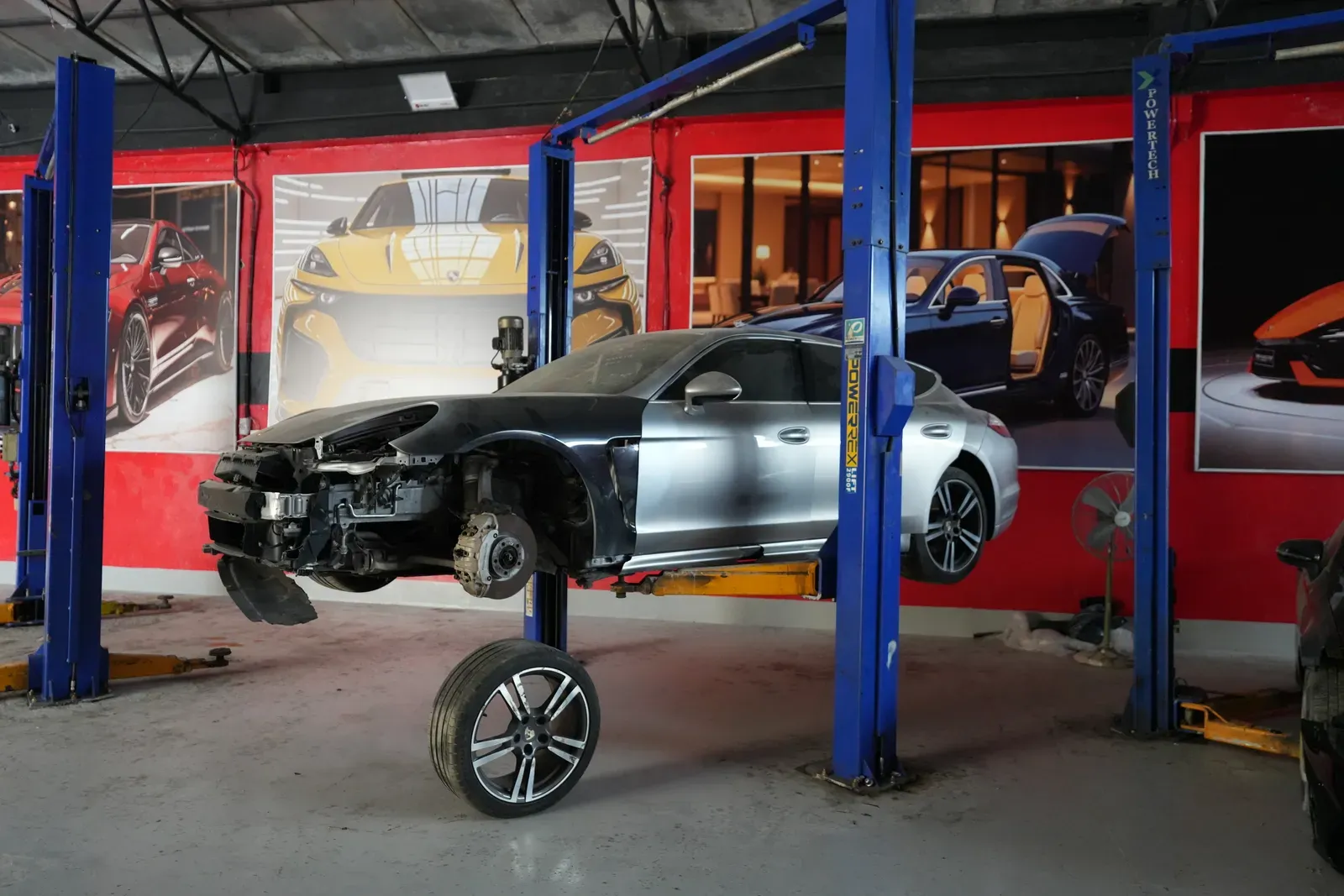
A brake job is usually described as one job and written on an estimate as one line. It is not one job. Pads, discs, fluid and the hardware that carries them wear on four separate clocks, and each clock is read with a different instrument against a different limit. The reason that matters is plain enough: the four are rarely finished at the same time.
How thin is a worn pad?
Thin enough that two governments print two different numbers, which is itself worth knowing. The DVSA’s MOT inspection manual fails a car at 1.1.13(a)(ii) for a “Brake lining or pad worn below 1.5mm”, and separately at 1.1.13(a)(i) for a “Brake lining or pad worn down to wear indicator”. The New Zealand Transport Agency’s inspection specification sets a general minimum for disc pads of 3.0 mm. Both are floors rather than targets — a pad sitting on the floor is a pad with no margin left — and neither is a local figure, because we could not find a published UAE one. What both assume is the part a driver cannot do for himself: the friction material is measured, inner pad and outer pad separately, with the wheel off. The inner pad is usually the one that wears first, and it is the one nobody can see.
What is measured on a disc?
Three things, and they are unrelated to one another. The first is thickness, taken with a micrometer and compared against a number that belongs to the manufacturer rather than to the workshop. The New Zealand brake inspection specification says so directly: run-out and thickness “must be within the service limits set by the vehicle or brake manufacturer”. It also gives a fallback for the case where that figure genuinely cannot be found — the thickness “must not be less than 90% of the original thickness”. A disc above its limit is not worn out, whatever the pads in front of it are doing. A disc below it does not become acceptable because the rest of the car is tidy.
The second and third are shape rather than size. Run-out is how far the disc face moves sideways as it turns, and the published limits are small: the same specification allows “0.1mm” on a disc with a single acting hydraulic piston and “0.2mm” with opposing pistons. Thickness variation is a separate fault — a disc can run perfectly true and still be thicker in some places than others — and it is checked around the face with “calibrated measuring equipment”, not by eye. Those two are what a judder is about. A disc can sit well inside its thickness limit and be out of shape, and a disc can be flat and be too thin. Neither measurement stands in for the other, and a pedal-feel opinion stands in for neither.
Pads are judged against a thickness. Discs are judged against three numbers. Fluid is judged against a temperature. The hardware is judged by how it moves. Sold as one item, at least three of the four were never measured.
Do brake discs always need replacing with pads?
Because a rule would have to come from somewhere, and it does not. The published inspection criteria describe a condition, never a schedule: the MOT manual fails a “Brake disc or drum significantly and obviously worn” at 1.1.14(a)(i), and one that is “insecure, fractured or otherwise likely to fail” at 1.1.14(a)(ii). Neither line says anything about what the pads in front of it are doing. Fitting discs every time is easier to sell than explaining a measurement, and it is not always the wrong call — a disc close to its limit will not last the life of the new pads, and taking the corner apart a second time costs another strip-down. But that is an argument built on a number, and the number belongs on the estimate next to the decision. The brake page puts the same thing in its own words: a disc that is still doing its job stays on the car.
Why the fluid is tested rather than looked at
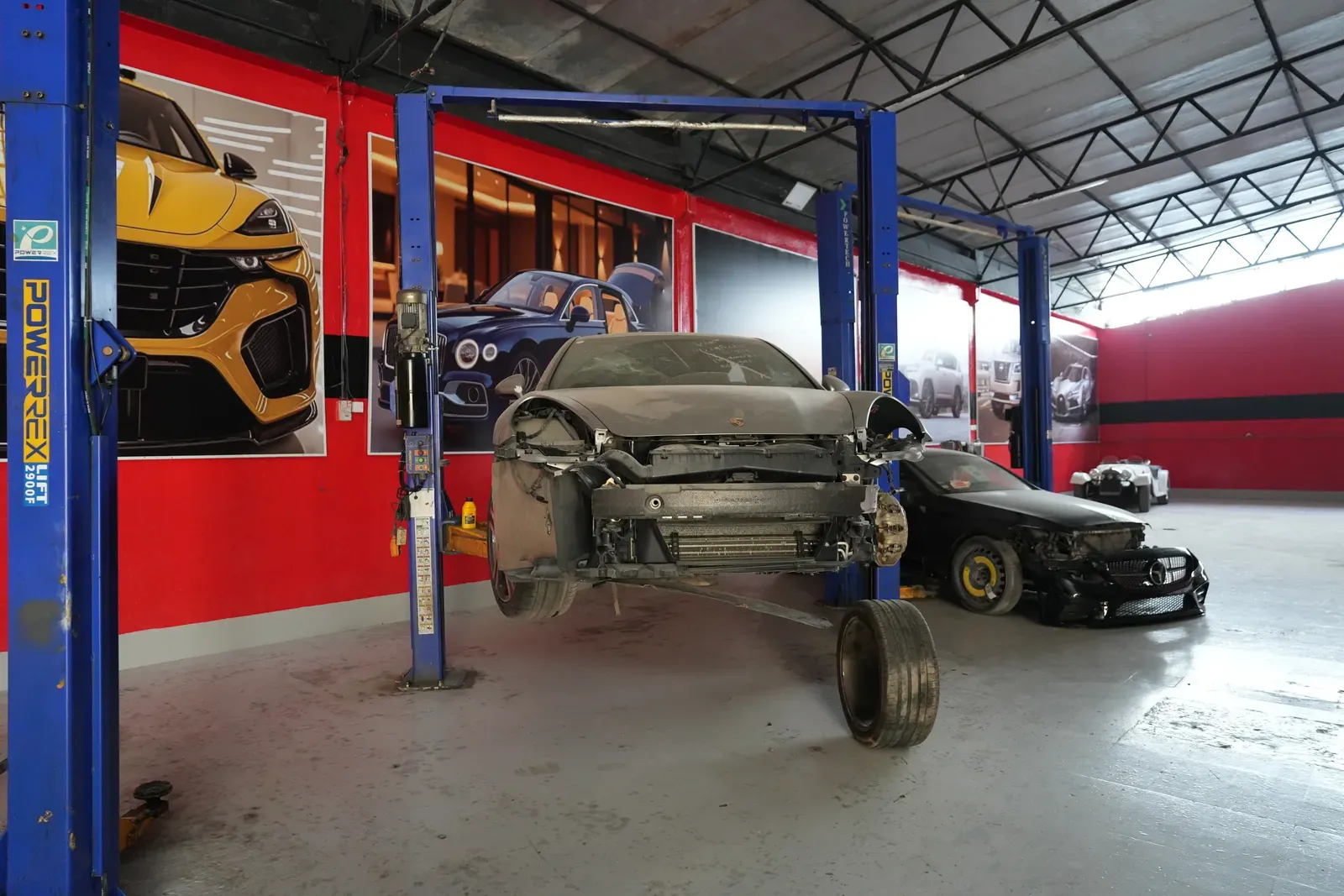
Because what goes wrong with brake fluid is invisible, and the failure it produces is a temperature. Brake fluid takes up water out of the air, and the standard that governs it is built around that fact. FMVSS No. 116 sets a dry boiling point — its “equilibrium reflux boiling point” — of “230 °C. (446 °F.)” for DOT 4 fluid, and then sets a second, lower figure for the same fluid once it has absorbed water: a wet ERBP of “155 °C. (311 °F.)”. That wet figure is not a thought experiment. The standard arrives at it by deliberately humidifying the fluid alongside a reference fluid and stopping “When the water content of the SAE fluid reaches 3.70 ±0.05 percent by weight”. The gap between the two minimums the standard sets for the same grade is seventy-five degrees, and it is that margin, not the colour of the fluid, which gives you a pedal at the bottom of a long descent. New Zealand’s inspectors are told to replace fluid showing “visible signs of dirt, moisture or other contaminants” — but by the time it is visible the number has moved long ago.
| What is measured | What it is measured against | What it does not tell you |
|---|---|---|
| Pad friction material, inner and outer separately | A published minimum — 1.5 mm in the MOT manual, 3.0 mm in the New Zealand one — or the wear indicator. | Anything about the disc behind it, or about the fluid. |
| Disc thickness, with a micrometer | The vehicle or brake manufacturer’s service limit, or 90% of original where that limit cannot be found. | Whether the disc is flat. A thick disc can still judder. |
| Disc run-out and thickness variation, on a gauge | 0.1 mm with a single acting piston, 0.2 mm with opposing pistons, measured with calibrated equipment. | Whether there is enough metal left to be worth keeping. |
| Brake fluid moisture and boiling point, on a tester | The standard’s own pair of figures — 230 °C dry against 155 °C wet for DOT 4. | Whether the calipers and hoses are healthy. Those are a different check. |
| Hoses and caliper slide movement, by hand | A condition rather than a number: a hose “bulging under pressure”, “twisted or stretched”, chafed or cracked, and slide pins that move freely. | A thickness. There is no millimetre here to quote back at you. |
A judder and a morning squeal are different stories
Different part, different mechanism, different urgency. A shake felt through the steering wheel only while braking is about the shape of the front discs and the hub they turn on — and it is separated from a wheel balance fault by when it happens, because a balance fault shakes the car at a particular speed whether you are braking or not. A squeal for the first few stops of a humid morning that clears once the brakes have been used is a film on the disc faces being scrubbed off, and near the coast it is close to routine. The reason it is still worth knowing about is that one other noise sounds similar and means the opposite: a wear indicator is a small metal tab designed to touch the disc when the pad is nearly finished, and it squeals too. The difference is the pattern rather than the pitch — one clears after a few stops and stays gone, the other gets worse and is there whenever you brake. There is a page on this site for each of those two noises, The steering wheel shakes when I brake and The brakes squeak or squeal in the morning, then stop, and a third for the brake complaint that is about one side rather than the disc: The car pulls to one side when I brake.