

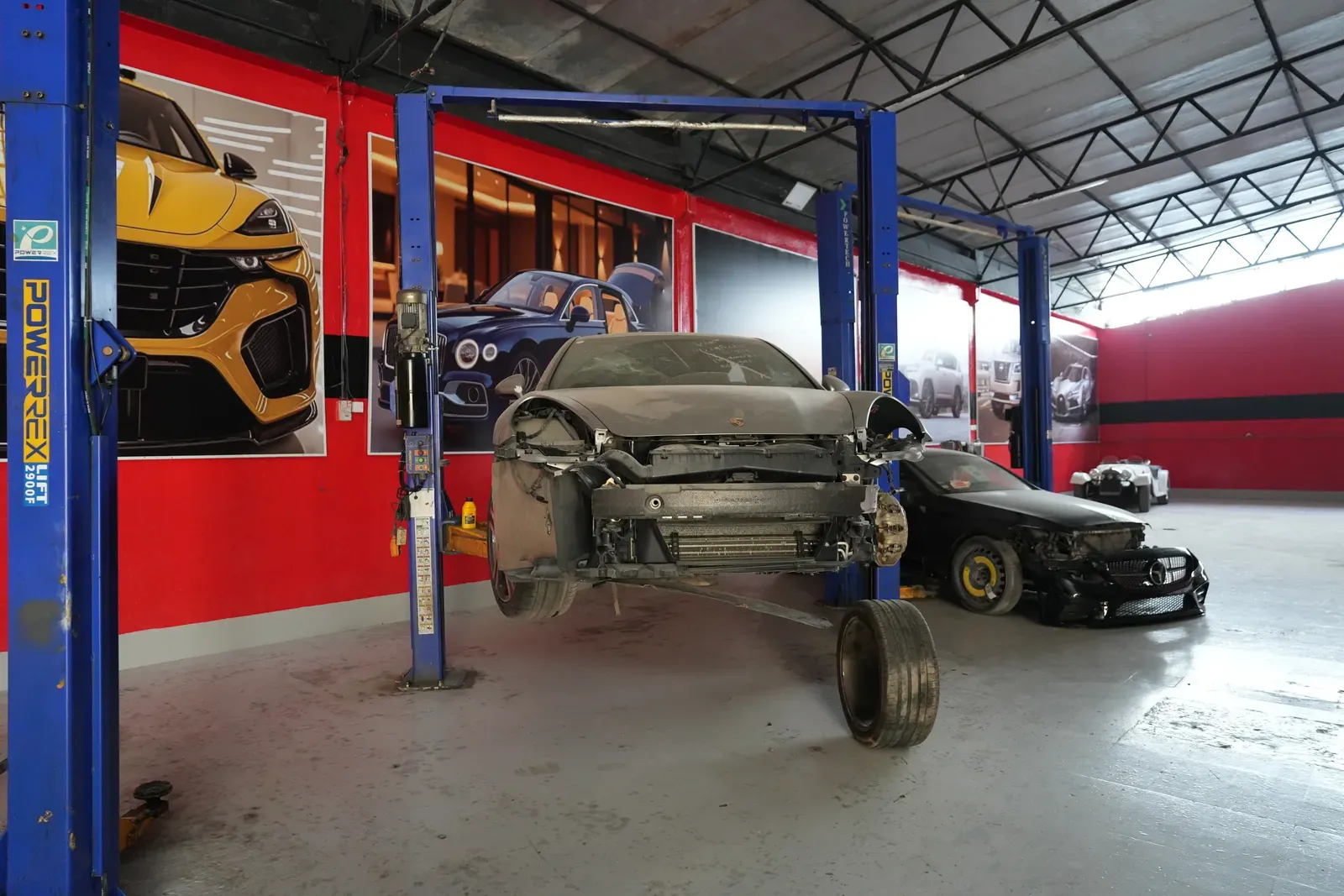
A suspension fault arrives as a sound, and a sound is a poor description of a part. Six or seven components can produce a knock over a bump, and from the driver’s seat they are indistinguishable. What separates them is not a sharper ear. It is the car off the ground, each joint loaded in turn, and a number for how far it moved.
Which suspension parts wear out on UAE roads?
- Bushes
- Rubber or urethane sleeves that let an arm pivot without passing every road shock into the body. They perish, split and separate, and the inspection criteria say so in those words: the New Zealand manual rejects a component with “a flexible bush that is significantly cracked, damaged or perished”. A bush carrying only an anti-roll bar makes a noise; a control arm bush that has separated lets the wheel move under braking, which is a different category of problem.
- Ball joints and track rod ends
- Steel balls in sockets, holding the wheel to the car and letting it steer. They wear as free play, and free play is what the manuals measure: New Zealand rejects a suspension component that “has play beyond manufacturer’s specifications”. These sit in the steering path, which is why a knock that arrives with vague steering is treated differently from one that does not.
- Drop links
- Short rods joining the anti-roll bar to the strut. Small, cheap, and a frequent source of a knock — which is exactly why they are worth confirming rather than assuming. They are the easy part to assume, and an assumption that costs little is still an assumption.
- Shock absorbers and top mounts
- The damper controls how the spring settles; the mount at the top of a strut carries the load and, on most cars, lets the strut turn with the steering. Both are on the rejection list separately — “excessive leakage of damping fluid or air”, and “excessive play, roughness or stiffness in a strut upper support bearing”. The MOT manual’s phrase for a tired damper is worth keeping: “negligible damping effect”.
- Wheel bearings
- The only item on this list that usually speaks as a hum rather than a knock. Two separate criteria apply and they catch different stages: a bearing that “has play beyond the manufacturer’s specifications, or is over-tight or binding”, and one that “feels/sounds rough when rotated”. A bearing normally goes rough before it goes loose, which is why the hum arrives long before anything else does.
Why does suspension wear faster in the UAE?
Because the three attack different parts of the same system. Heat is the one with a published number: the National Center of Meteorology’s July figures for the UAE give mean maxima of 39.7 °C to 43.8 °C and a mean July minimum of 29.1 °C to 31.4 °C, so there is no cool part of the day in which rubber recovers. Speed bumps are the mechanical half — a large, repeated vertical input taken at low speed, which is the loading a bush and a top mount feel most and a smooth motorway never applies. Load is the quiet third: a car that is regularly full, towing, or carrying a roof box asks more travel control of its springs and dampers than the same car empty. None of that dates a component. It explains why parts here reach their limits sooner than a schedule written somewhere temperate expects.
The noise is not the diagnosis. The noise is the reason to go and take a measurement, and six components can be the reason for the same noise.
A knock, a clunk and a rumble are three questions
| What you hear | When it happens | The set it belongs to | How the set is separated |
|---|---|---|---|
| A knock | Over a bump, as the wheel travels | Free play somewhere that should be held tight: drop links, anti-roll bar bushes, control arm bushes, top mounts, a tired damper, a track rod end, a loose subframe bolt. | Each joint loaded in turn with the weight off the wheel, and the movement compared against the manufacturer’s figure. |
| A clunk | Turning the wheel at low speed, or at the moment the car changes direction | The steering path and the top of the strut: a top mount bearing, a track rod end, a steering rack with play at the pinion. | Turning the steering lock to lock with the car raised, with a hand on each joint, rather than listening from the seat. |
| A rumble or hum | Rising and falling with road speed, not with engine speed or gear | Something that turns with the wheels: a wheel bearing, or a tyre worn into an uneven pattern. | A steady-speed road test, steering gently left and right — weight moves onto and off a failing bearing, and tyre noise does not care. |
| A float or a second movement after a bump | The car keeps moving after the road has finished | Damping: shock absorbers with “negligible damping effect”, or leaking. | Leakage is visible with the car raised; damping is judged on the road and by how the car behaves under braking, not by pushing a wing. |
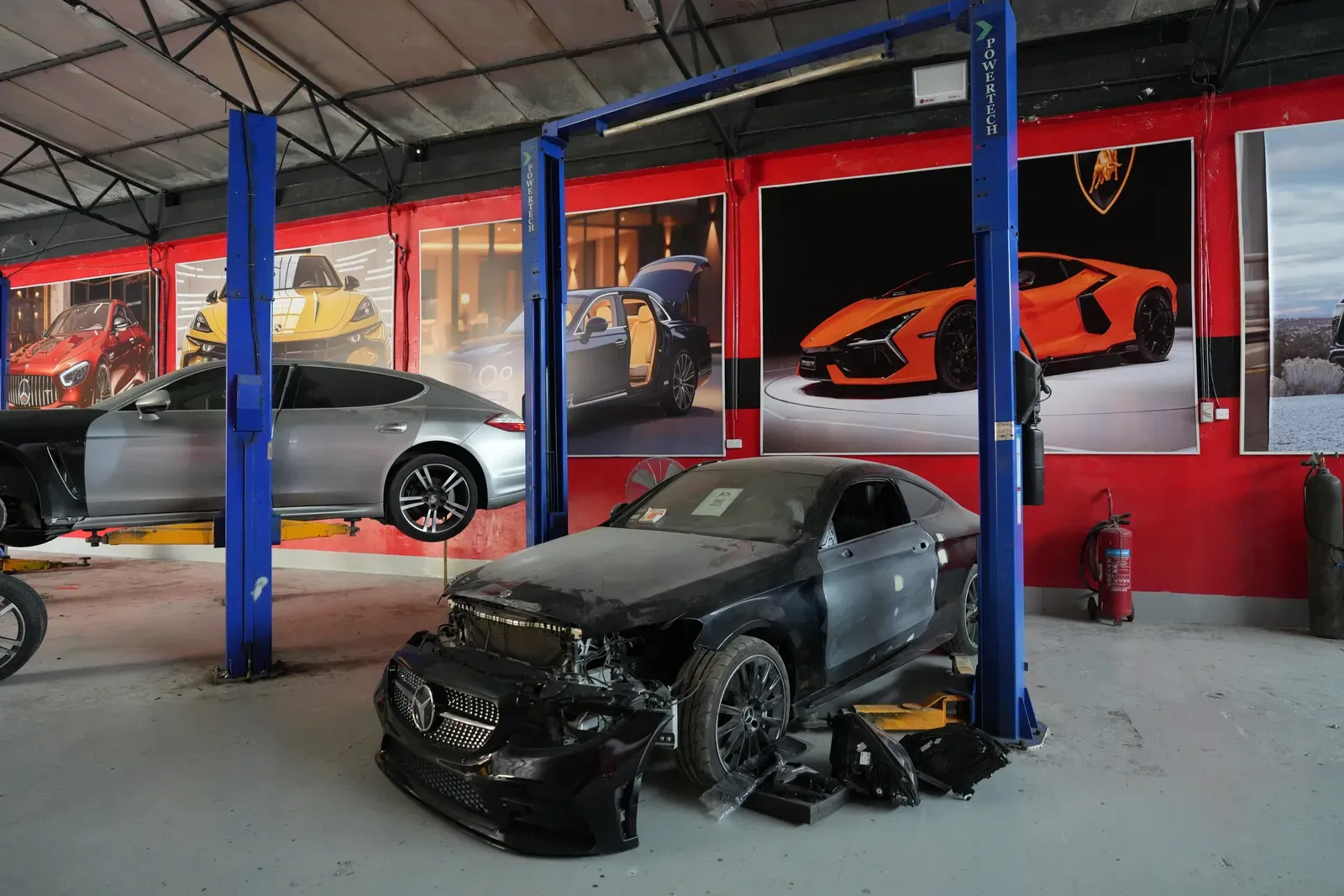
Is the bounce test a reliable shock absorber test?
Pushing down on a wing and counting the rebounds tests one thing and none of the rest. It loads spring and damper together, by hand, through a fraction of the travel they see on a road, at a speed a damper barely resists — and a damper resists by velocity, so a slow push is the condition under which a worn one behaves most like a good one. It also puts no load at all on the joints that make the noise you came about: a bush, a ball joint or a drop link can be visibly worn and pass it without complaint. The test is not useless. It is answering a question nobody asked.
How is suspension play measured?
A number. With the wheels hanging, a joint can be levered under load and the movement watched at the joint itself rather than felt through the body of the car — and that movement is what the inspection standards are written around. The MOT manual is explicit that this is measurement rather than impression: a worn pin or bush is assessed with small pinch bars or a wheel play detector, against stated tolerances of 2 mm for a 12 mm pin, 3 mm for a 25 mm pin and 10 per cent of the diameter for anything larger. New Zealand’s list adds the faults a lever will not find: a part that “does not operate smoothly without roughness or stiffness”, and a damper with “excessive leakage of damping fluid or air”. Done joint by joint, the knock ends up belonging to one named component rather than to the front of the car in general — which is what the suspension and steering job is for.
The road test with the radio off
It is a diagnostic step, not a courtesy. Three of the four rows in the table above are decided by when the noise happens, and none of those conditions can be reproduced on a ramp. A noise over bumps, a noise on lock and a noise that rises with speed are three different faults, and the last of those is separated from tyre noise by a test that costs nothing but the drive: hold a steady speed, steer gently left and then right, and listen for the volume changing as weight moves across the axle. There is a reason this site keeps a separate page for a knock over speed bumps and another for a hum that rises with speed, rather than one page about noises; both sit under what is your car doing, and they are There is a knocking noise over speed bumps and A humming noise that gets louder with speed. They are different questions with different answers, and they are not told apart by how loud they are.