
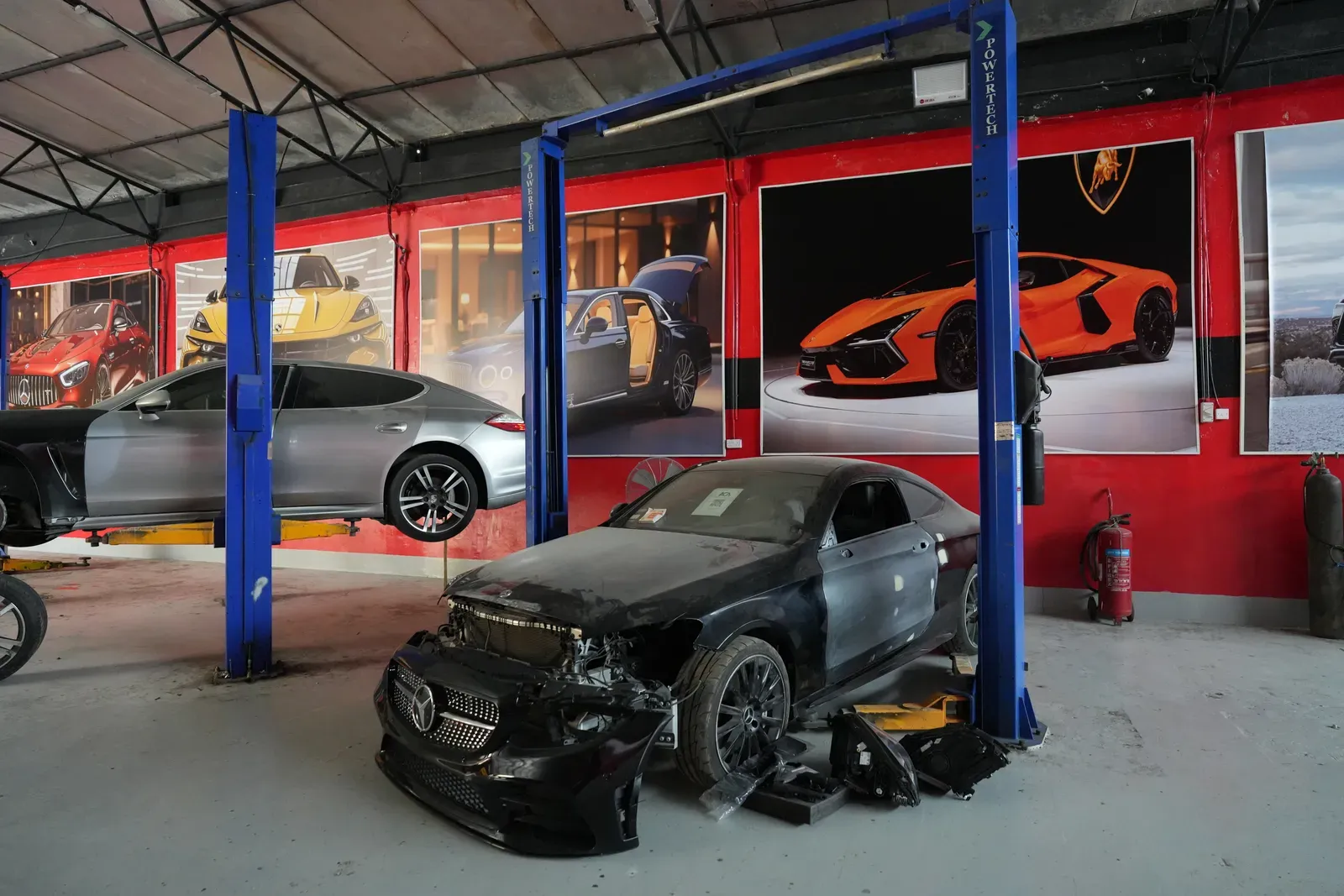
Heat is not one problem. It is about eight different problems that arrive together every May and leave in October, and each of them attacks a different material by a different mechanism. Treating them as one thing — “the summer is hard on cars” — is why so many people are surprised by the bill.
How hot does a car here actually get?
Much hotter than the air, and the air is already hot enough. The National Center of Meteorology’s July climate summary for the UAE gives a mean air temperature of 34.6°C to 37.2°C, mean maxima of 39.7°C to 43.8°C and a July record of 51.8°C at Mezaira’a in 2017. The figure that matters most for a car is the quiet one: the mean July minimum is 29.1°C to 31.4°C. There is no cool part of the day for the metal to recover in.
Inside a parked car it is worse again. In 2018 a team from Arizona State University and UC San Diego parked cars on three summer days in Tempe, Arizona, with air temperatures in the 100s Fahrenheit, and measured what the interior reached after one hour. In the sun: cabin air 116°F (about 47°C), dashboard 157°F (about 69°C), steering wheel 127°F (about 53°C), seats 123°F (about 51°C). In the shade the same cars reached about 100°F in the cabin and 118°F on the dashboard. That study was run in Arizona, not here — we quote it because it is a controlled measurement, and we have not found one done in this country.
And the road under the car is hotter than both. Superpave, the system that grades the bitumen in asphalt, labels a binder with two numbers, the first of which is “the average seven-day maximum pavement temperature (°C)”. A 2024 study in the International Journal of Pavement Engineering built a Superpave grade map for the UAE from air temperature records at twenty weather stations: at 98 per cent reliability it found three grades in use — PG 76-10, PG 70-10 and PG 64-10 — with PG 76-10 covering more than 85 per cent of the country. Read that as a temperature and it says the road your tyres sit on is specified to stay solid at up to 76°C.
The engine bay is not sitting in 43°C air. It is sitting above a surface graded for 76°C, under a bonnet that has been in the sun since morning.
What does heat do to engine oil?
It ages it chemically, and the rate roughly doubles for every ten degrees. That is the Arrhenius rate rule, and the lubrication trade states it plainly: “For every 10°C (18°F) increase in temperature, the rate of lubricant oxidation doubles, cutting the lubricant’s life in half.” The same article is honest about the limits of the rule — “other factors, such as contaminants, mechanical stress, and the quality of the lubricant, influence lubricant degradation” — so it is a slope, not a calculator. But the direction is not in dispute.
You do not have to take that from a workshop. Take it from the carmaker. Mazda’s scheduled maintenance section lists five “unique driving conditions” that put a car on the severe schedule, and one of them is, word for word, “Driving under extremely high temperature conditions.” On that schedule the instruction is to “replace the engine oil and filter every 8,000 km (5,000 miles) or 6 months, whichever comes first” — against a normal maximum interval of 16,000 km or 12 months. The manufacturer has already halved its own number for the climate you are driving in.
Why is the cooling system the one to watch?
Because it works by holding pressure, and pressure is the only reason the coolant is not already boiling. MACS, the mobile air conditioning trade body, puts the mechanism plainly: “the use of a pressure cap on the radiator increases the air pressure within the cooling system by several pounds so that the water (coolant) may be circulated at higher temperatures without boiling.” It puts a number on it too — roughly 3°F of extra boiling point per psi, so a 16 psi cap lets the system run to around 268°F before it boils.
Now put a tired cap, a soft hose or a slow leak into that sentence. The system stops holding pressure, the boiling point falls back towards where it started, and it falls back on the afternoon the car is loaded and stationary in traffic — which is exactly when you needed the margin. MACS adds the caveat that matters: the cap “increases the engine cooling system efficiency, yet it does not lower the engine temperature.” A cooling system is not a thing that makes the engine cooler. It is a thing that stops the coolant flashing to steam, and it does that job with pressure it has to keep.
Why do batteries fail so early here?
Because a lead-acid battery is a chemical device that is happiest at around room temperature and never gets one. VARTA state their optimum plainly: “an outside temperature of +20 °C is optimal for a car battery.” Look back at the NCM’s mean July minimum of 29.1°C to 31.4°C and you can see the problem — for months of the year the battery does not reach its best condition even at four in the morning. The mechanisms are worth understanding on their own, and we have written them up separately.
What does heat do to tyres?
It ages the rubber chemically, independently of how far you drive. NHTSA’s own summary of its tire aging research names the mechanism: “Chemical aging occurs due to the combined effect of heat and oxygen on the rubber compound.” The agency also found the geography you would expect — “In the warmer parts of the United States where we have data, including Arizona, Florida, Texas and Southern California, there appears to be a relationship between the age of the tire and the propensity of the tire to fail.” The sentence that should change how you look at a tyre, though, is this one: “The effect of aging may not be visibly detectable on these tires and their integrity may be compromised even though they could be showing a great deal of remaining tread.”
What does the sun do to paint, plastic and rubber?
It is a slow chemical attack, and the industry takes it seriously enough to have built a standard around it. SAE J2527 is the “Performance Based Standard for Accelerated Exposure of Automotive Exterior Materials Using a Controlled Irradiance Xenon-Arc Apparatus” — a laboratory test in which paints, plastics and coatings are put under a filtered xenon lamp with controlled heat and moisture until they fail, so that a carmaker can find out in months what a decade outdoors would do. The existence of that test is the point: the failure it is accelerating is sunlight plus heat, and outside it is not accelerated at all, merely constant.
Inside the car the same thing is happening to a dashboard that the Tempe experiment measured at about 69°C after an hour. Interior plastics do not crack on the day; they go chalky, then brittle, then a clip breaks when somebody removes a trim panel four years later. Rubber follows the tyre’s rule — heat plus oxygen — which is why a wiper blade, a door seal and a boot gaiter all have a shorter life here than their catalogue life anywhere else. The paint itself has its own article, because protecting it is a genuinely different conversation.
Why does the air conditioning make everything else harder?
Because the heat it takes out of the cabin does not disappear; it is dumped at the front of the car, into the same air that is supposed to be cooling the engine. In almost every car the condenser sits directly in front of the radiator, so the radiator is fed air that the air conditioning has already warmed. That is the arrangement — not an opinion about it. It means a marginal cooling system and a hard-working air conditioner are the same problem in two costumes, and in July they arrive on the same afternoon.
The summary, in one table
| System | What the heat is doing | What you notice first |
|---|---|---|
| Engine oil | Oxidation, at roughly double the rate per extra 10°C. | Nothing. This one is silent until it is not. |
| Coolant system | Every seal, hose and cap is asked to hold pressure it needs to raise the boiling point. | A gauge creeping up in traffic; a sweet smell; a low header tank. |
| Battery | Chemistry running permanently above its stated optimum of about +20°C. | A slow crank one morning, then nothing the next. |
| Tyres | Heat and oxygen ageing the rubber whether the car moves or not. | Often nothing visible at all. That is the danger. |
| Paint and exterior plastics | Sunlight plus heat — the exact combination laboratory weathering tests accelerate. | Flatness, then a roof and bonnet that have faded away from the doors. |
| Interior plastics and rubber | Dashboard surfaces measured at about 69°C after an hour parked in sun. | A brittle clip, a sagging headlining, a seal that no longer seals. |
| Air conditioning | Working hardest exactly when the engine needs the same airflow. | Cold at speed, warm at a red light. |
What actually helps?
- Park in shade when you have the choice. The Tempe experiment measured the same cars in sun and in shade and the shaded dashboards came in roughly 39°F lower after an hour. Shade is not a small intervention.
- Use your car’s severe-conditions maintenance column, not its normal one. It exists because the manufacturer already knows about this climate.
- Have the cooling system checked as a pressure system, not as a fluid level. A cap, a hose and a header tank that hold pressure are the whole margin.
- Treat tyre age as a separate question from tyre tread. They are not the same measurement and they do not fail together.
- Deal with a weak air conditioner before July rather than in it — the same airflow is doing two jobs.