
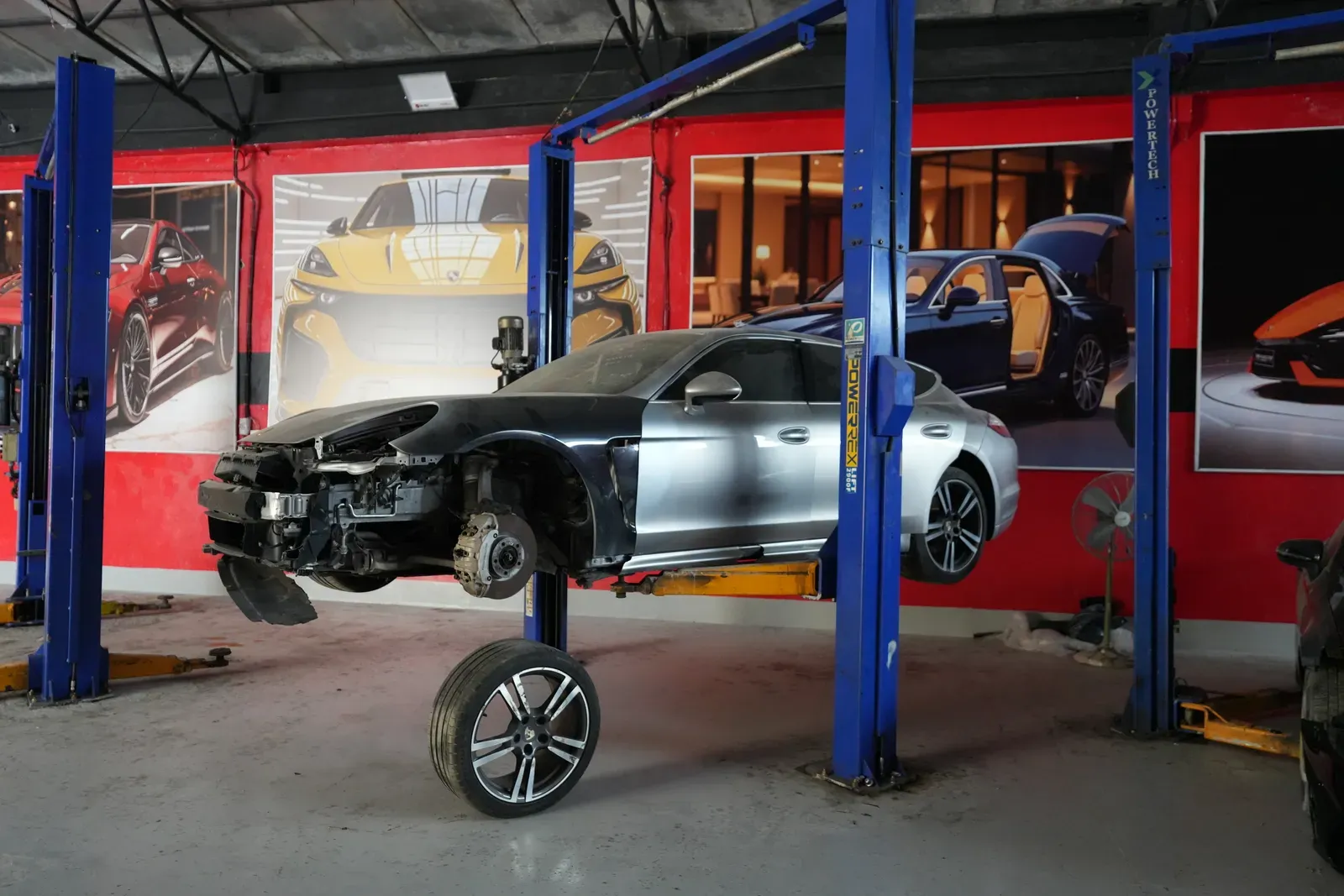
A humming noise that gets louder with speed
A hum or drone that rises and falls with road speed — not with engine speed, and not with which gear you are in — is coming from something that turns with the wheels. That narrows it usefully: a wheel bearing, or tyres that have worn into an uneven pattern. Telling those two apart is the whole job, and there is a test that often separates them before the car is even on a lift. A worn bearing usually changes volume when the car is steered gently left and right at a steady speed, because weight moves onto and off the failing side; tyre noise does not care. Tyre wear patterns are also a symptom rather than a cause — they come from alignment or a worn suspension joint, so replacing the tyres without finding out why they wore that way buys the noise back.
Can I keep driving it?
Drivable, but do not leave it
A faint hum is not an emergency, but it is one of the few noises worth acting on early rather than living with, because a wheel bearing does not stay a noise forever — left long enough it develops play, and play at a wheel is a steering and braking problem rather than a comfort one. Come in sooner if the noise has grown noticeably over a few weeks, if you can feel a vibration through the floor or the seat as well as hear it, or if there is any looseness in the steering.
How we find out which one it is
Shock absorbers, arms, bushes, joints and steering — found by hand on a lift, not by guesswork.
-
01
We reproduce it on the road first
A noise over bumps, a noise on lock and a noise that rises with speed are three different faults. We drive the car over the surface you described before it goes on the lift, because a suspension fault found only by feel on a ramp is half a diagnosis.
-
02
Every joint is loaded by hand
Play does not show itself on a part that is standing still and only looked at. It shows when the joint is levered under load. That is what we do to each one in turn, until the knock belongs to a specific component rather than to the front of the car in general.
-
03
We separate noise from unsafe
A split anti-roll bar bush is a noise. A worn lower ball joint is a safety item. Both go on the report, marked differently, with the reason written next to each, so you are spending on what actually needs it.
-
04
Geometry after the work, not before
Replacing an arm, a ball joint or a track rod end changes the wheel angles, so the geometry has to be reset afterwards or the new part will eat a tyre. We will tell you plainly whether that alignment is done here or somewhere we send you, before you book, not after.
Other things this system does
- There is a knocking noise when I go over a speed bump
- The steering wheel is not straight when the car is going straight
- The car wanders and I keep correcting it
- The steering has gone heavy
- It feels floaty over bumps and keeps bouncing
- There is a clunk when I turn the wheel at low speed
- One tyre is wearing on the inside edge
Other complaints with a page
- The brakes squeal in the morning and then stop A squeal that clears after the first few stops is usually overnight moisture on the discs. A wear indicator sounds similar and means the opposite — the difference is the pattern.
- The revs rise but the car does not speed up Slipping is self-worsening: the slip makes heat, heat cooks the fluid, and cooked fluid cannot hold the pressure that stops the slip. Why the distance driven decides the bill.
- The steering wheel shakes when I brake A shake felt only under braking points at the front brakes, not the tyres. What separates disc wear from heat distortion from a bearing, and how it is checked in Sharjah.
- The car pulls to one side when I brake Pulling only under braking is a difference between the two front brakes — caliper, hose, pad or slide pin. Pulling all the time is usually alignment. How the two are told apart.