

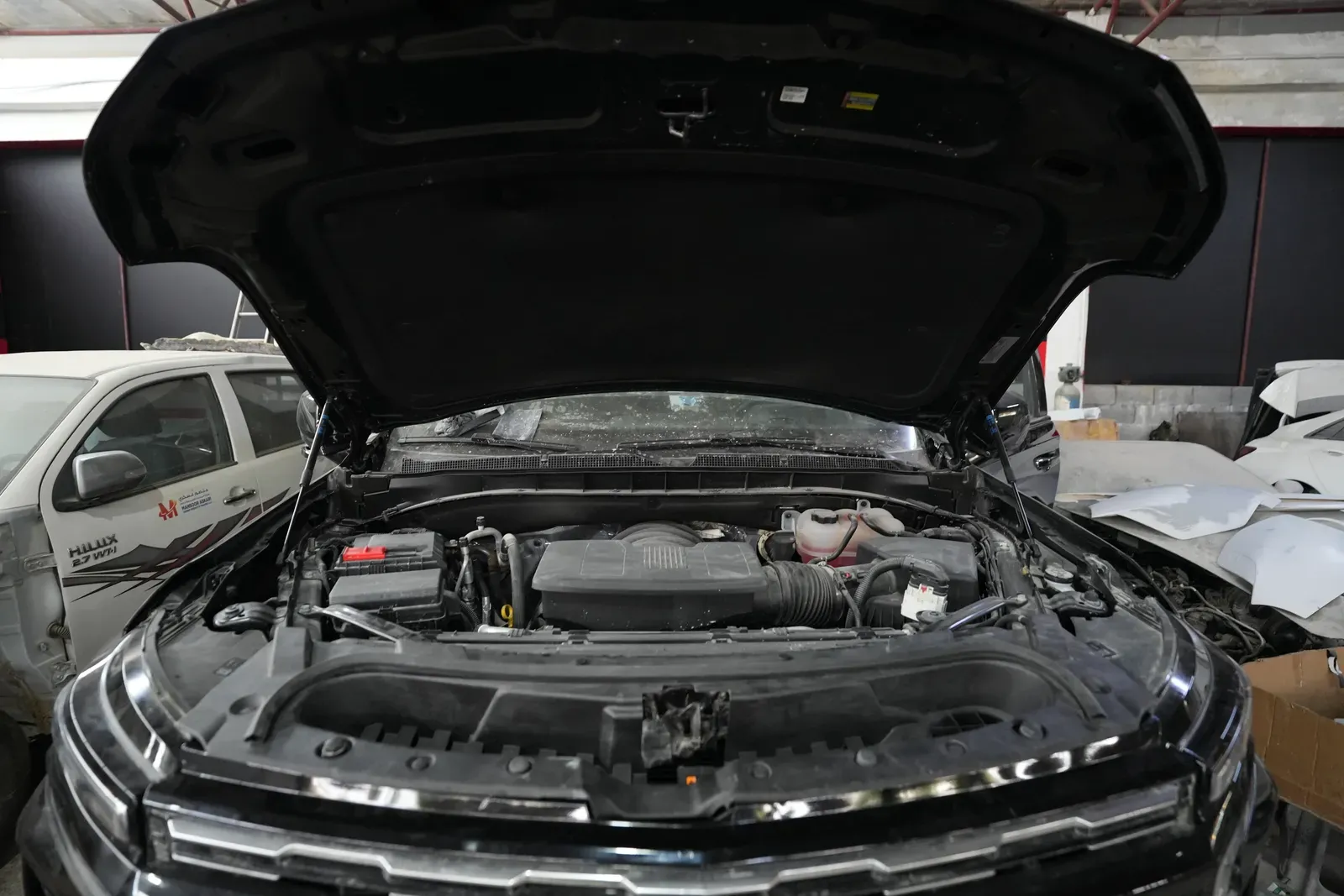
Most conversations about engine oil collapse two separate things into one. The grade — 0W-20, 5W-30 — describes how the oil flows. The specification printed next to it describes what the oil is required to survive. A car can be filled with exactly the right grade of exactly the wrong oil, and nothing on the dipstick will tell you.
What do the numbers in 5W-30 mean?
The two numbers are two separate viscosity measurements taken at two different temperatures, and the classification that defines them is SAE J300. API sets out the structure in its own licensing publication: “Two series of viscosity grades are defined in SAE J300: (a) those that contain the letter W and those that do not contain the letter W.” Grades with the W “are defined by maximum low-temperature cranking and pumping viscosities and a minimum kinematic viscosity at 100°C”; grades without it by kinematic viscosity at 100°C “and a minimum high-temperature/high-shear measured at 150°C”. A multigrade has to satisfy all of it at once. So the W half is a cold-start measurement and the second half is a hot, loaded, inside-the-bearing measurement — and here the first half is rarely tested and the second is tested every afternoon.
The grade says nothing about detergency, oxidation resistance, ash content or whether the oil will ruin a particle filter. That is what the performance specification beside it is for. API’s programme exists “to ensure that engine oils meeting the minimum performance standards of vehicle and engine manufacturers are easily identified by consumers” — the donut and starburst marks on a bottle. The European ACEA Oil Sequences do the same job with classes and categories, and are careful about who has the last word: “This sequence defines the minimum quality level of a product … Individual member companies may indicate performance parameters other than those covered by the tests shown or more stringent limits.” On viscosity the sequence imposes “No restriction except as defined by HTHS and Shear Stability requirements”, adding that “Manufacturers may indicate specific Viscosity requirements”. Which is the long way of saying the handbook for your engine outranks the shelf — and why the grade and the filter part number go on the invoice by name on a minor service.
Why an oil wears out rather than runs out
Two of the laboratory tests in the ACEA sequences describe the ageing directly, and both get worse with heat — what the heat does to oil. The first is shear stability. A multigrade holds its hot viscosity partly through polymer additives; those polymers are cut up by the mechanical work of being pumped through an engine, and the requirement is that after the test all grades are “to be ‘stay in grade’”. An oil that has sheared out of grade is still oil, still amber, still at the right level on the dipstick — and no longer the grade printed on the cap. The second is evaporative loss, measured by the Noack test, and the ACEA limit names the conditions it simulates: “Max. Weight Loss after 1 h at 250 °C”, capped at 13 per cent for the light-duty categories. Oil leaves an engine as vapour as well as through a hole, which is one reason the level falls on a car that is neither leaking nor visibly smoking.
An oil does not run out. It stops being the oil the engine was designed around, and it does that quietly, at the same level on the dipstick.
How often should engine oil be changed in the UAE?
Every service schedule carries a second, shorter schedule underneath it for what manufacturers call special operating conditions, and that list is more useful than the headline number. Toyota states the general rule in its 2025 Warranty & Maintenance Guide as a distance-or-time pair: replace the oil and filter “after 12 months have passed, or when driven over 10,000 miles since the last oil change” — then halves it for one condition, “every 5,000 miles or 6 months, in which the vehicle is mainly driven in dirt or dusty roads”. The rest of that footnote list is worth reading with local eyes, because it was not written with local eyes. One item is “repeated trips of less than five miles in temperatures below freezing”, which describes nobody here. Another is “extensive idling and/or low-speed driving for a long distance such as police, professional/private use like taxi or door-to-door delivery use”, which describes an enormous number of cars here on any weekday afternoon. A schedule is not one number; it is a number with a set of assumptions attached, and it is the assumptions that travel badly. Two things follow. A schedule has two limits, a distance and a period, and whichever arrives first counts — so a car that does very few kilometres is governed by the time limit rather than the odometer. And we read the schedule for your model and engine rather than quoting one figure at everybody, which is what car servicing says on its own page, and what a major service is built from.
Is it normal to use oil — and is it use or a leak?
Some use is normal, and manufacturers say so in the owner’s manual rather than leaving it to the workshop. Nissan: “Some amount of oil is consumed by your engine under normal operating conditions, and oil consumption by itself does not necessarily indicate any malfunction.” The sentence immediately after it is the one that does the work: “If your rate of oil consumption increases suddenly or without explanation, NISSAN recommends that you have your vehicle inspected.” The signal is not that the engine uses oil. The signal is a change in how much — which makes topping up a measurement rather than a repair. A litre added is a data point: how far since the last one, on what kind of driving, and from what level. Written down, “it seems to use a bit” becomes a rate, and a rate is the only version of this complaint anyone can act on. Manufacturers work the same way: Ford’s bulletin on one engine sets its threshold at “oil consumption greater than 1 liter (1 quart) in less than 4,800 km (3,000 miles)” — a figure for that engine in that bulletin, and nobody else’s benchmark. A leak, meanwhile, leaves evidence outside the engine and consumption does not — except that a leak onto a hot exhaust burns off before it reaches the floor, and a car parked on sand leaves no mark at all. So the two are separated with the car in the air.
- Where the oil is, not just that it is there: a wet rocker cover edge, a wet sump seam, a wet bell housing, a wet turbo drain line and a wet front crank seal are five different jobs.
- Whether the film is fresh or old. Dust sticks to fresh oil differently, and here there is always dust.
- The level over a known distance, taken cold and on level ground, rather than one reading argued about.
- The crankcase breathing system, because a blocked one raises case pressure and pushes oil past seals that were fine last week.
- What the oil looks and smells like coming out, and whether coolant has got into it — a different fault, with a different test.
What does blue smoke from the exhaust mean?
These two get mixed up constantly and they point at different fluids. White smoke that persists once the engine is warm, hangs in the air and smells faintly sweet is coolant, and what has to be separated in that case is set out on the page for “White smoke comes out of the exhaust”, filed under what is your car doing?. A thin white vapour for a minute on a cool morning is condensation and is neither. Blue-grey smoke is oil — and what it narrows down to is a set, which depends heavily on when it appears. On a cold start it means oil has collected somewhere overnight and is burnt off in one go: BMW’s bulletin for two of its engines describes “blue smoke … for approximately 10-20 seconds”, with no boost faults and no drivability issues, caused by “Engine oil leakage into the induction system and/or the turbo charger assembly” — then adds the line worth quoting in full, “There are several possible causes for this symptom.” Smoke under load, or after a hot restart, or alongside a rough idle, belongs to another part of the set: Ford’s bulletin on one engine ties oil consumption, a rough idle and misfire codes to “a concern with the cylinder head valve guides”, noting that “Blue smoke may also be present from the exhaust only after a hot restart”. Between those two documents you have valve guides, valve stem seals, turbocharger oil seals and drain lines, crankcase ventilation and piston rings — candidates, not answers. They are separated by measurement rather than by looking at the smoke: a compression test names the weak cylinder, a leak-down test says where that cylinder is losing its pressure — past the rings, past a valve, or into the cooling system — and oil pressure is read on a mechanical gauge. That is the order of work on engine repair.