
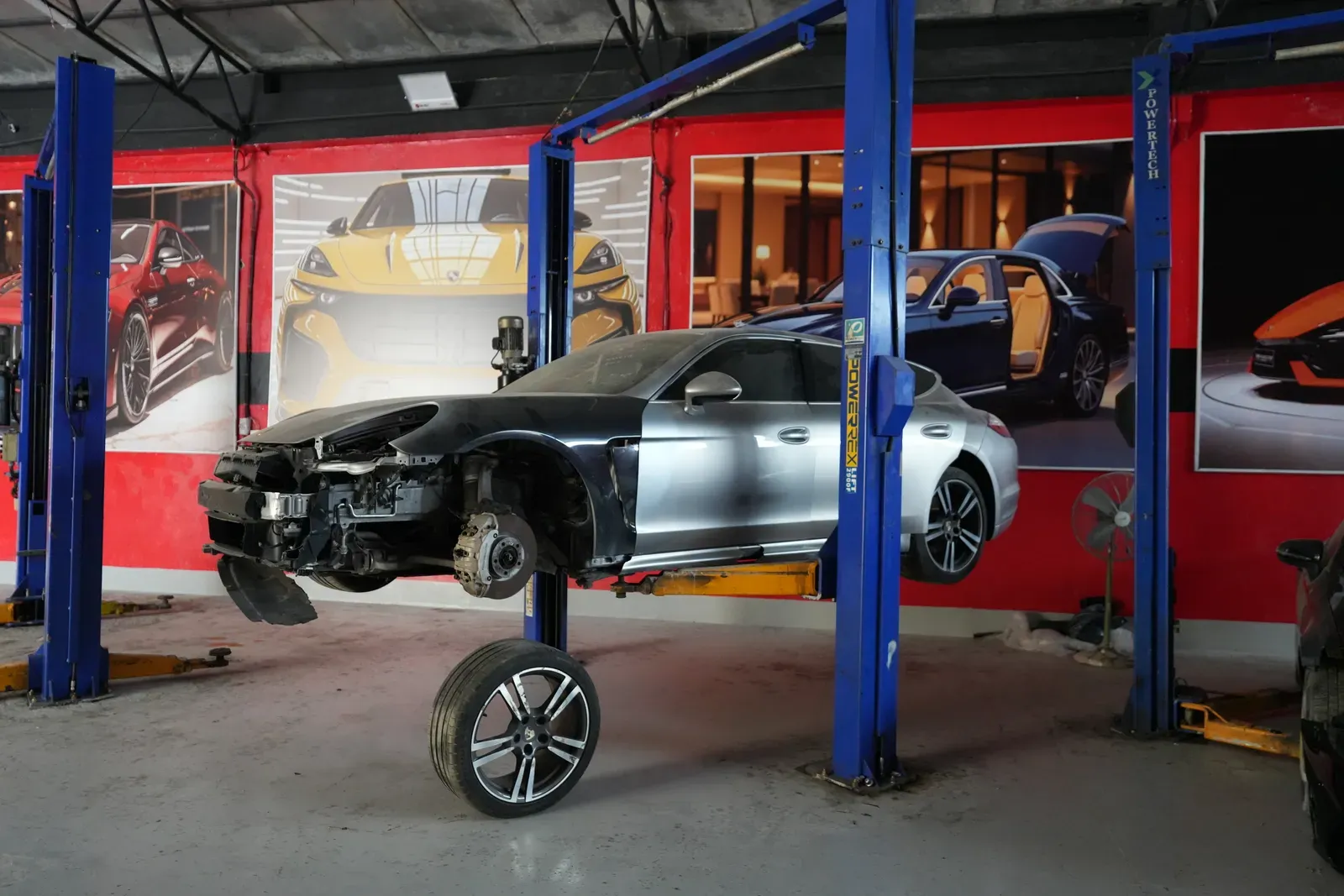
The temperature gauge climbs in traffic
A car that runs at a normal temperature on the move and climbs the moment it stops is failing to shed heat without airflow — the same pattern an air conditioning system shows when the condenser or the fans are the problem, and often the same cause. Moving, the radiator gets air for free. Standing in traffic, it depends entirely on the cooling fans. The set that has to be told apart is the fans and their controls, a radiator blocked externally with dust or internally with deposits, a thermostat stuck part-closed, a weak water pump, or a coolant level that is already low because of a leak nobody has found. In a Sharjah summer the margin between a cooling system that copes and one that does not is very thin, which is why this appears in July on a car that was fine in February.
Can I keep driving it?
Drivable, but do not leave it
While the needle stays in its normal band you are driving a car with no margin left rather than a broken one — so have it looked at instead of waiting for the next jam. What changes immediately: if the needle reaches the red, a warning lights up, or you see steam, pull over and switch the engine off. Overheating is the fastest way to turn a hose or a thermostat into a cylinder head, and that damage happens in minutes rather than weeks. Do not open the coolant cap on a hot engine — the system is under pressure and it will scald.
How we find out which one it is
General mechanical repair — cooling, belts, leaks, exhaust, the work that keeps a car usable.
-
01
You describe it, then we reproduce it
A fault that only happens cold, or only at 80 km/h, or only after twenty minutes, is a different fault from one that is always there. We ask when, and then we drive the car until we have heard it ourselves.
-
02
We find the source, not the symptom
A wet engine bay is cleaned and driven before anything is quoted, because oil travels and the highest wet point is not always the leak. A noise is isolated with a stethoscope or by disconnecting the driven component, not by replacing parts until it stops.
-
03
The estimate separates the must from the might
Parts and labour are listed separately, with VAT shown as its own line. What is unsafe to drive on is marked as such. What can wait is marked as such. You approve each line before anything is ordered.
-
04
If the job grows, it stops
Stripping a component sometimes reveals more than the estimate covered. When that happens the work stops where it is, and you are told what was found, why it changes the job and what the revised line costs, to approve or decline. Nobody phones you from under a car to ask for more money without explaining what changed.
Other things this system does
- There is a noise and I do not know where it is coming from
- There is a puddle under the car in the morning
- It shakes when I stop at the lights
- There is a burning smell after I drive
- The steam comes out when I open the bonnet
- It is loud from underneath, like a hole in the exhaust
- Another garage quoted me a big job and I want a second opinion
Other complaints with a page
- It clicks when I turn the key but will not start One loud clunk points at the starter; rapid clicking points at current — battery, connection or charging. They feel identical, and the wrong guess buys a starter that does not fix it.
- White smoke comes out of the exhaust Thin vapour on a cold start is normal. White smoke that continues warm, hangs in the air and smells faintly sweet is coolant — and the car will still drive perfectly while it happens.
- A humming noise that gets louder with speed A drone rising with road speed, not engine speed, comes from something turning with the wheels — a bearing or a tyre wear pattern. The steering test that often separates them.
- The brakes squeal in the morning and then stop A squeal that clears after the first few stops is usually overnight moisture on the discs. A wear indicator sounds similar and means the opposite — the difference is the pattern.