
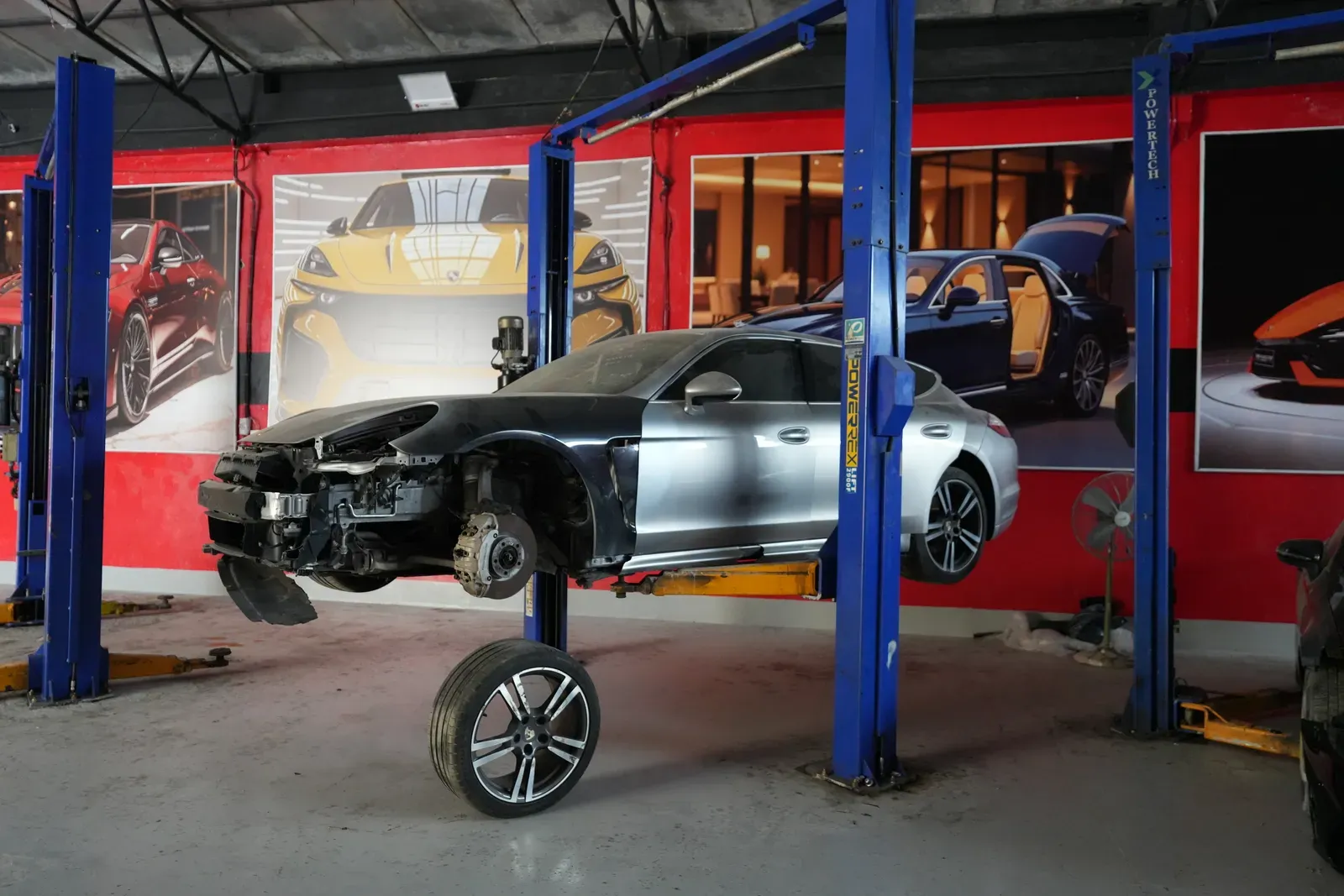
A used car is a set of claims: the mileage on the cluster, the seller’s account of its history, the absence of a light on the dashboard. An inspection is the process of testing those claims against the car. It is very good at some of them and it genuinely cannot settle others, and knowing which is which is the whole of the value.
Start with what the paperwork will not tell you
Before anyone puts a car on a lift, it is worth knowing what the official record covers — because in this country, it covers less than most buyers assume. The RTA publishes a Technical Vehicle Status Report for used vehicles, costing AED 100 plus an AED 20 knowledge and innovation fee, issued in one working day. It carries insurance validity and ownership history. In the RTA’s own words, “This report doesn’t include the vehicle accidents data”.
The same page lists what else it excludes: “Registration records, advertisements, maintenance records, recall information, or odometer readings”. And it carries a condition — “The owner of the vehicle must agree on disclosing its data”. A seller who does not want the report produced simply declines.
The government’s own used-car report excludes accidents, mileage and service history, and the seller can decline to authorise it.
There is a separate route: the Ministry of Interior runs an Accidents Inquiry service under its traffic services, searched on the chassis number — the seventeen-character VIN stamped on the registration card and the car itself. Run it. But run it knowing that a repair paid for privately, with no police report, leaves no trace in any of these systems at all. That is the gap the car itself has to answer for.
Accident repair under fresh paint
A good respray is meant to be invisible, and to the eye it usually is. What it cannot easily be is the same THICKNESS as the rest of the car. DeFelsko, who manufacture coating thickness gauges, give the working range: “Most factory paint jobs seem to range from 4–7 mils (100–180 microns)”, of which the clear coat alone is “1.5–2.0 mils (35–50 microns)”. They also describe the other end of the reading: “If the instrument does not give a measurement it means that the thickness is over the gage’s limit and could mean the presence of filler and a likely repair.”
The honest caveat matters as much as the number, and we would rather print it than have you over-trust a gauge: there is no single “factory thickness” for a car, readings vary between panels on the same vehicle, and a thin, well-done respray can read within normal range. What the gauge actually gives you is COMPARISON — panel against equivalent panel, one side of the car against the other. A door that reads forty microns above its opposite number is not proof of an accident. It is a reason to go and look at the shut line, the bolt heads and the seam sealer, which is where the answer usually is.
Factory seam sealer is applied by machine to a consistent, recognisable bead — the trade literature around repair products names the textures it has to imitate, with 3M supplying tips “to match OEM seams, door skins & hem flanges or textures like caterpillar and lasagna beads”. Which tells you the important thing: a sealer bead that does not match the pattern on the other side of the car was applied by a person. So was a bolt head whose paint has been broken by a spanner. So was a plug weld sitting where the factory would have used a spot weld, because a spot welder cannot reach a seam once the car is built.
Structure is a different question from bodywork
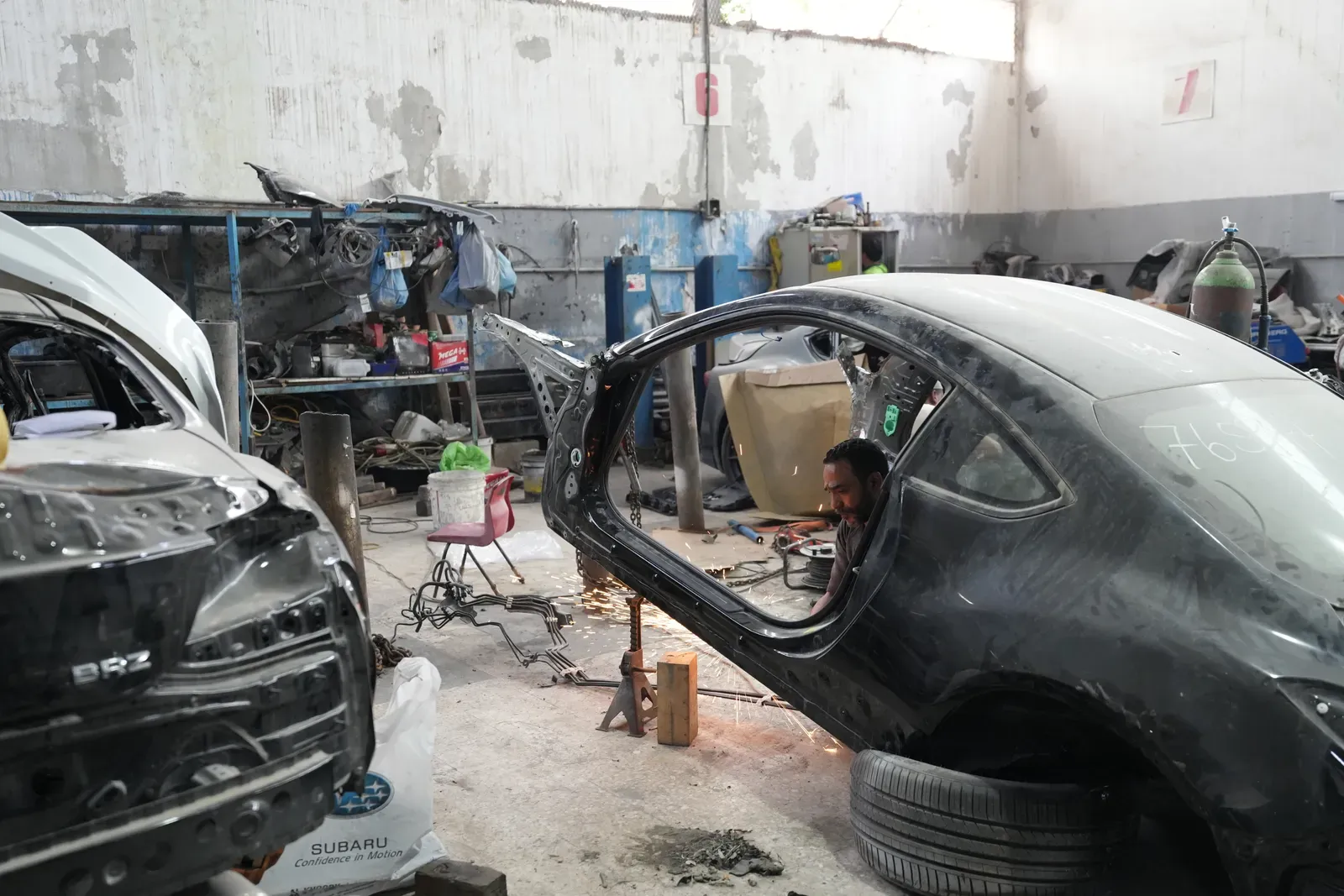
A dented wing is cosmetic. A displaced rail is not. On a modern unibody car the shell is the structure: the front and rear rails, the sills and the pillars are engineered to fold in a specified order and absorb a specified amount of energy, and the tolerances they are built to are millimetric. Repair work that restores the shape without restoring the geometry leaves a car that looks finished and behaves differently in the one event it was designed for.
How much that matters is not a matter of opinion. When the Insurance Institute for Highway Safety compared its crash-test ratings against real-world fatality data, it found that “a driver of a vehicle rated good for driver protection in a side impact is 70 percent less likely to die in a left-side crash” than a driver of a poor-rated one — and, critically for this argument, that “a vehicle’s structure rating was by far the best predictor of fatality risk.” Not the airbags. The structure.
So an inspection that reports on paint but not on structure has reported on the wrong thing. Under the car, on a lift, with the wheels hanging, the questions are: do the rails run straight and symmetrical, is the seam sealer along the floor and the rails original, are the suspension mounting points and subframe pickups undamaged and unwelded, do the shut lines taper evenly on both sides, and is there any sign the front or rear end has been pulled.
The fault code that was cleared this morning
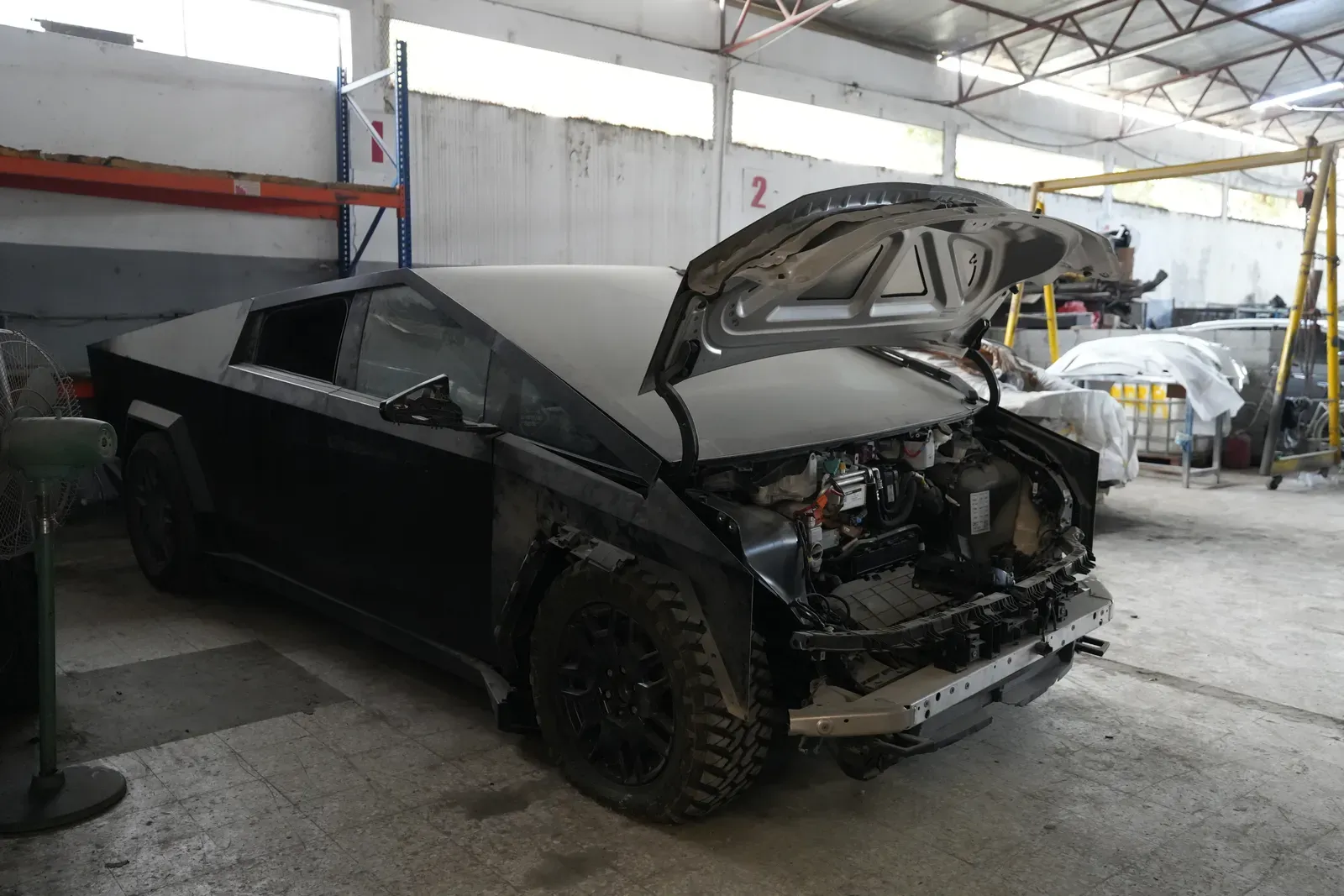
This is the part of an inspection that most people do not know exists, and it is the part that catches the most deliberate concealment. Clearing a car’s fault memory with a scan tool turns the warning light off. It does not leave the car in the state it was in before the fault. It leaves a very specific, very readable set of fingerprints.
SAE J1979, the standard that defines what a diagnostic tool may ask a car and what the car must answer, spells out exactly what a clear command erases. Alongside the codes themselves it names “Freeze frame data”, “On-board monitoring test results”, “Status of system monitoring tests”, “Number of warm-ups since DTC cleared”, “Distance since diagnostic trouble codes cleared” and “Time since diagnostic trouble codes cleared”.
Read that list again. The last three items are counters that START AT ZERO when the memory is wiped, and they are readable as standard data — warm-ups since cleared, distance since cleared and time since cleared are defined in the standard as parameters $30, $31 and $4E. A car whose seller says it has never had a fault, and whose distance-since-cleared reads eleven kilometres, has told you something the seller did not.
The same applies to readiness. The car continuously self-tests its emissions systems, and reports each one as complete or not complete “since DTCs were last cleared”. Those tests do not run in a car park; several need a particular combination of speed, load and temperature, sometimes over repeated journeys. A car presented for sale with most of its monitors showing “not ready” has either had its battery disconnected or had its memory cleared, recently. New York State’s own DMV explains it to motorists in exactly those terms: the causes are “recent vehicle repairs in which diagnostic trouble codes have been cleared with a OBD II scan tool; or, if the battery has been recently disconnected or replaced.”
And on cars from roughly 2010 onwards there is a category of code that cannot be cleared at all. California’s Bureau of Automotive Repair describes permanent diagnostic trouble codes in its own workshop material: “Stored in Non-Volatile Random Access Memory (NVRAM) · Cannot be erased by DTC code clearing or battery disconnect · Stated purpose is to prevent DTC clearing to obtain a passing test.” Only the car itself may remove one, and only “the related readiness monitor(s) ran to completion with no malfunction detected.” In other words: the car will not forgive a fault until the fault is actually gone.
Two more things in the same data are worth having. Freeze frame stores the engine’s actual readings at the instant a fault was recorded — J1979 specifies that they “will be actual stored readings, not default or substitute values” — so it can tell you the car was hot, loaded and at speed when it broke rather than cold on a driveway. And pending codes report a test that has failed once but not yet lit the lamp; the standard describes their purpose as reporting “test results after a single driving cycle”. A pending code is a fault the car has noticed and the seller has not.
The mileage
The American federal road safety agency, NHTSA, estimates that “more than 450,000 vehicles are sold each year with false odometer readings” in the United States alone. Their advice to buyers is not technical and it is still the best first move: compare the odometer against the title, against the maintenance and inspection records, and against the car. “Look at the wear and tear on the vehicle — especially the gas, brake and clutch pedals — to be sure it seems consistent with and appropriate for the number of miles displayed on the odometer.”
Worth repeating here, because it closes the loop with the top of this article: the RTA report explicitly does not carry odometer readings. There is no official number to check the cluster against. Consistency between the car, the service history and the displayed figure is what you have.
Imports, and what the certificate is resting on
The UAE restricts the import of write-offs. Gulf News reported the Emirates Authority for Standardisation and Metrology banning the import of “burnt out, water-damaged, rebuilt and non-repairable cars as well as vehicles with major manufacturing defects”. The mechanism for flagging one is worth understanding, though, because it explains where the gap is. In the same paper, the RTA’s Licensing Agency chief executive described it: “The Customs have to identify such vehicles by marking the Vehicle Clearance Certificate (VCC) with a statement indicating the vehicle is a salvaged vehicle.” And Dubai Customs’ director added the condition that decides it: “A vehicle is declared undrivable in accordance with the rules and regulations in force in the country of export.”
That last sentence is the whole point. The flag depends on a declaration made in another country, under that country’s rules, by that country’s insurer. Where the damage was repaired before export, or was never declared at all, the paperwork arrives clean. The car does not. This is exactly the case a physical inspection exists to cover, and it is the strongest reason to have an imported car looked at whatever the certificate says.
What an inspection cannot do
This section is longer than most workshops would print, and it is the reason to trust the rest of it. An inspection is a point-in-time assessment of a car’s condition. It is not a warranty and it cannot be one.
- An intermittent fault may simply not appear. A misfire that only shows up on a cold start, or a transmission shudder that only arrives after forty minutes of highway driving, can pass through an inspection untouched — and will come back on the fourth week of ownership.
- Internal engine and gearbox wear can be assessed but not seen. Compression and leak-down, oil condition, noise, fault history and a drive tell you a great deal. None of them is the same as opening the engine.
- A component near the end of its life but not yet failing will not announce itself. “Nothing wrong today” and “nothing about to go wrong” are different sentences, and only the first one is honest.
- Flood damage that has been cleaned thoroughly enough can hide. So can repair work that would only be visible with panels, trim or carpet removed, which is not what a buyer is authorised to do to a car they do not own.
- Nothing in an inspection values the car or negotiates for you. It tells you what is true. What that is worth is your decision.
And the annual test is not this
It is worth saying because it is assumed so often. Registration in the UAE requires a technical inspection at an authorised centre — the government portal states you must “get your vehicle inspected at one of the authorised testing centres (except vehicles produced in the last three years before registration)”, and that “the inspection result has to be positive”. That test exists to establish that a car is roadworthy on the day it is presented. It is not an assessment of repair history, structural integrity, fault memory or value, and a valid registration says nothing about any of them.
One item from the RTA’s published inspection material is worth carrying into a viewing anyway, because it is cheap to check and expensive to discover afterwards: the brochure states that tyres expire five years from the date of manufacture, and the manufacturing week and year are stamped on every tyre as four digits. A car with four tyres older than that is a car with an immediate bill attached to it.
What we do, in order
- The car goes on a lift. Everything that matters structurally is under it, and no amount of walking round a car in a car park substitutes for hanging the suspension and looking.
- Paint thickness is measured panel by panel and compared across the car, then anything anomalous is investigated by eye rather than reported as a number.
- The shell is checked for repair: shut lines, bolt heads, seam sealer patterns, weld type at the seams, and any sign of the structure having been pulled.
- The fault memory is read properly — codes, pending codes, freeze frame, readiness monitors, and the counters that say how recently the memory was cleared.
- Mechanical condition: fluids, leaks, brakes, suspension, steering, tyres and their date codes, and the car driven.
- You get the findings written down, with the limits stated. Where we could not establish something, the report says we could not establish it.
That is the pre-purchase inspection. The point of it is not to stop you buying the car. It is to make sure that whatever you decide, you decided it knowing what the car is.